

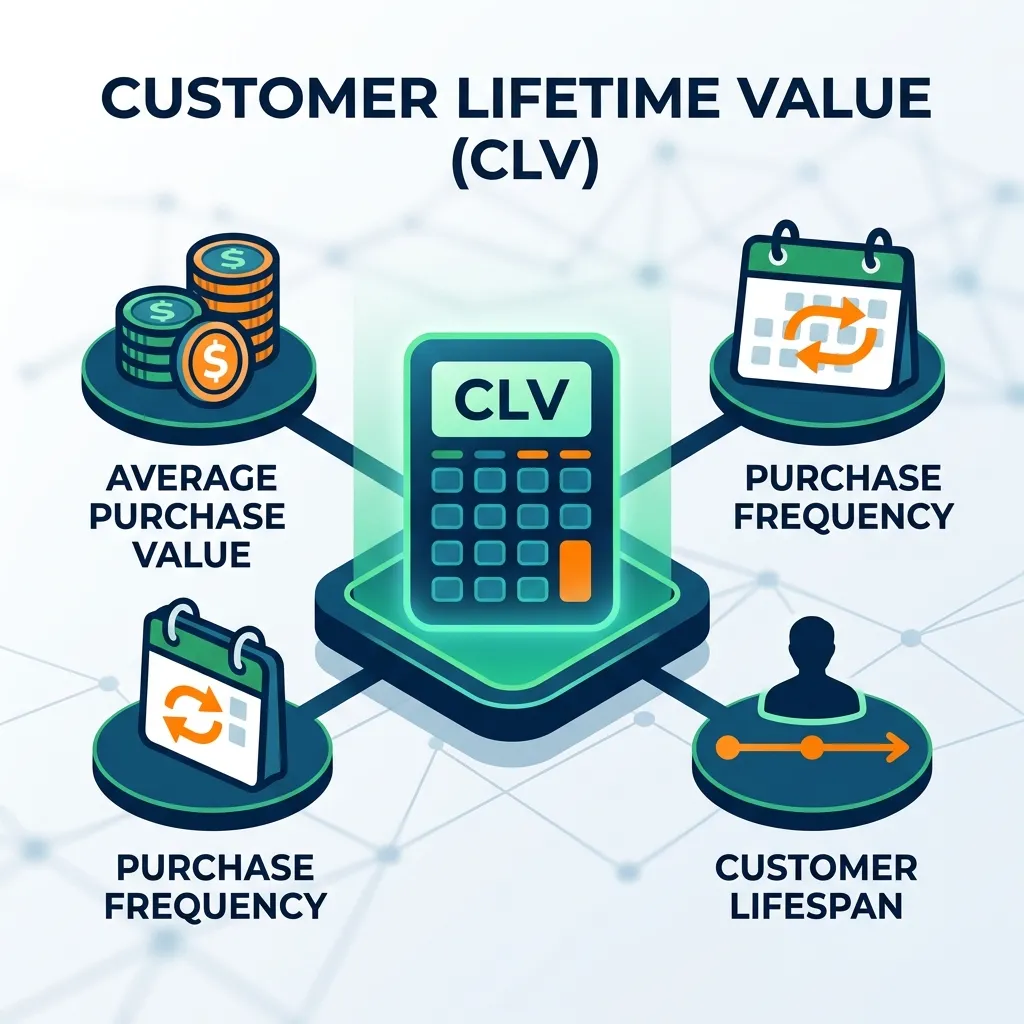
Customer Lifetime Value (CLV) measures the total revenue a business can expect from a single customer over the entire relationship. Businesses that track and optimize CLV allocate marketing budgets more efficiently, reduce Customer Acquisition Cost, and build sustainable long-term growth strategies.
Every business wants more customers. But the smartest businesses focus on something else first: keeping the ones they already have—and making those relationships as valuable as possible.
Customer Lifetime Value (CLV) is the metric that makes this possible. It tells you exactly how much revenue a customer is worth over the course of their relationship with your brand. Armed with that number, you can make smarter decisions about how much to spend acquiring new customers, which segments to prioritize, and where to invest in retention.
CLV isn’t a new concept, but it’s become increasingly central to modern digital marketing strategy. As customer acquisition costs rise and competition intensifies across nearly every industry, businesses that optimize for CLV consistently outperform those that focus solely on short-term conversions.
This guide breaks down everything you need to know: what CLV is, how to calculate it, how it connects to your Digital Marketing Objectives, and the proven strategies that drive it higher.
Understanding Customer Lifetime Value (CLV)
What is Customer Lifetime Value (CLV)?
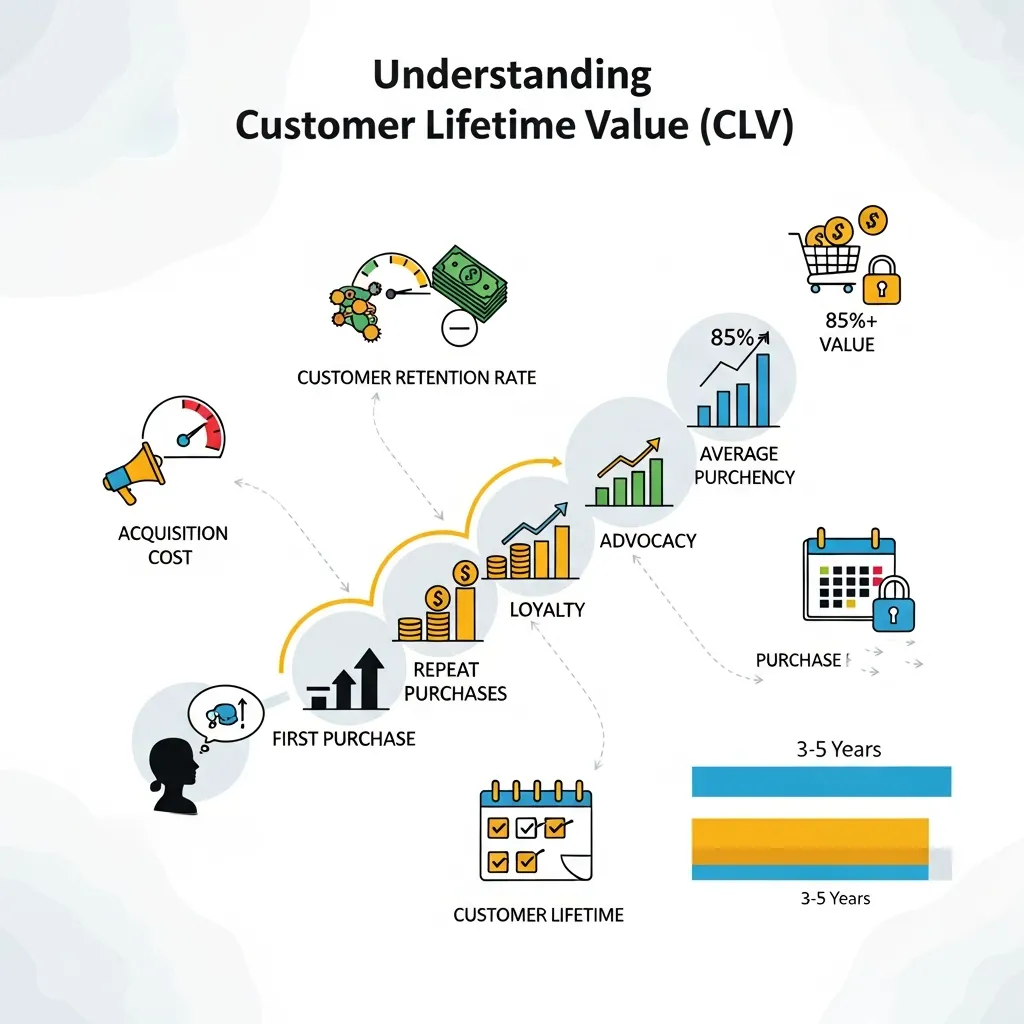
Customer Lifetime Value (CLV) is the total net revenue a business expects to generate from a customer throughout the entire duration of their relationship. Put simply, CLV answers the question: “How much is this customer actually worth to my business?”
CLV differs from metrics like conversion rate or average order value because it takes a long-term view. A customer who makes one large purchase may be less valuable than a customer who makes smaller, recurring purchases over several years.
How does CLV differ from other customer metrics?
Other common customer metrics—like Net Promoter Score (NPS), customer satisfaction (CSAT), and churn rate—measure specific moments or behaviors. CLV synthesizes all of these dimensions into a single financial figure that reflects the total value of the customer relationship.
This makes CLV uniquely actionable. It connects directly to profitability, making it easier to justify investment in retention programs, loyalty initiatives, and customer experience improvements.
The core components and calculation of CLV
The basic CLV formula is:
CLV = Average Purchase Value × Purchase Frequency × Customer Lifespan
For example, if a customer spends $100 per order, places 4 orders per year, and remains a customer for 5 years, their CLV is $2,000.
More advanced models factor in gross margin, discount rates, and the probability of a customer remaining active—but even the basic formula provides a powerful foundation for decision-making.
The Strategic Importance of CLV in Digital Marketing
How does CLV align with Digital Marketing Objectives?
Your Digital Marketing Objectives typically fall into three categories: acquiring new customers, retaining existing ones, and increasing revenue per customer. Customer Lifetime Value (CLV) sits at the intersection of all three.
When CLV is high, you can afford to invest more in acquisition. When it’s low, it signals a problem in retention or customer experience that no amount of top-of-funnel spending will fix. Aligning CLV with your Digital Marketing Objectives ensures your marketing budget flows toward activities that generate long-term profit, not just short-term conversions.
How does CLV inform the Digital Marketing Process?
The Digital Marketing Process—from audience targeting and content creation to campaign optimization and reporting—becomes significantly more precise when CLV data is available.
For example, knowing which customer segments have the highest CLV allows marketers to:
- Target lookalike audiences that mirror high-value customers
- Allocate ad spend more effectively across channels
- Personalize email sequences based on purchase history and predicted lifetime value
- Prioritize retention campaigns for at-risk high-value customers
What Types of Digital Marketing have the most impact on CLV?
Several Types of Digital Marketing directly influence CLV:
- Email marketing: Nurture campaigns and personalized recommendations keep customers engaged between purchases
- Content marketing: Educational content builds trust and reduces churn
- Loyalty programs promoted via social media: Reward programs incentivize repeat purchases
- Search engine optimization (SEO): Attracts high-intent customers who are more likely to convert and return
- Paid retargeting: Re-engages existing customers with relevant offers
Each channel plays a different role. The key is understanding which types drive the highest-CLV customers—not just the most conversions.
Calculating and Measuring Customer Lifetime Value (CLV)
What are the different models for calculating CLV?
There are two primary CLV models:
Historical CLV uses past transaction data to calculate how much a customer has already spent. It’s straightforward to calculate but doesn’t account for future behavior.
Predictive CLV uses statistical modeling or machine learning to forecast how much a customer is likely to spend in the future. Predictive models are more complex but significantly more useful for proactive decision-making.
For most businesses, a predictive CLV model is the gold standard—it enables you to identify high-value customers early and invest in the relationship before competitors do.
What data points are needed for accurate CLV calculation?
Accurate Customer Lifetime Value (CLV) calculation requires:
- Purchase history: Frequency, recency, and average order value
- Customer tenure: How long customers typically remain active
- Churn rate: The percentage of customers who stop buying in a given period
- Gross margin: The profit earned on each transaction
- Acquisition source: Which channels bring in the highest-value customers
Without clean, integrated data across these dimensions, CLV calculations will be imprecise—and potentially misleading.
What tools and platforms help track CLV?
Several platforms support CLV tracking and analysis:
- Salesforce and HubSpot CRM: Centralize customer data and support CLV segmentation
- Google Analytics 4: Includes built-in CLV reporting for e-commerce businesses
- Klaviyo: Tracks CLV specifically for e-commerce email marketing
- Segment: Unifies customer data from multiple sources for CLV modeling
- Looker and Tableau: Visualize CLV trends across customer segments
Choosing the right tool depends on your business model, data infrastructure, and the level of predictive sophistication you need.
Strategies to Enhance Customer Lifetime Value (CLV)
How can improving customer acquisition reduce Customer Acquisition Cost and raise CLV?
Customer Acquisition Cost (CAC) and CLV are two sides of the same coin. A high CLV:CAC ratio (typically 3:1 or higher) signals a healthy, scalable business. Improving acquisition quality—attracting customers who are likely to buy repeatedly—raises CLV while keeping CAC in check.
Tactics include:
- Using CLV data to build lookalike audiences for paid campaigns
- Prioritizing acquisition channels that historically attract high-retention customers
- Offering onboarding experiences that drive early repeat purchases
What loyalty and retention strategies have the biggest impact on CLV?
Retention is the most direct lever for improving Customer Lifetime Value (CLV). Even a 5% increase in retention rate can increase profits by 25–95%, according to research cited by Harvard Business Review.
Effective retention strategies include:
- Loyalty programs that reward repeat purchases
- Subscription models that lock in recurring revenue
- Proactive outreach to customers showing signs of churn
- Post-purchase follow-ups that reinforce buying decisions and reduce buyer’s remorse
How does personalization affect CLV?
Personalization is one of the most powerful—and underutilized—drivers of Customer Lifetime Value (CLV). When customers receive recommendations, offers, and communications that feel relevant to them, they buy more frequently and stay longer.
According to McKinsey, personalization can deliver 5–8x the ROI on marketing spend and lift sales by 10% or more. For CLV, this translates into higher purchase frequency, larger average order values, and reduced churn.
How does a Customer Support Platform contribute to higher CLV?
A strong Customer Support Platform directly impacts Customer Lifetime Value (CLV) by resolving issues quickly, reducing friction, and turning negative experiences into positive ones.
Customers who have a complaint resolved satisfactorily are often more loyal than those who never had a problem at all. Platforms like Zendesk, Intercom, and Freshdesk enable businesses to track support interactions, identify recurring pain points, and deliver faster, more personalized resolutions—all of which reduce churn and improve long-term value.
What upselling and cross-selling techniques increase CLV most effectively?
Upselling and cross-selling are two of the most cost-effective ways to increase Customer Lifetime Value (CLV) because they target customers who have already demonstrated trust in your brand.
Effective techniques include:
- Post-purchase email sequences recommending complementary products
- Bundle pricing that increases average order value at the point of sale
- In-app or onsite recommendations based on purchase history
- Tiered subscription plans that incentivize upgrades
The key is relevance. Poorly timed or irrelevant upsell attempts increase churn, not CLV.
CLV in Action: Case Studies and Best Practices

Which companies have successfully leveraged CLV?
Amazon is perhaps the clearest example of CLV-driven strategy. Amazon Prime was designed specifically to increase CLV by driving purchase frequency—Prime members spend an average of $1,400 per year compared to $600 for non-members, according to Consumer Intelligence Research Partners.
Starbucks uses its loyalty app to track purchasing patterns and deliver highly personalized offers. The company reports that its Rewards members account for more than 55% of its total revenue in the US, demonstrating the outsized CLV of loyalty program participants.
Sephora’s Beauty Insider program segments customers into tiers based on annual spending, rewarding higher-value customers with exclusive perks. This structure encourages customers to increase their spending to unlock the next tier—a textbook CLV optimization strategy.
What are the most actionable best practices for increasing CLV?
- Calculate CLV by customer segment, not just overall averages
- Set a CLV:CAC target ratio and review it quarterly
- Map the customer journey to identify the moments where churn is most likely
- Use predictive CLV to prioritize retention spend on at-risk high-value customers
- Integrate CLV data into every stage of the Digital Marketing Process
Challenges and Considerations in CLV Management
How do data quality and integration issues affect CLV accuracy?
CLV is only as reliable as the data behind it. Businesses that store customer data across disconnected systems—separate CRMs, e-commerce platforms, and support tools—often struggle to build a complete picture of customer behavior.
Investing in a unified customer data platform (CDP) is often the most effective way to resolve this. A CDP consolidates data from every touchpoint, giving marketers the clean, integrated dataset needed for accurate CLV modeling.
How should businesses account for dynamic customer behavior and market changes?
Customer behavior is not static. Economic conditions, competitive dynamics, and shifts in consumer preferences can all alter CLV trajectories. Businesses that treat CLV as a fixed metric—calculated once and revisited annually—will consistently underestimate churn risk and overestimate future revenue.
Best practice is to update CLV models at least quarterly and build early-warning dashboards that flag significant changes in key inputs like purchase frequency and average order value.
What ethical considerations arise in CLV optimization?
Optimizing for CLV can create ethical blind spots if left unchecked. Businesses that de-prioritize low-CLV customers entirely may inadvertently introduce bias into their service levels—providing faster support, better pricing, or more personalized experiences only to high-value segments.
Transparency, fairness, and responsible data use should sit alongside CLV as guiding principles for any customer strategy.
Future Trends in CLV and AI
What role does AI play in predicting Customer Lifetime Value (CLV)?
Artificial intelligence and machine learning are transforming how businesses predict and optimize Customer Lifetime Value (CLV). Traditional CLV models rely on historical averages; AI-powered models analyze hundreds of behavioral signals simultaneously to predict future value at the individual customer level.
This means businesses can identify a high-potential customer after their very first purchase—and begin nurturing that relationship before competitors even know that customer exists.
What emerging technologies are shaping the future of CLV strategy?
Several technologies are reshaping CLV strategy:
- Generative AI: Enables hyper-personalized content and recommendations at scale, directly impacting purchase frequency and CLV
- Real-time CDP platforms: Deliver instant CLV updates as new customer interactions occur
- Predictive churn models: Flag at-risk customers days or weeks before they disengage, enabling proactive retention interventions
- Conversational AI: Improves Customer Support Platform efficiency and resolution quality, reducing churn-driven CLV loss
Businesses that invest in these capabilities now will be significantly better positioned to compete on CLV as AI becomes the default infrastructure for customer intelligence.
Maximizing Profitability Through Proactive CLV Management
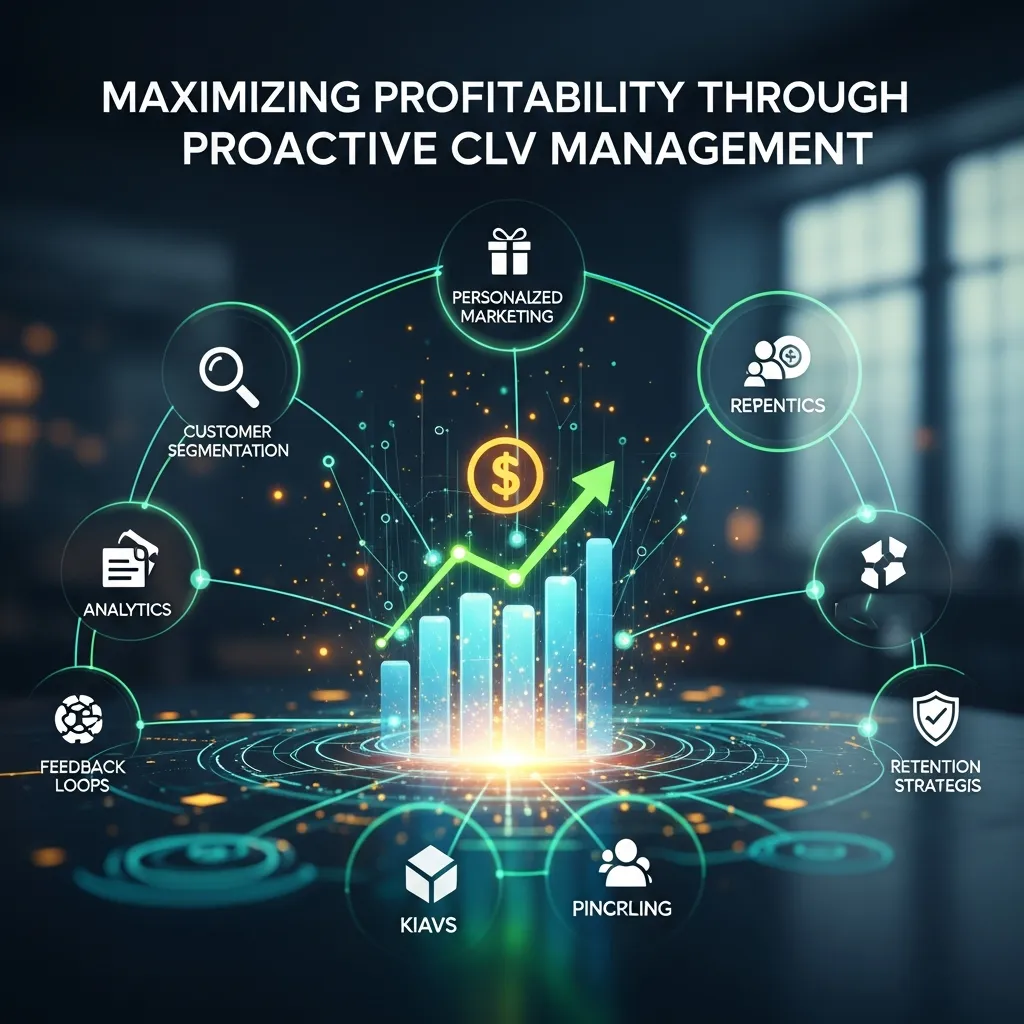
Customer Lifetime Value (CLV) is not just a metric—it’s a strategic lens. Businesses that build their Digital Marketing Objectives, acquisition strategy, and retention programs around CLV consistently outgrow those that optimize for short-term conversions alone.
The path to a higher CLV runs through better data, smarter personalization, stronger retention programs, and a Customer Support Platform that turns every service interaction into a loyalty-building opportunity. It also runs through discipline: regularly recalculating CLV by segment, setting meaningful CLV:CAC targets, and ensuring the entire Digital Marketing Process is aligned with long-term customer value.
Start with the basics. Calculate your CLV. Identify your highest-value segments. Then build every campaign, program, and customer experience around retaining and growing those relationships. The compounding effect on profitability will speak for itself.
Frequently Asked Questions About Customer Lifetime Value (CLV)
What is Customer Lifetime Value (CLV)?
Customer Lifetime Value (CLV) is the total revenue a business expects to earn from a single customer over the entire duration of their relationship. It is calculated by multiplying average purchase value, purchase frequency, and customer lifespan.
Why is Customer Lifetime Value (CLV) important for businesses?
CLV helps businesses understand the long-term profitability of their customer base, allocate marketing budgets more effectively, and prioritize retention over short-term acquisition. A higher CLV means more sustainable revenue growth.
How do you calculate Customer Lifetime Value (CLV)?
The basic formula is: CLV = Average Purchase Value × Purchase Frequency × Customer Lifespan. More advanced predictive models incorporate gross margin, churn rate, and discount rates for greater accuracy.
What is the relationship between CLV and Customer Acquisition Cost?
Customer Acquisition Cost (CAC) represents how much you spend to acquire a customer; CLV represents what that customer is worth. A healthy business typically maintains a CLV:CAC ratio of at least 3:1, meaning each customer generates three times more revenue than it cost to acquire them.
How can digital marketing improve Customer Lifetime Value (CLV)?
Digital marketing improves CLV through personalized email campaigns, loyalty programs, retargeting strategies, and content marketing that keeps customers engaged between purchases. Aligning all Types of Digital Marketing with CLV data ensures spend flows toward retention and repeat purchase behavior.
What role does a Customer Support Platform play in CLV?
A strong Customer Support Platform reduces churn by resolving issues quickly and improving the overall customer experience. Customers who receive fast, effective support are significantly more likely to make repeat purchases and remain loyal long-term.
What Types of Digital Marketing have the biggest impact on CLV?
Email marketing, loyalty programs, SEO, content marketing, and paid retargeting all directly influence CLV. Email marketing and loyalty programs tend to have the highest impact because they target existing customers who have already demonstrated purchase intent.
How can I increase my customers’ CLV?
Focus on personalization, proactive retention programs, upselling and cross-selling strategies, and investing in a strong Customer Support Platform. Reducing churn by even a small percentage has a significant compounding effect on overall CLV.
What are common mistakes in managing Customer Lifetime Value (CLV)?
Common mistakes include calculating CLV using averages rather than segment-specific data, failing to update CLV models regularly, focusing exclusively on acquisition over retention, and neglecting data quality issues that undermine CLV accuracy.
How does personalization affect Customer Lifetime Value (CLV)?
Personalization increases purchase frequency and average order value by delivering relevant recommendations, offers, and communications. According to McKinsey, personalization can deliver 5–8x ROI on marketing spend, making it one of the most impactful levers for CLV growth.
What is a good Customer Lifetime Value (CLV)?
There is no universal benchmark—what constitutes a “good” CLV depends on your industry, business model, and Customer Acquisition Cost. The most useful benchmark is a CLV:CAC ratio of 3:1 or higher, combined with positive CLV trends over time within each customer segment.
How often should I re-evaluate my CLV strategies?
CLV strategies should be reviewed at least quarterly. Customer behavior, competitive dynamics, and market conditions change continuously, and CLV models that aren’t updated regularly will produce inaccurate forecasts and misallocated marketing spend.



Leave a Reply