

Digital Marketing Objectives are specific, measurable goals that guide every decision in a digital marketing strategy—from SEO to paid ads to email campaigns. Businesses that align their Digital Marketing Objectives with broader business goals are far more likely to generate consistent revenue, retain customers, and outpace competitors.
Every marketing dollar you spend is either working toward something or disappearing into the void. The difference between those two outcomes almost always comes down to one thing: whether your Digital Marketing Objectives are clearly defined before you start.
Most businesses understand that digital marketing matters. Fewer understand how to build a structured, goal-driven approach that actually delivers results. Without clear Digital Marketing Objectives, campaigns become guesswork—budgets get wasted, teams lose focus, and results become impossible to measure meaningfully.
This guide covers everything you need to know about setting, executing, and optimizing Digital Marketing Objectives. You’ll learn how the Digital Marketing Process works, which types of digital marketing are best suited to specific goals, how to select the right Digital Marketing Channels for your audience, and how a Digital Marketing App can streamline your entire operation. By the end, you’ll have a clear framework for building a digital marketing strategy that drives real business growth.
What Are Digital Marketing Objectives—and Why Do They Matter?
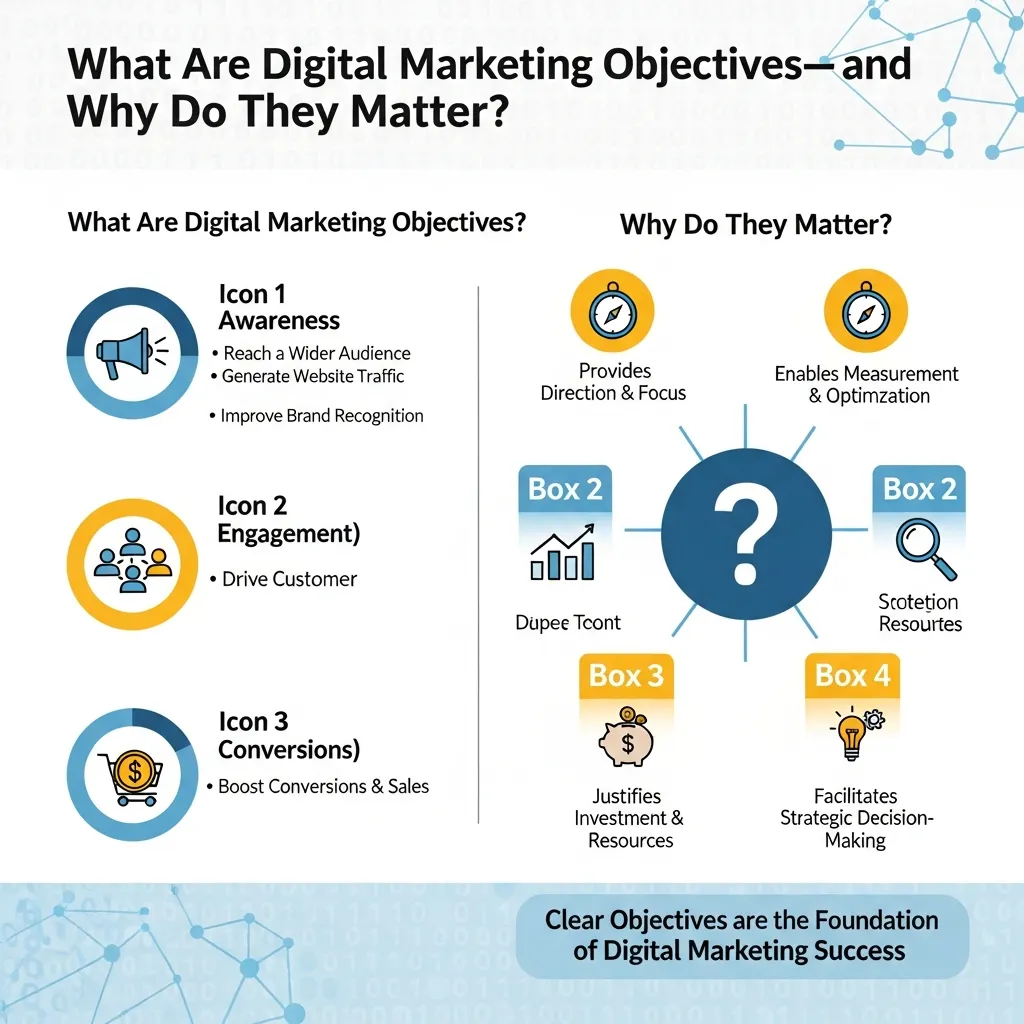
Digital Marketing Objectives are specific, measurable targets that define what a business wants to achieve through its online marketing efforts. They sit at the intersection of strategy and execution, translating broader business goals—like growing revenue by 20% or entering a new market—into actionable digital priorities.
The distinction between goals and objectives matters here. A goal might be “grow our customer base.” A Digital Marketing Objective turns that into something concrete: “Increase organic website traffic by 35% within six months through SEO and content marketing.” The specificity is what makes it actionable.
Clear Digital Marketing Objectives matter for three core reasons:
- Focus: They prevent teams from spreading resources too thin across too many initiatives.
- Measurement: They give you defined benchmarks against which to evaluate performance.
- Alignment: They ensure every marketing activity contributes to overarching business outcomes.
Research consistently shows that marketers who document their goals are significantly more likely to achieve them. According to CoSchedule’s 2023 Marketing Strategy Report, marketers who set goals are 376% more likely to report success than those who don’t.
Understanding the Digital Marketing Process
Before setting Digital Marketing Objectives, it’s worth understanding the broader Digital Marketing Process—the repeating cycle that structures how objectives are built, executed, and refined.
What are the five stages of the Digital Marketing Process?
The Digital Marketing Process typically flows through five stages:
- Research — Analyzing your audience, competitors, and market landscape to identify opportunities.
- Planning — Defining your Digital Marketing Objectives, selecting channels, allocating budget, and building campaign timelines.
- Execution — Launching campaigns across chosen Digital Marketing Channels.
- Measurement — Tracking KPIs and assessing performance against your objectives.
- Optimization — Using data insights to refine campaigns and improve future results.
Digital Marketing Objectives integrate at every stage. During research, they shape what questions you ask. During planning, they determine which channels you use. During measurement, they define what “success” looks like. The Digital Marketing Process only works well when objectives are established early—otherwise, you’re optimizing for nothing in particular.
The 8 Key Digital Marketing Objectives Every Business Should Know
1. Brand Awareness: How do you increase visibility through digital marketing?
Brand awareness is the foundation of the customer journey. Before anyone buys from you, they need to know you exist. Digital Marketing Objectives focused on brand awareness typically target metrics like impressions, reach, social media followers, and share of voice.
Effective brand awareness strategies include display advertising, social media marketing, video content, and influencer partnerships. For newer businesses especially, prioritizing awareness early sets the stage for every other objective downstream.
2. Lead Generation: Which Digital Marketing Channels work best for attracting prospects?
Lead generation Digital Marketing Objectives focus on capturing contact information or expressions of interest from potential customers. Key metrics include cost per lead (CPL), lead volume, and lead quality.
Different Digital Marketing Channels serve lead generation differently. Search ads capture high-intent users actively looking for solutions. Content marketing attracts leads through educational value. Social media lead ads reduce friction by collecting information directly within the platform.
3. Customer Acquisition: How do you convert leads into paying customers?
Customer acquisition is where leads become revenue. Digital Marketing Objectives here revolve around conversion rate optimization (CRO), cost per acquisition (CPA), and sales cycle length.
Landing page design, retargeting campaigns, and personalized email sequences are among the most effective acquisition levers. A well-configured Digital Marketing App can automate much of this process—triggering follow-ups based on user behavior and moving leads through the funnel with minimal manual intervention.
4. Customer Retention and Loyalty: How does digital marketing build long-term relationships?
Acquiring a new customer costs five to seven times more than retaining an existing one, according to research from Bain & Company. That ratio alone makes retention a critical category of Digital Marketing Objectives.
Retention-focused objectives typically target metrics like churn rate, repeat purchase rate, and Net Promoter Score (NPS). Email marketing, loyalty programs, and personalized product recommendations—often powered by a Digital Marketing App—are the most reliable retention tools.
5. Increased Sales and Revenue: How do you measure digital marketing ROI?
Revenue-driven Digital Marketing Objectives are the most directly tied to business performance. The challenge is attribution—understanding which touchpoints actually drove a conversion.
Multi-touch attribution models (linear, time-decay, or data-driven) give a clearer picture than last-click attribution alone. Setting up proper tracking through Google Analytics 4 or a similar platform is non-negotiable for measuring the ROI of your Digital Marketing Objectives accurately.
6. Website Traffic: What’s the difference between organic and paid traffic strategies?
Website traffic objectives focus on bringing more qualified visitors to your site. Organic traffic—driven by SEO and content marketing—compounds over time and delivers a lower cost per visit at scale. Paid traffic through PPC delivers faster results but requires ongoing spend to maintain volume.
Most mature digital marketing strategies use both. Paid channels fill the gap while organic strategies build long-term traffic assets.
7. Engagement: How do social media and content marketing drive audience interaction?
Engagement Digital Marketing Objectives measure how actively your audience interacts with your content—likes, shares, comments, time on page, video completion rates. High engagement signals relevance and builds the kind of brand trust that precedes purchase decisions.
Social media marketing and content marketing are the primary drivers. Short-form video, in particular, has emerged as one of the highest-engagement formats across platforms like Instagram Reels, TikTok, and YouTube Shorts.
8. Market Share Expansion: How does competitive analysis fit into the Digital Marketing Process?
Market share expansion objectives are typically longer-term and require ongoing competitive analysis as part of the Digital Marketing Process. Tools like SEMrush, Ahrefs, and SimilarWeb allow businesses to benchmark their performance against competitors and identify gaps in positioning, content coverage, or channel presence.
Types of Digital Marketing and How They Align with Your Objectives

Understanding the different types of digital marketing helps you match the right approach to each objective.
Search Engine Optimization (SEO)
Best aligned with: Website traffic, brand awareness, lead generation
SEO builds organic visibility over time. It’s a long-term investment, but one that delivers compounding returns. Businesses that publish high-quality, keyword-optimized content consistently outperform competitors across search results pages.
Pay-Per-Click (PPC) Advertising
Best aligned with: Customer acquisition, sales, immediate traffic
PPC delivers fast, measurable results. Google Ads, Microsoft Ads, and paid social campaigns give you precise targeting and real-time performance data—making it one of the most controllable types of digital marketing for revenue-focused Digital Marketing Objectives.
Content Marketing
Best aligned with: Brand awareness, engagement, lead generation, SEO
Content marketing builds authority. Blog posts, whitepapers, videos, and podcasts attract and educate audiences, positioning your brand as a trusted resource—essential for any business with a longer sales cycle.
Social Media Marketing
Best aligned with: Brand awareness, engagement, community building
Social platforms offer unmatched reach and targeting precision. Whether organic or paid, social media marketing remains one of the most effective types of digital marketing for building brand affinity and driving top-of-funnel awareness.
Email Marketing
Best aligned with: Customer retention, lead nurturing, re-engagement
Email delivers the highest average ROI of any digital channel—$36 for every $1 spent, according to Litmus (2023). Segmented, automated email campaigns are a cornerstone of retention-focused Digital Marketing Objectives.
Affiliate and Influencer Marketing
Best aligned with: Brand awareness, customer acquisition
Both rely on third-party credibility to reach new audiences. Affiliate marketing is performance-based and lower risk. Influencer marketing adds the dimension of personal trust—particularly effective when the influencer’s audience closely matches your target customer profile.
How to Choose the Right Digital Marketing Channels for Your Objectives
Not every Digital Marketing Channel suits every objective or audience. Choosing the wrong channel is one of the most common (and costly) mistakes businesses make.
How do you align Digital Marketing Channels with your target audience?
Start with your audience. Where do they spend time online? How do they prefer to receive information? A B2B software company targeting senior executives will find far more traction on LinkedIn than on TikTok. A fashion brand targeting Gen Z consumers faces the opposite dynamic.
Next, consider the intent of each channel. Search channels (SEO and PPC) capture users who are actively looking for solutions. Social channels build awareness among users who aren’t necessarily searching. Email reaches users who have already expressed interest. Matching channel intent to objective type dramatically improves campaign efficiency.
What are the strengths and weaknesses of the major Digital Marketing Channels?
|
Channel |
Strengths |
Weaknesses |
|---|---|---|
|
SEO |
Long-term, compounding ROI |
Slow to build traction |
|
PPC |
Fast, measurable, controllable |
Ongoing cost, no residual value |
|
Social Media |
Broad reach, strong targeting |
Algorithm dependency |
|
Email Marketing |
High ROI, direct access |
Requires list building |
|
Content Marketing |
Authority, SEO synergy |
Resource-intensive |
|
Influencer Marketing |
Trust, reach |
Hard to scale, variable quality |
Integrated strategies—combining multiple Digital Marketing Channels toward a shared objective—outperform single-channel approaches in almost every case.
Measuring and Optimizing Your Digital Marketing Objectives
Setting Digital Marketing Objectives without a measurement framework is like navigating without a map.
What KPIs should you track for each Digital Marketing Objective?
Each objective demands its own set of Key Performance Indicators:
- Brand Awareness: Impressions, reach, branded search volume
- Lead Generation: Lead volume, cost per lead, lead-to-customer rate
- Customer Acquisition: Conversion rate, cost per acquisition, sales cycle length
- Retention: Churn rate, customer lifetime value (CLV), NPS
- Revenue: ROI, revenue per channel, average order value
How does a Digital Marketing App improve tracking and reporting?
A Digital Marketing App consolidates data from multiple channels into a single dashboard, enabling faster, more informed decisions. Platforms like HubSpot, Marketo, and Monday.com serve as Digital Marketing App solutions that automate reporting, trigger campaign actions based on user behavior, and help teams stay aligned around shared Digital Marketing Objectives.
Iterative optimization—regularly reviewing performance data and adjusting campaigns accordingly—is what separates high-performing digital marketers from average ones. Build this review cadence into your Digital Marketing Process from the start.
How AI and Personalization Are Reshaping Digital Marketing Objectives
Artificial intelligence is fundamentally changing what’s possible in digital marketing. AI-powered tools now handle tasks that once required entire teams—from automated ad bidding and predictive audience segmentation to real-time content personalization.
For Digital Marketing Objectives, this means two things. First, measurement has become more precise. AI attribution models can trace conversions across complex, multi-touch journeys with far greater accuracy than traditional models. Second, hyper-personalization is now achievable at scale. Instead of sending the same message to every subscriber, a Digital Marketing App powered by AI can serve each user content tailored to their specific behavior, preferences, and stage in the funnel.
Businesses that integrate AI into their Digital Marketing Process are not just optimizing faster—they’re defining entirely new Digital Marketing Objectives that weren’t measurable or achievable before.
Build Your Digital Marketing Strategy Around Clear Objectives
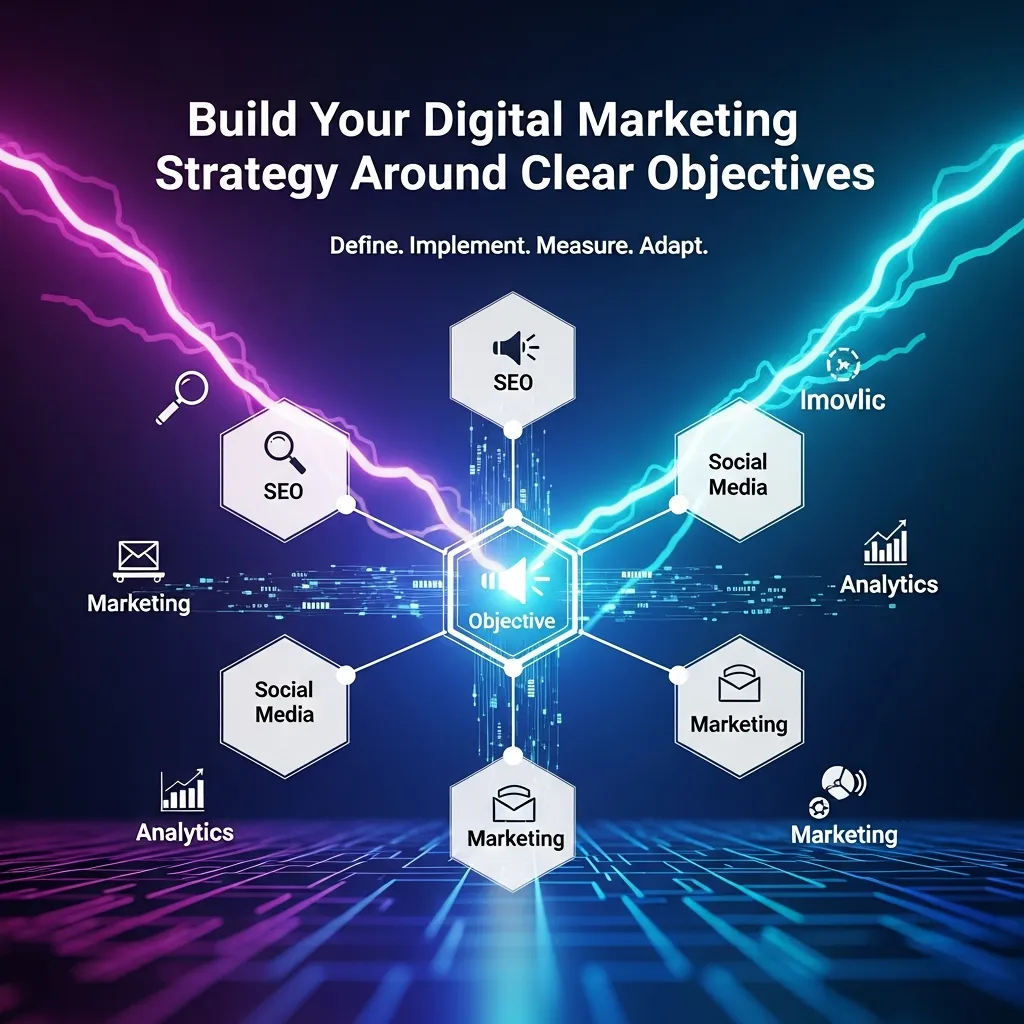
Digital marketing without clear Digital Marketing Objectives is activity masquerading as strategy. Every campaign, channel, and dollar spent should trace back to a specific, measurable goal—and that goal should connect to a meaningful business outcome.
The businesses that consistently outperform in digital marketing share a common approach: they define their Digital Marketing Objectives first, choose their Digital Marketing Channels and types of digital marketing second, and measure relentlessly throughout. They treat the Digital Marketing Process as a cycle, not a one-time event. And increasingly, they use a Digital Marketing App to automate, track, and optimize everything in between.
Start with one or two clear objectives. Build your measurement framework before your campaigns launch. Review performance regularly and optimize without ego. That discipline, more than any single tactic or channel, is what drives sustained digital marketing success.
Frequently Asked Questions About Digital Marketing Objectives
What are the SMART criteria for Digital Marketing Objectives?
SMART stands for Specific, Measurable, Achievable, Relevant, and Time-bound. A SMART Digital Marketing Objective doesn’t say “grow traffic”—it says “increase organic website traffic by 30% within 90 days through SEO and content marketing.” Each element of the SMART framework makes the objective more actionable and easier to evaluate.
What is the difference between goals and Digital Marketing Objectives?
Goals are broad, directional ambitions—like “become a market leader” or “improve customer retention.” Digital Marketing Objectives are the specific, measurable steps that move you toward those goals. A goal without a corresponding Digital Marketing Objective is difficult to execute or track.
How do I prioritize multiple Digital Marketing Objectives?
Start by identifying which objectives are most directly tied to your current business priorities. A startup generating its first revenue should prioritize lead generation and customer acquisition. An established business might focus on retention and market share expansion. Resources are finite—focus on two or three objectives at a time before expanding.
Can a small business realistically pursue multiple Digital Marketing Objectives at once?
Yes, but with realistic expectations about capacity. Small businesses with limited teams should prioritize Digital Marketing Objectives that address their most pressing growth challenge first. Using a Digital Marketing App to automate repetitive tasks—like email sequences and reporting—can free up bandwidth to pursue additional objectives simultaneously.
How often should I review my Digital Marketing Objectives?
At minimum, review your Digital Marketing Objectives quarterly. Fast-moving campaigns (like paid advertising) warrant weekly or bi-weekly reviews. Annual reviews are useful for assessing strategic alignment, but not frequent enough to catch underperformance early.
Which types of digital marketing are best for a new business?
New businesses typically benefit most from SEO (for long-term organic visibility), content marketing (to build authority), and PPC (for immediate traffic while organic presence builds). Social media marketing is valuable for brand awareness. The right mix depends on your audience and budget.
What are the most common Digital Marketing Objectives for e-commerce businesses?
E-commerce businesses most commonly focus on website traffic, customer acquisition, sales revenue, and customer retention. Cart abandonment recovery—typically addressed through retargeting ads and automated email sequences—is also a high-priority objective for most online retailers.
How do Digital Marketing Channels affect which objectives I can pursue?
Each Digital Marketing Channel has inherent strengths tied to specific objectives. SEO and content marketing suit awareness and traffic objectives. PPC suits acquisition and sales. Email suits retention. Choosing channels that don’t match your objectives leads to poor ROI and wasted spend—alignment between channel and objective is essential.
What role does a Digital Marketing App play in achieving Digital Marketing Objectives?
A Digital Marketing App centralizes campaign management, automates workflows, and consolidates reporting across Digital Marketing Channels. Platforms like HubSpot, Marketo, and ActiveCampaign help teams track progress toward each Digital Marketing Objective in real time, enabling faster optimization and more consistent execution.
How does AI change the way businesses set Digital Marketing Objectives?
AI expands what’s measurable and achievable. AI-driven attribution models make it possible to set more precise revenue and conversion objectives. Predictive analytics allow businesses to set proactive retention objectives based on churn probability signals. As AI tools become more accessible, Digital Marketing Objectives can become more ambitious and more precisely defined.
What’s the biggest mistake businesses make when setting Digital Marketing Objectives?
Setting objectives without a measurement plan. Many businesses define what they want to achieve but don’t establish the KPIs, tracking tools, or reporting cadence needed to evaluate progress. Without measurement infrastructure in place before campaigns launch, optimization becomes reactive rather than strategic.
How do Digital Marketing Objectives connect to overall business strategy?
Digital Marketing Objectives should be direct translations of business priorities. If the business goal is to grow annual recurring revenue by 25%, the corresponding Digital Marketing Objectives might include increasing qualified lead volume, improving conversion rate, and reducing customer churn. Each objective maps to a specific business outcome—that connection is what keeps marketing aligned with business strategy.



Leave a Reply