

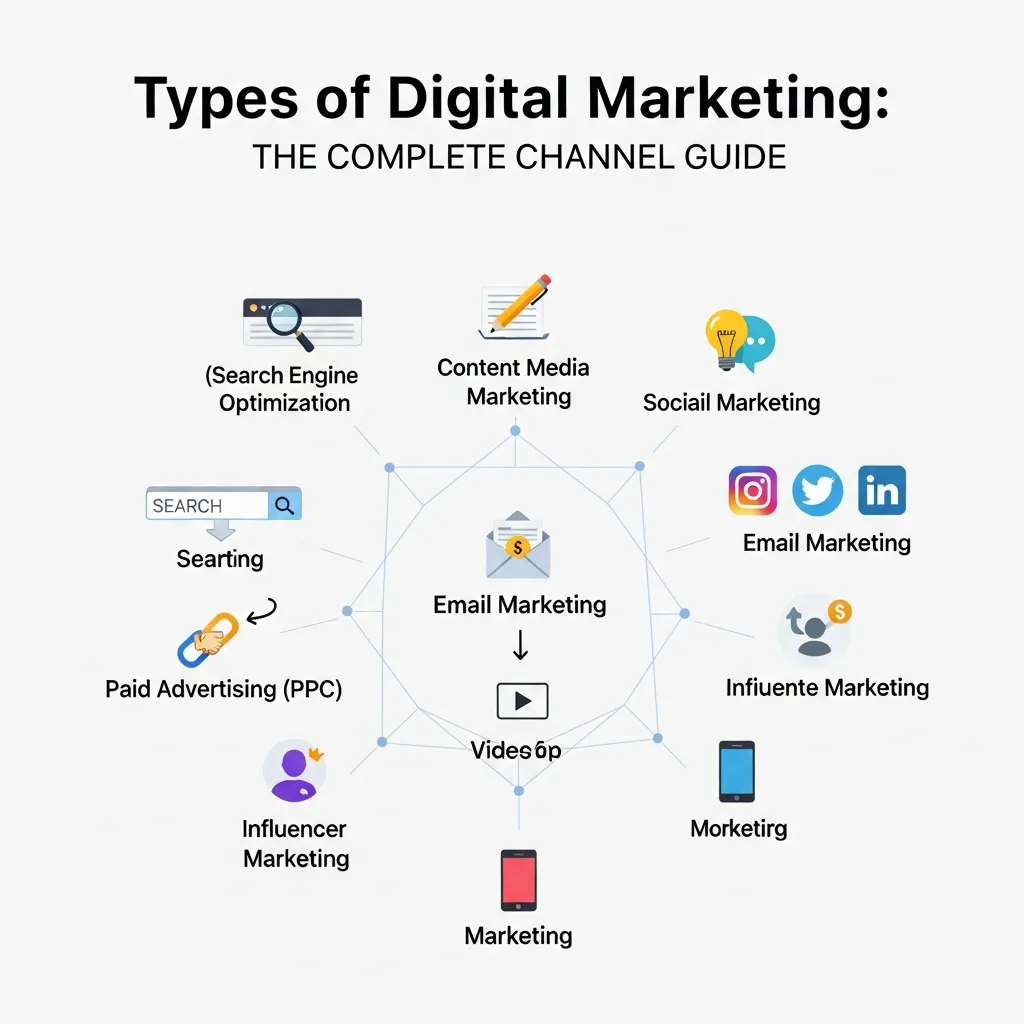
Types of digital marketing include SEO, PPC, content marketing, social media marketing, email marketing, affiliate marketing, influencer marketing, video marketing, mobile marketing, native advertising, and programmatic advertising. Each channel serves distinct goals across the marketing funnel—from building brand awareness to driving conversions and fostering customer loyalty.
Digital marketing has fundamentally reshaped how businesses connect with their audiences. A decade ago, a well-placed billboard or a prime-time TV spot could make or break a brand. Today, the battleground has shifted—to search engines, social feeds, inboxes, and smartphone screens.
But here’s the challenge: the digital landscape is vast, fragmented, and constantly evolving. New platforms emerge, algorithms shift, and consumer behavior changes faster than most marketing teams can keep up. For businesses trying to build a meaningful online presence, knowing which channels to use—and how to use them effectively—is the difference between a strategy that scales and one that stalls.
This guide breaks down every major type of digital marketing, explains how each channel works, and connects them to real business outcomes. Whether you’re building your first digital strategy or auditing an existing one, you’ll walk away with a clear picture of how the pieces fit together.
What Is Digital Marketing?
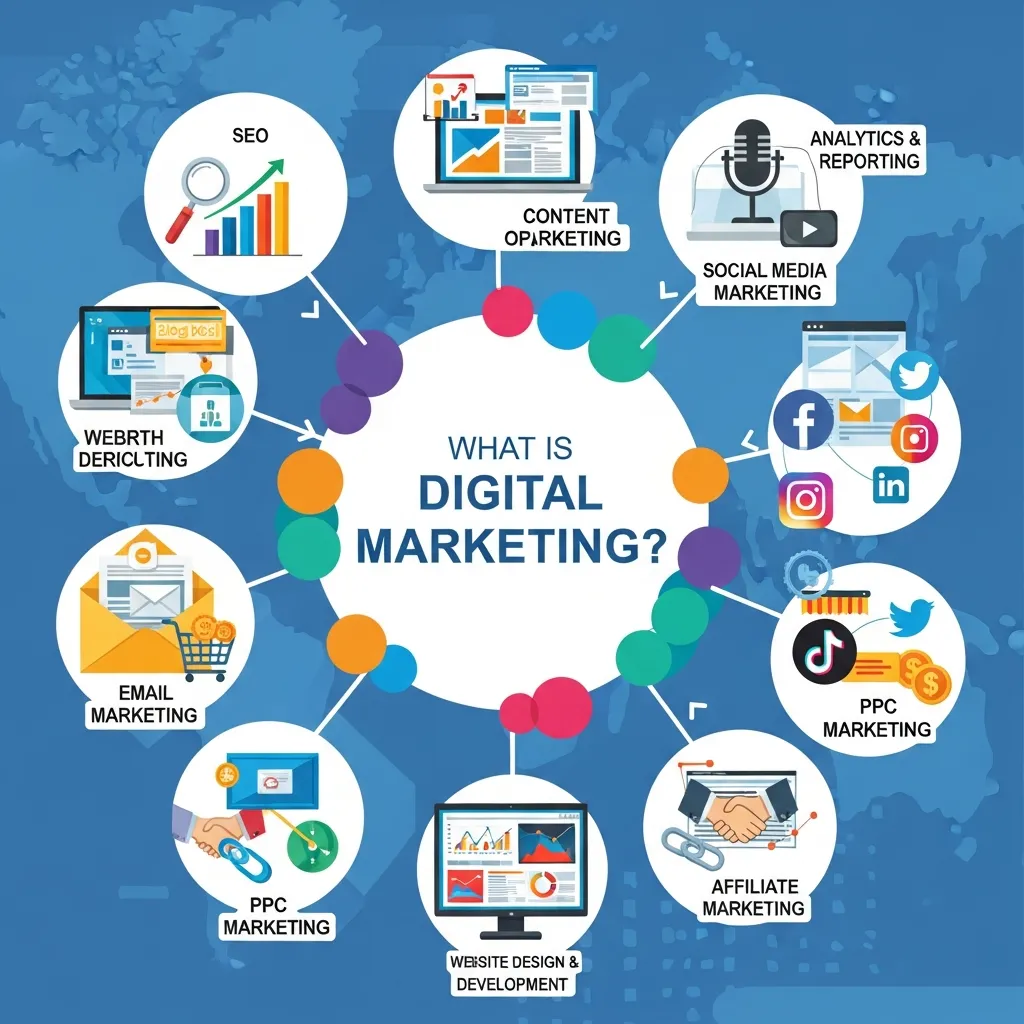
Digital marketing refers to any promotional activity conducted through digital channels—search engines, websites, social media platforms, email, mobile apps, and more. Unlike traditional marketing, digital marketing allows businesses to target specific audiences, track performance in real time, and adjust campaigns on the fly.
The core advantage? Precision. A TV commercial reaches everyone watching a particular channel, regardless of whether they’re interested in your product. A well-targeted Google Ad reaches someone actively searching for exactly what you offer.
Why Is Digital Marketing Essential for Businesses Today?
Consumer attention has migrated online. According to DataReportal’s 2024 Global Overview Report, there are over 5.35 billion internet users worldwide, representing 66.2% of the global population. People research products, compare prices, read reviews, and make purchases—all digitally.
For businesses, this creates enormous opportunity. But it also means that a brand without a coherent digital presence is effectively invisible to a significant portion of its potential market.
Key Types of Digital Marketing Channels
Search Engine Optimization (SEO)
SEO is the practice of optimizing a website so it ranks higher in organic (unpaid) search engine results. It’s one of the most valuable long-term digital marketing channels because it drives consistent, high-intent traffic without ongoing ad spend.
SEO breaks down into three core areas:
- On-page SEO: Optimizing individual web pages through keyword placement, meta tags, content quality, and internal linking.
- Off-page SEO: Building the website’s authority through external backlinks, brand mentions, and social signals.
- Technical SEO: Improving the website’s infrastructure—site speed, mobile responsiveness, crawlability, and structured data—so search engines can index it efficiently.
SEO is a long-term play. Results typically take three to six months to materialize, but the compounding returns make it one of the highest-ROI digital marketing channels available.
Search Engine Marketing (SEM) / Pay-Per-Click (PPC)
SEM involves paying for placement in search engine results pages. The most common model is pay-per-click (PPC), where advertisers pay each time a user clicks their ad.
Key platforms include:
- Google Ads: The dominant platform, capturing over 90% of global search engine market share (StatCounter, 2024).
- Bing Ads (Microsoft Advertising): Smaller audience but often lower cost-per-click and older, higher-income demographics.
- Social Media Ads: Paid placements on Facebook, Instagram, LinkedIn, and TikTok, which function differently from search ads but are often categorized under paid digital marketing.
SEM delivers immediate visibility, making it particularly useful for product launches, time-sensitive promotions, and competitive keywords where organic ranking would take months to achieve.
Content Marketing
Content marketing focuses on creating and distributing valuable, relevant content to attract and engage a clearly defined audience. The goal is not direct selling—it’s building trust, authority, and long-term relationships that eventually drive conversions.
Common content formats include:
- Blog posts: Ideal for SEO, thought leadership, and educating potential customers.
- Videos: High engagement and shareability, particularly effective for product demonstrations.
- Infographics: Simplify complex data and are highly shareable across social platforms.
- E-books and whitepapers: Useful for lead generation, particularly in B2B industries.
According to the Content Marketing Institute’s 2024 B2B report, 72% of the most successful content marketers have a documented content strategy. The channel works best when content is mapped to specific stages of the marketing funnel.
Social Media Marketing (SMM)
Social media marketing involves creating and publishing content on social platforms to build brand awareness, drive engagement, and generate leads or sales. Each platform requires a distinct approach:
- Facebook: Best for community building, local business advertising, and retargeting campaigns.
- Instagram: Visual-first platform suited for lifestyle brands, product showcases, and influencer collaborations.
- LinkedIn: The go-to channel for B2B marketing, thought leadership, and professional recruitment.
- TikTok: Short-form video dominates here; brands that succeed on TikTok tend to prioritize entertainment over promotion.
Email Marketing
Email marketing remains one of the highest-ROI digital marketing channels. According to Litmus’s 2023 State of Email report, email generates an average return of $36 for every $1 spent.
Effective email marketing strategies include:
- Newsletter campaigns: Regular updates that nurture subscriber relationships and drive repeat traffic.
- Drip campaigns: Automated email sequences triggered by specific user actions (e.g., signing up, abandoning a cart).
- Segmentation: Dividing your subscriber list by behavior, demographics, or purchase history to deliver more relevant messaging.
Affiliate Marketing
Affiliate marketing is a performance-based model where businesses (advertisers) pay external partners (publishers) a commission for driving traffic or sales. Publishers promote the advertiser’s products through content, reviews, or ads on their own channels.
The arrangement benefits both parties: advertisers gain extended reach without upfront ad spend, while publishers earn passive income by recommending products their audience trusts.
Influencer Marketing
Influencer marketing leverages individuals with established audiences to promote products or services. Influencers are typically categorized by follower count:
- Micro-influencers (10K–100K followers): Higher engagement rates and niche audiences—ideal for targeted campaigns.
- Macro-influencers (100K–1M followers): Broader reach with a more varied audience.
- Celebrity influencers (1M+ followers): Maximum visibility, but lower engagement rates and significantly higher costs.
Video Marketing
Video is the most consumed content format online. YouTube alone has over 2.5 billion monthly active users (YouTube, 2024). Short-form video on TikTok, Instagram Reels, and YouTube Shorts has further accelerated video consumption, particularly among younger demographics.
Video marketing works across the entire funnel—from brand awareness campaigns to product tutorials to customer testimonials.
Mobile Marketing
Mobile marketing reaches consumers through their smartphones via SMS campaigns, push notifications, in-app advertising, and location-based targeting. With mobile devices accounting for 58.67% of global web traffic (StatCounter, 2024), optimizing for mobile isn’t optional—it’s foundational.
Native Advertising
Native advertising blends promotional content into the surrounding editorial environment so it looks and feels like organic content. Common formats include in-feed sponsored posts on news websites and content recommendation widgets (like those served by Taboola or Outbrain). Because native ads don’t disrupt the user experience, they typically generate higher engagement than standard display ads.
Programmatic Advertising
Programmatic advertising automates the buying and placement of digital ads using real-time bidding (RTB) technology. Instead of negotiating ad placements manually, algorithms purchase impressions in milliseconds based on audience data and campaign parameters. This approach enables highly precise audience targeting at scale, making it a cornerstone of large-scale digital marketing operations.
The Role of the Marketing Funnel in Digital Marketing
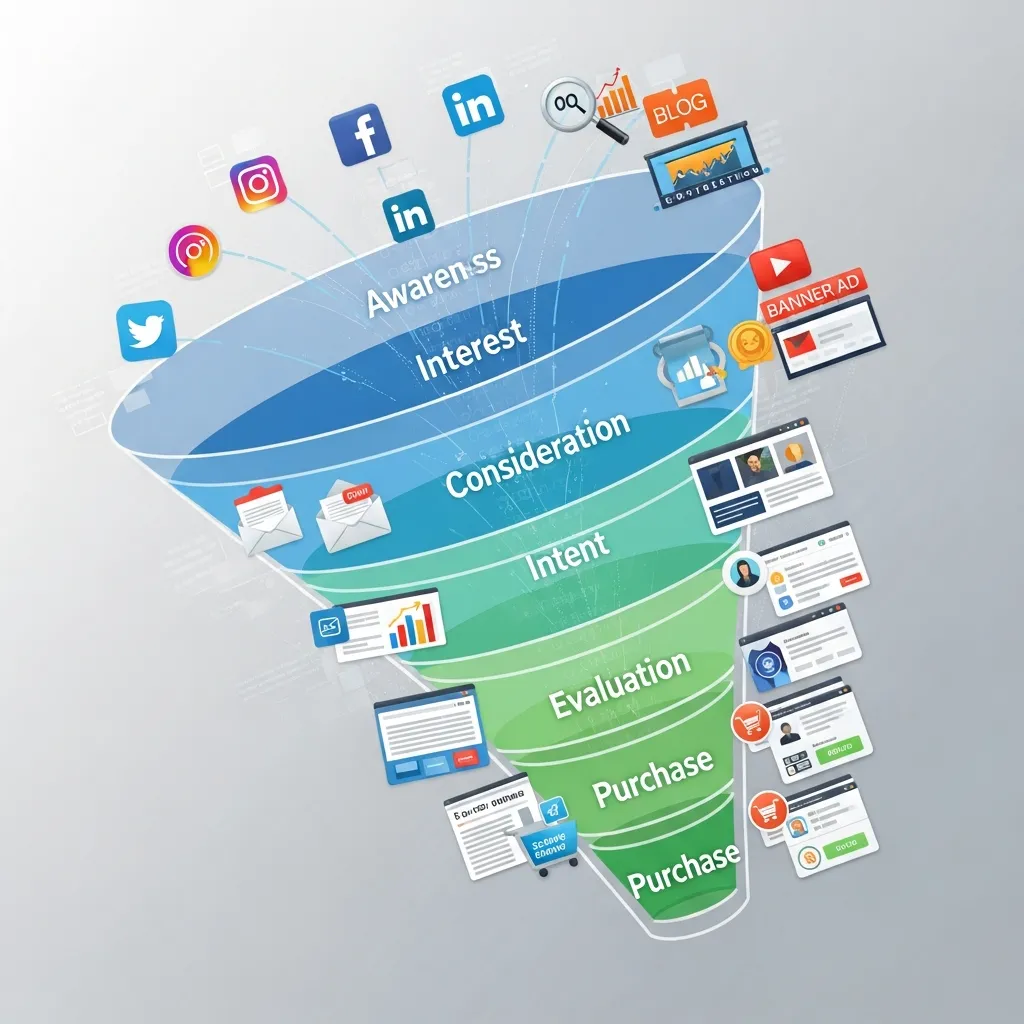
Understanding the marketing funnel in digital marketing helps businesses match the right channel to the right stage of the customer journey.
Awareness Stage Strategies
At the top of the funnel, the goal is visibility. SEO, social media marketing, video marketing, programmatic advertising, and content marketing all serve awareness objectives by introducing your brand to new audiences.
Consideration Stage Strategies
Mid-funnel strategies nurture prospects who are evaluating options. Email drip campaigns, retargeting ads, case studies, and comparison content help move leads closer to a decision.
Conversion Stage Strategies
Bottom-of-funnel tactics focus on closing the sale. PPC ads targeting high-intent keywords, landing page optimization, and time-limited promotions are highly effective here.
Retention and Loyalty Strategies
Post-purchase, the focus shifts to keeping customers engaged. Loyalty programs, personalized email sequences, and community-building on social media all contribute to long-term customer retention—and reduce the cost of acquiring repeat business.
Marketplace vs. eCommerce Website: Choosing the Right Platform
For businesses selling products online, the choice between a marketplace and a dedicated eCommerce website significantly impacts digital marketing strategy.
Advantages and Disadvantages of Marketplaces (Amazon, eBay)
Marketplaces like Amazon and eBay provide instant access to millions of shoppers, built-in trust, and a ready-made infrastructure for payments and fulfillment. The trade-off: limited brand control, high competition, seller fees, and little access to customer data. Businesses on marketplaces effectively rent their audience rather than own it.
Advantages and Disadvantages of Dedicated eCommerce Websites (Shopify, Magento)
Platforms like Shopify and Magento give businesses complete control over branding, customer experience, and data. This ownership enables more sophisticated digital marketing—personalized email campaigns, SEO-optimized product pages, and loyalty programs. The challenge is traffic: unlike marketplaces, a standalone website must generate its own audience through digital marketing channels.
Hybrid Approaches
Many successful businesses use both. Products listed on Amazon capture high-intent shoppers; the brand website captures direct, loyal customers. Marketing efforts then work to migrate marketplace buyers toward the owned channel over time.
Understanding Consumer Behavior in Digital Marketing
The Digital Customer Journey
The digital customer journey is rarely linear. A typical buyer might discover a product through a TikTok video, research it via Google, read reviews on Reddit, and finally purchase after receiving a retargeted email. Consumer behavior in digital marketing is shaped by multiple touchpoints, which is why cross-channel attribution matters so much.
Factors Influencing Online Purchases
Key factors include social proof (reviews and ratings), perceived trust (secure website, recognizable brand), price competitiveness, and ease of checkout. Research by the Baymard Institute indicates that the average cart abandonment rate is 70.19%—a statistic that underscores the importance of optimizing every step of the purchase flow.
Personalization and Customer Experience
Personalization has moved from a competitive advantage to a baseline expectation. According to McKinsey (2021), 76% of consumers say they’re more likely to purchase from brands that personalize their experience. Data-driven segmentation in email marketing, dynamic website content, and personalized product recommendations all serve this goal.
Measuring Success: Key Performance Indicators (KPIs)
No digital marketing strategy is complete without clear KPIs. Core metrics include:
- Traffic: Total visitors, organic vs. paid breakdown, and source attribution.
- Conversions: The percentage of visitors who complete a desired action—purchase, sign-up, or download.
- ROI: Revenue generated relative to marketing spend across each digital marketing channel.
- Engagement: Metrics like click-through rate (CTR), time on page, social shares, and email open rates.
Regular performance reviews allow marketers to double down on what’s working and reallocate budget away from underperforming channels.
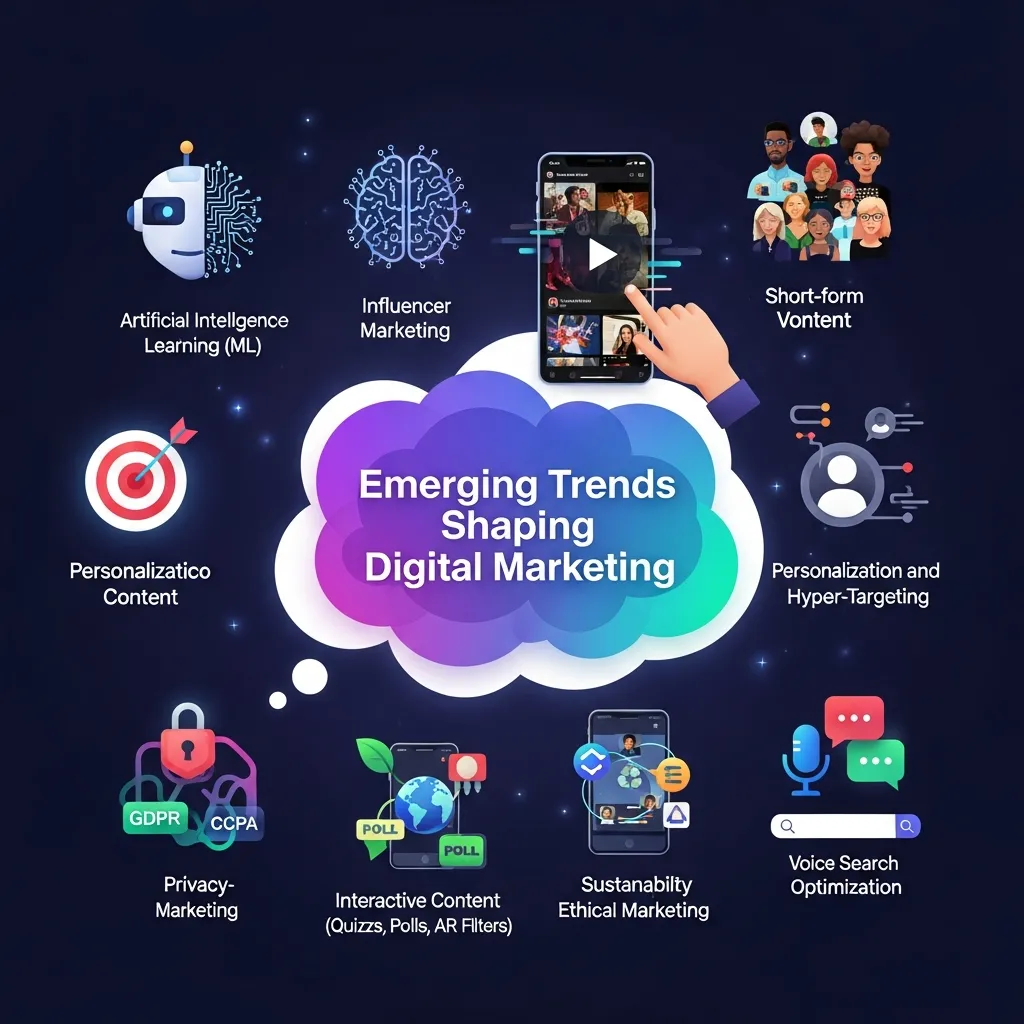
Emerging Trends Shaping the Types of Digital Marketing
AI and Machine Learning in Digital Marketing
AI is transforming digital marketing at every level—from automated bidding in PPC campaigns to AI-generated content and predictive audience segmentation. Tools like ChatGPT, Jasper, and Google’s Performance Max campaigns are already in widespread use, and their influence will only grow.
Voice Search Optimization
Smart speaker adoption and voice-activated search on mobile devices are changing how people query search engines. Voice searches tend to be longer and more conversational, which means content optimized for voice search requires a different keyword strategy—focusing on natural language phrases and question-based queries.
Interactive Content
Quizzes, polls, interactive infographics, and augmented reality (AR) try-on features are driving significantly higher engagement than static content. Interactive formats hold attention longer, generate more data, and create memorable brand experiences.
Conclusion
The types of digital marketing available today offer businesses an unprecedented range of tools to reach, engage, and convert their target audiences. SEO builds long-term organic visibility. PPC delivers immediate reach. Content marketing earns trust. Email marketing nurtures relationships. Social media builds community. And programmatic advertising scales it all with precision.
No single channel works in isolation. The most effective digital marketing strategies combine multiple channels, map them to specific funnel stages, and continuously optimize based on data. Understanding consumer behavior in digital marketing—how people discover, evaluate, and buy—is what turns a collection of tactics into a coherent strategy.
Start by auditing your current digital marketing channels against your business goals. Identify the gaps, prioritize two or three high-impact channels based on your audience and resources, and build from there. A focused, well-executed strategy will always outperform a scattered one.
Frequently Asked Questions About Types of Digital Marketing
What are the main types of digital marketing?
The main Types of Digital Marketing include SEO, PPC, content marketing, social media marketing, email marketing, affiliate marketing, influencer marketing, video marketing, and mobile marketing. Each channel supports different goals, audiences, and stages of the customer journey.
How do the types of digital marketing differ from one another?
The Types of Digital Marketing differ based on how they reach users, how quickly they produce results, and how much they cost. SEO is organic and long-term, PPC delivers faster paid traffic, social media builds visibility and engagement, and email marketing focuses on nurturing leads and customers.
What is a marketing funnel in digital marketing?
A marketing funnel helps organize the Types of Digital Marketing around the customer journey, from awareness to conversion and retention. Different channels work better at different stages, so understanding the funnel makes it easier to choose the right strategy for each goal.
Is SEO one of the main types of digital marketing?
Yes, SEO is one of the most important Types of Digital Marketing. It focuses on improving a website’s visibility in search engines through content optimization, technical improvements, and link-building strategies that attract organic traffic over time.
Why is consumer behavior important in digital marketing?
Understanding customer behavior helps businesses choose the most effective Types of Digital Marketing for their audience. It shows how people discover products, compare options, and make buying decisions, which improves targeting, messaging, and overall campaign performance.
Which types of digital marketing are best for small businesses?
For many small businesses, the most effective Types of Digital Marketing are SEO, content marketing, email marketing, and social media. These channels often provide strong long-term value without requiring a large advertising budget.
What role does content play in digital marketing?
Content supports nearly all Types of Digital Marketing. It helps websites rank in search results, gives social media posts value, strengthens email campaigns, and educates potential customers throughout the marketing funnel.
How often should I update my digital marketing strategy?
A strategy built around different Types of Digital Marketing should be reviewed regularly. Most businesses benefit from quarterly performance reviews and annual strategy updates, with more frequent changes for fast-moving channels like PPC and social media ads.
What are common mistakes in digital marketing?
Common mistakes across the Types of Digital Marketing include weak audience targeting, poor mobile optimization, inconsistent content, ignoring analytics, and using channels without a clear funnel strategy. These issues often reduce traffic, engagement, and conversions.
How does social media fit into digital marketing?
Social media is one of the most flexible Types of Digital Marketing because it supports brand awareness, community building, paid advertising, and customer engagement. The right platform depends on your audience, content style, and business goals.
How can I learn more about types of digital marketing?
The best way to learn about the Types of Digital Marketing is through a mix of courses, blogs, and hands-on practice. Free resources from Google, HubSpot, and other trusted platforms can help you understand how each channel works and when to use it.



Leave a Reply