

Digital marketing channels are the platforms and strategies businesses use to reach customers online—including SEO, content marketing, social media, email, PPC, affiliate marketing, and influencer marketing. Mastering the right mix of digital marketing channels drives brand awareness, lead generation, and sustainable revenue growth.
Digital marketing has fundamentally changed how businesses connect with their audiences. A decade ago, a well-placed billboard or a TV spot could carry a brand for months. Now, the average consumer interacts with a brand across six or more touchpoints before making a purchase decision—and most of those touchpoints are digital.
For businesses of every size, understanding digital marketing channels is no longer optional. It’s the foundation of growth. Whether you’re a startup trying to carve out market share or an established brand looking to scale, the channels you choose—and how well you use them—will determine your competitive position.
This guide covers everything you need to know about digital marketing channels: which ones matter most, how they work together to build a marketing funnel in digital marketing, how to avoid critical SEO mistakes, where AI in digital marketing fits in, and what creative marketing ideas can set your campaigns apart. You’ll also find a breakdown of digital marketing careers and a framework for measuring results.
By the end of this post, you’ll have a clear, actionable roadmap for building a multi-channel digital marketing strategy that drives real business outcomes.
Understanding the Digital Marketing Landscape

What are the key digital marketing channels available today?
Digital marketing channels fall into three broad categories: owned, earned, and paid.
- Owned channels are platforms you control—your website, email list, and social media profiles.
- Earned channels include organic search rankings, press mentions, and user-generated content.
- Paid channels cover any media you pay for—Google Ads, social media advertising, and sponsored content.
Each category serves a different purpose. Owned channels build long-term equity. Earned channels signal trust and credibility. Paid channels deliver speed and precision. The most effective digital marketing strategies leverage all three.
How do digital marketing channels drive business growth?
Digital marketing channels drive growth by placing your brand in front of the right people at the right stage of their buying journey. SEO captures demand when users are actively searching. Social media builds brand awareness and community. Email nurtures relationships and drives repeat purchases. PPC accelerates results when speed matters.
Used in combination, these digital marketing channels create a compounding effect—each one reinforcing the others and shortening the path from discovery to conversion.
Essential Digital Marketing Channels to Master
Search Engine Optimization (SEO)
SEO remains one of the highest-ROI digital marketing channels available. Unlike paid advertising, organic rankings generate traffic without a cost-per-click, making SEO a powerful long-term asset.
On-page SEO strategies focus on optimizing the content and HTML of individual pages. This includes targeting relevant keywords, writing compelling meta titles and descriptions, using header tags correctly, and ensuring your content genuinely answers the user’s query.
Off-page SEO techniques build your site’s authority through backlinks, brand mentions, and social signals. High-quality backlinks from credible websites signal to search engines that your content is trustworthy and worth ranking.
Technical SEO considerations address the infrastructure of your site—page speed, mobile-friendliness, crawlability, structured data, and Core Web Vitals. Even the best content will underperform if technical issues prevent search engines from indexing it properly.
What are the most critical SEO mistakes to avoid?
Avoiding critical SEO mistakes is just as important as implementing best practices. The most damaging errors include:
- Keyword stuffing: Forcing keywords into content unnaturally hurts both readability and rankings.
- Ignoring search intent: Targeting keywords without matching the intent behind them leads to high bounce rates.
- Neglecting mobile optimization: Over 60% of Google searches now happen on mobile devices.
- Thin or duplicate content: Pages with little unique value are often penalized or ignored by search engines.
- Skipping internal linking: A poor internal link structure limits how search engines discover and index your pages.
Content Marketing
Content marketing powers nearly every other digital marketing channel. Strong content improves SEO rankings, fuels social media engagement, supports email campaigns, and builds brand authority.
Types of content span blog posts, videos, infographics, podcasts, case studies, whitepapers, and interactive tools. The format should match both your audience’s preferences and the platform you’re distributing on.
Content distribution strategies include organic social sharing, email newsletters, content syndication, and paid promotion. Creating great content without a distribution plan is one of the most common marketing mistakes brands make.
Measuring content performance involves tracking metrics like organic traffic, time on page, backlinks earned, social shares, and conversion rates. Tools like Google Analytics 4 and SEMrush provide detailed insights into how content contributes to business goals.
Social Media Marketing
Social media is one of the most dynamic digital marketing channels—and one of the most misunderstood. Success on social media doesn’t come from posting frequently; it comes from posting with purpose.
Choosing the right platforms depends on your audience demographics and content type. LinkedIn excels for B2B brands and thought leadership. Instagram and TikTok drive engagement for visual and entertainment-led content. Facebook remains effective for community building and local advertising.
Engagement strategies include responding to comments, asking questions, running polls, and creating content that invites participation rather than passive consumption.
Paid social media advertising allows precise audience targeting based on demographics, interests, behaviors, and lookalike audiences. With organic reach declining across most platforms, a paid amplification strategy is increasingly essential.
Email Marketing
Email marketing consistently delivers one of the highest returns of all digital marketing channels. According to Litmus, email generates an average ROI of $36 for every $1 spent.
Building an email list starts with offering genuine value—lead magnets, free resources, exclusive content, or early access to products. Purchased email lists should be avoided; they damage deliverability and brand reputation.
Crafting effective email campaigns requires a clear goal for every send. Promotional emails, nurture sequences, re-engagement campaigns, and transactional emails all serve distinct purposes and require different approaches to copy and design.
Automation and personalization allow you to deliver the right message to the right person at the right time—without manual effort. Behavioral triggers, segmentation, and dynamic content significantly improve open rates, click-through rates, and conversions.
Paid Advertising (PPC)
Pay-per-click advertising gives brands immediate visibility at the top of search results and across display networks.
Google Ads and search advertising target users with high purchase intent—people actively searching for products or solutions. Google Search ads are particularly effective for digital marketing channels with clear commercial intent keywords.
Social media advertising on platforms like Meta, LinkedIn, and TikTok allows brands to reach audiences based on who they are, rather than what they’re searching for. This makes paid social ideal for awareness and consideration campaigns.
Display advertising uses visual banners across websites and apps to build brand awareness and retarget previous visitors.
Affiliate Marketing
Affiliate marketing is a performance-based model where businesses reward partners (affiliates) for driving traffic or sales.
How affiliate marketing works: Affiliates promote a brand’s products through their own channels—blogs, social media, email lists, or YouTube. When a referred user completes a desired action (usually a purchase), the affiliate earns a commission.
Benefits for businesses and affiliates: Brands gain access to new audiences with minimal upfront cost. Affiliates earn passive income by promoting products they genuinely endorse. When well-managed, affiliate programs scale efficiently and generate measurable ROI.
Influencer Marketing
Influencer marketing bridges the gap between social media and word-of-mouth. Consumers trust recommendations from people they follow more than traditional advertising.
Identifying the right influencers goes beyond follower count. Engagement rate, audience demographics, content quality, and brand alignment matter far more than raw numbers. Micro-influencers (10,000–100,000 followers) often deliver higher engagement rates and more targeted audiences than macro-influencers.
Campaign execution and measurement should include clear goals, defined deliverables, and agreed-upon KPIs. Track reach, engagement, website traffic, and conversions attributable to each influencer partnership.
Building a Robust Marketing Funnel in Digital Marketing
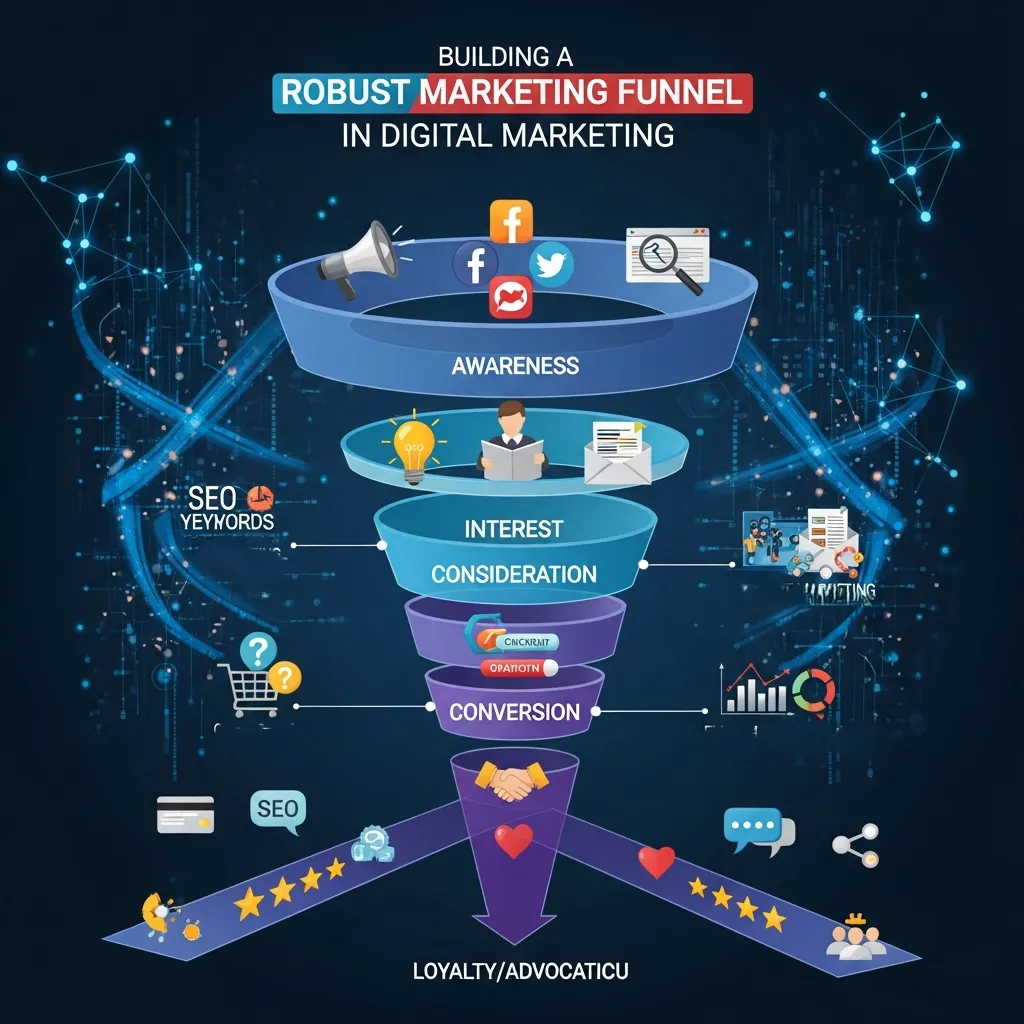
A well-structured marketing funnel in digital marketing maps the customer journey from first awareness to loyal advocacy—and assigns the right channels and tactics to each stage.
Awareness stage: SEO, social media, and content marketing introduce your brand to new audiences. The goal here is visibility, not conversion.
Consideration stage: Email nurture sequences, retargeting ads, and in-depth content (case studies, comparison guides, webinars) help prospects evaluate your offering.
Conversion stage: Clear landing pages, strong calls-to-action, social proof, and seamless checkout experiences remove friction and drive decisions.
Retention and loyalty: Post-purchase email flows, loyalty programs, community building, and exceptional customer service turn one-time buyers into repeat customers and brand advocates.
The marketing funnel in digital marketing is not linear. Customers move between stages, re-enter at different points, and are influenced by multiple channels simultaneously. A cross-channel strategy that accounts for this complexity will always outperform a siloed one.
Leveraging AI in Digital Marketing
AI in digital marketing has shifted from novelty to necessity. Brands that use AI strategically are outpacing competitors in speed, personalization, and efficiency.
AI for personalization: Machine learning algorithms analyze user behavior to deliver personalized product recommendations, email content, and ad creative at scale. Netflix and Amazon have built much of their engagement model on AI-driven personalization.
AI for data analysis and insights: AI tools process vast datasets to surface trends, predict customer behavior, and identify optimization opportunities that human analysts would likely miss. Platforms like Google Analytics 4 use AI to generate predictive metrics like purchase probability.
AI-powered content creation: Tools like Jasper, Copy.ai, and ChatGPT accelerate content production by generating first drafts, repurposing existing content, and scaling personalized messaging. AI in digital marketing works best as a collaborator—augmenting human creativity rather than replacing it.
Creative Marketing Ideas for Standout Campaigns
Standing out in a crowded digital landscape requires creative marketing ideas that go beyond conventional content.
Interactive content—quizzes, calculators, polls, and assessments—generates significantly higher engagement than static content. BuzzFeed’s viral quiz format demonstrated how interactive content can drive millions of organic shares.
User-generated content (UGC) is one of the most cost-effective creative marketing ideas available. Encouraging customers to share photos, reviews, and testimonials builds authentic social proof and reduces content production costs. GoPro built a billion-dollar brand largely on customer-created content.
Experiential marketing in a digital world blends physical and digital experiences—virtual events, live-streamed product launches, augmented reality try-ons, and branded digital activations. These creative marketing ideas create memorable moments that traditional content formats can’t replicate.
Exploring Digital Marketing Career Paths
Are digital marketing jobs legitimate, and what do they involve?
Yes—digital marketing jobs are legitimate, in-demand, and increasingly well-compensated. The U.S. Bureau of Labor Statistics projects marketing-related roles to grow faster than the average for all occupations through 2030. Remote work options are common, and the skills are transferable across industries.
Key roles in digital marketing include:
- SEO Specialist
- Content Strategist
- Social Media Manager
- PPC/Paid Media Manager
- Email Marketing Specialist
- Digital Marketing Analyst
- Marketing Automation Specialist
Skills needed for success include data analysis, copywriting, platform-specific knowledge (Google Ads, Meta Ads Manager, HubSpot), SEO fundamentals, and an understanding of digital marketing channels as an interconnected system. Soft skills—creative thinking, adaptability, and communication—are equally important.
Measuring Success Across Digital Marketing Channels
What KPIs and analytics tools should you use for digital marketing?
Key Performance Indicators (KPIs) vary by channel and objective:
- SEO: Organic traffic, keyword rankings, domain authority, click-through rate
- Content: Page views, time on page, backlinks, conversion rate
- Social media: Reach, engagement rate, follower growth, link clicks
- Email: Open rate, click-through rate, unsubscribe rate, revenue per email
- PPC: Cost-per-click, cost-per-acquisition, Quality Score, ROAS
Analytics tools include Google Analytics 4 for website performance, SEMrush or Ahrefs for SEO, Hootsuite or Sprout Social for social media, and HubSpot or Mailchimp for email.
ROI calculation follows a straightforward formula: (Revenue Generated − Marketing Investment) ÷ Marketing Investment × 100. Tracking ROI across digital marketing channels allows you to allocate budget to the highest-performing areas and continuously optimize your strategy.
Building a Digital Marketing Strategy That Lasts
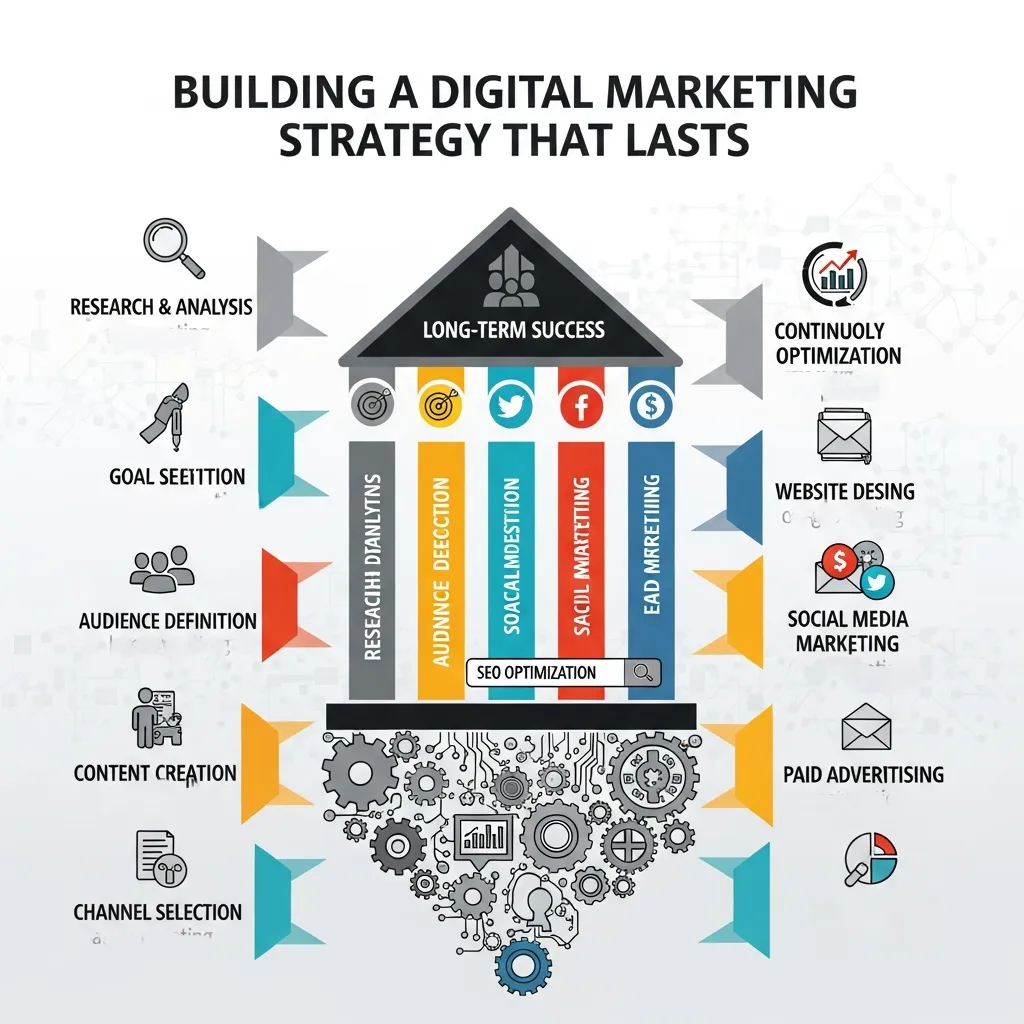
Digital marketing channels will keep evolving—new platforms will emerge, algorithms will change, and consumer behavior will shift. What won’t change is the underlying principle: reach the right people, with the right message, at the right moment.
The brands that win long-term aren’t necessarily those with the biggest budgets. They’re the ones that understand their audience deeply, test consistently, measure rigorously, and adapt quickly. Start by mastering two or three of the digital marketing channels most relevant to your audience, build a clear marketing funnel in digital marketing, and expand from there.
The tools, channels, and creative marketing ideas available today are more powerful than ever. Use them wisely, and the results will follow.
Frequently Asked Questions (FAQs)
What are the most effective digital marketing channels for small businesses?
For small businesses with limited budgets, SEO, email marketing, and organic social media offer the highest ROI. Google My Business optimization is particularly valuable for local businesses. Start with channels where your target audience is most active and where you can produce consistent, quality content.
How can I avoid critical SEO mistakes that hurt rankings?
The most important step is aligning your content with search intent—ensure every page answers the specific question users are asking. Beyond that, fix technical issues like slow page speed and broken links, avoid duplicate content, and build backlinks from reputable sources rather than low-quality directories.
What is the role of AI in digital marketing today?
AI in digital marketing is used for personalization, predictive analytics, content generation, ad optimization, and customer service automation (via chatbots). Tools like Jasper and Google’s Performance Max campaigns use AI to improve targeting efficiency and content quality at scale.
How do I create a marketing funnel in digital marketing?
Map your customer journey from awareness to purchase, then assign appropriate channels and content to each stage. Use SEO and social media for awareness, email and retargeting for consideration, and optimized landing pages for conversion. Measure drop-off at each stage and optimize accordingly.
Are digital marketing jobs legitimate, and what are their career prospects?
Digital marketing jobs are fully legitimate and growing rapidly. The U.S. Bureau of Labor Statistics confirms marketing roles are projected to grow through 2030. Roles range from SEO specialists to data analysts, with salaries varying by specialization, experience, and industry.
What are some creative marketing ideas that work on a tight budget?
User-generated content campaigns, repurposing existing content into new formats (turning a blog post into a short video or infographic), collaborating with micro-influencers, and running interactive social media polls are all high-impact creative marketing ideas that require minimal financial investment.
How often should I post on social media for effective digital marketing?
Posting frequency should prioritize consistency over volume. For most platforms, 3–5 posts per week is sufficient. More important than frequency is quality and timing—post when your audience is most active and focus on content that generates genuine engagement rather than passive impressions.
What’s the difference between SEO and PPC in digital marketing channels?
SEO generates organic traffic over time without a direct cost per click, but results take months to build. PPC delivers immediate visibility at the top of search results but requires ongoing budget. SEO builds long-term equity; PPC provides speed and precision. Most effective strategies use both in combination.
How can I measure the ROI of my digital marketing channels?
Assign clear conversion goals to each channel in your analytics platform (e.g., Google Analytics 4). Track revenue or lead value attributed to each channel, subtract your marketing investment, and divide by that investment. Multi-touch attribution models give a more accurate view than last-click attribution alone.
What are the latest trends shaping digital marketing channels?
Key trends include the rise of AI-generated and AI-assisted content, the growth of short-form video (Reels, TikTok, YouTube Shorts), increasing importance of first-party data as cookies phase out, and the expansion of search to include AI-powered answer engines like Google’s AI Overviews and ChatGPT.
How can I personalize my digital marketing efforts without a large team?
Marketing automation tools like HubSpot, Klaviyo, and Mailchimp allow small teams to deliver personalized email sequences based on user behavior. Dynamic content blocks, audience segmentation, and AI-powered ad personalization through platforms like Meta Advantage+ make personalization scalable at any team size.
What are the ethical considerations in using digital marketing channels?
Ethical digital marketing requires transparency in data collection, compliance with regulations like GDPR and CCPA, honest advertising claims, and responsible use of AI-generated content. Brands should clearly disclose sponsored content and influencer partnerships, and avoid manipulative dark patterns in UX design or ad targeting.



Leave a Reply