

Customer Acquisition Cost (CAC) measures how much a business spends to acquire a single new customer. Calculating and optimizing CAC is essential for profitability, sustainable growth, and smarter digital marketing decisions. This guide covers everything from the CAC formula to proven strategies for reducing it.
Every customer your business wins comes with a price tag. Some companies know exactly what that price is. Others are guessing—and that gap can mean the difference between scaling profitably and burning through your budget without knowing why.
Customer Acquisition Cost (CAC) is one of the most important metrics in digital marketing. Yet, despite its significance, many businesses either calculate it incorrectly or ignore it altogether. The result? Wasted ad spend, misaligned Digital Marketing Objectives, and growth that looks impressive on paper but fails to translate into real profitability.
This guide breaks down everything you need to know about Customer Acquisition Cost (CAC)—what it is, how to calculate it, and what strategies actually move the needle. Whether you’re a startup trying to stretch a lean budget or an established brand looking to refine your Digital Marketing Process, you’ll find actionable insights throughout.
By the end, you’ll know how to measure CAC accurately, identify what’s inflating it, and implement practical steps to bring it down—without sacrificing the quality of leads coming in.
I. What Is Customer Acquisition Cost (CAC) and Why Does It Matter?
What is Customer Acquisition Cost (CAC)?
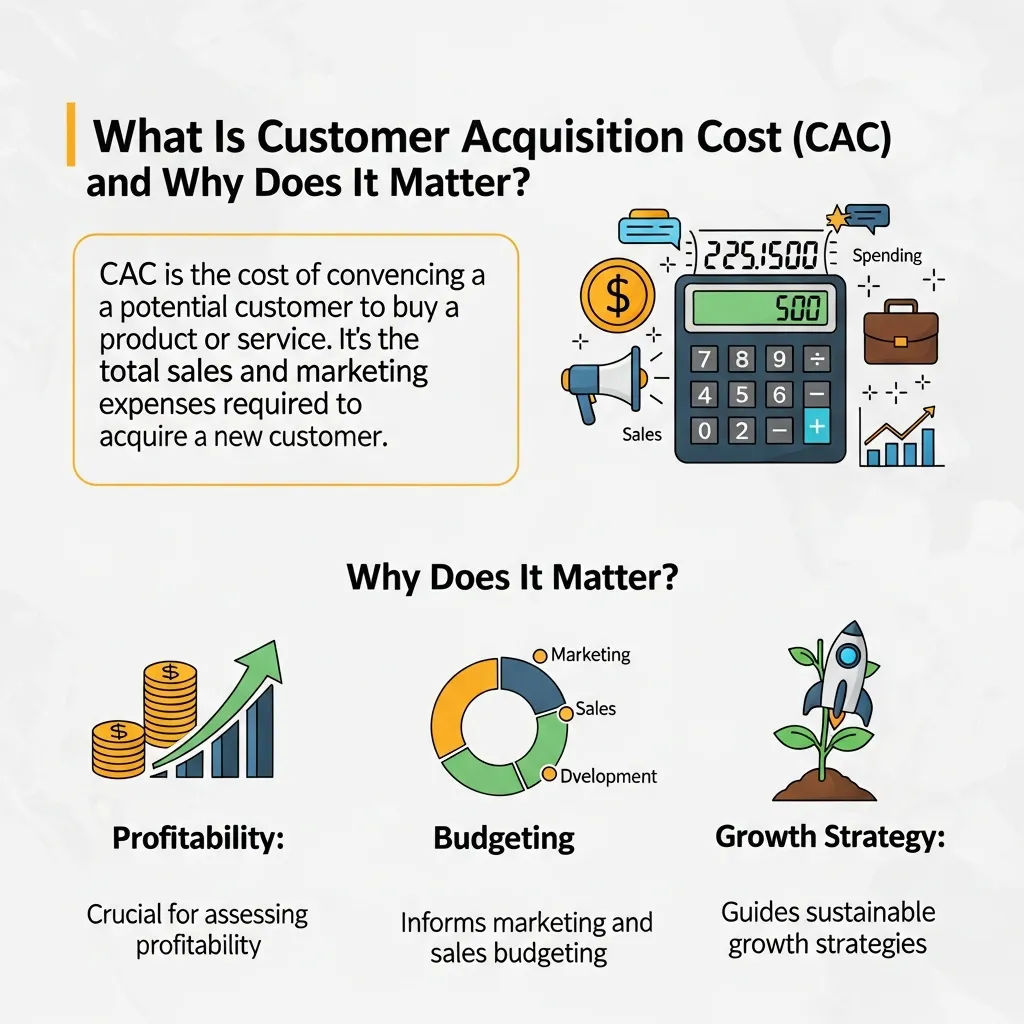
Customer Acquisition Cost (CAC) is the total amount a business spends to acquire one new paying customer. This includes every dollar invested in marketing, sales, tools, and overhead directly tied to the acquisition process—divided by the number of customers gained during that period.
Simple in concept, powerful in practice. CAC gives businesses a clear benchmark for evaluating whether their growth is financially sustainable.
Why is CAC crucial for business growth and profitability?
High revenue doesn’t always mean high profit. A business generating $1M in annual revenue, but spending $900K to acquire those customers, is barely surviving. Customer Acquisition Cost (CAC) cuts through vanity metrics and reveals the true cost of growth.
More specifically, CAC matters because:
- It determines profitability: If CAC exceeds the revenue generated from a customer, the business loses money on every sale.
- It guides budget allocation: Knowing which channels deliver the lowest CAC helps marketers invest smarter.
- It attracts investors: Venture capitalists and stakeholders use CAC (alongside Customer Lifetime Value) to assess business viability.
- It benchmarks performance: Tracking CAC over time reveals whether your Digital Marketing Process is improving or deteriorating.
The relationship between CAC and Digital Marketing Objectives
Customer Acquisition Cost (CAC) sits at the intersection of nearly every Digital Marketing Objective. Whether your goal is brand awareness, lead generation, or direct conversion, the efficiency of those efforts ultimately shows up in your CAC. A well-executed SEO strategy, for instance, reduces dependency on paid acquisition, pulling your CAC down over time. Conversely, poorly targeted paid campaigns inflate it quickly.
Aligning your CAC goals with broader Digital Marketing Objectives ensures every tactic serves a measurable financial purpose.
II. How to Calculate Customer Acquisition Cost (CAC)
The formula for Customer Acquisition Cost (CAC)
The CAC formula is straightforward:
CAC = Total Cost of Sales and Marketing ÷ Number of New Customers Acquired
For example, if a company spends $50,000 on sales and marketing in a given month and acquires 500 new customers, the Customer Acquisition Cost (CAC) is $100.
What to include in “Costs of Acquisition”
This is where many businesses go wrong. A complete and accurate CAC calculation should include:
- Advertising spend: Paid search, social media ads, display advertising
- Content and creative costs: Copywriting, design, video production
- Salaries: Marketing and sales team compensation (prorated to acquisition activities)
- Software and tools: CRM platforms, marketing automation, analytics tools
- Agency and contractor fees: Any outsourced marketing or sales support
- Event and outreach costs: Trade shows, webinars, cold outreach campaigns
Excluding any of these will understate your true Customer Acquisition Cost (CAC) and lead to misguided decisions.
Examples of CAC calculation
Example 1 – E-commerce brand:
Monthly spend: $20,000 (ads) + $5,000 (content) + $10,000 (team) = $35,000
New customers acquired: 700
CAC = $50
Example 2 – B2B SaaS company:
Quarterly spend: $80,000 (paid ads) + $40,000 (sales team) + $10,000 (tools) = $130,000
New customers acquired: 65
CAC = $2,000
These figures mean nothing in isolation—context matters. A $2,000 CAC is entirely reasonable for a SaaS product with a $24,000 annual contract value.
III. What Factors Influence Customer Acquisition Cost (CAC)?
Marketing channels: Paid ads, SEO, content marketing, and social media
Different channels carry very different cost structures. Paid advertising—Google Ads, Meta, LinkedIn—delivers fast results but at a higher per-customer cost. SEO and content marketing have higher upfront investment but generate compounding returns, often driving the lowest long-term Customer Acquisition Cost (CAC).
Social media sits in the middle: highly scalable for brand awareness and Enhancing Customer Engagement, but conversion rates vary significantly by platform and industry.
Sales cycle length
Longer sales cycles inflate CAC. Each additional touchpoint—email, call, demo, proposal—adds cost. B2B companies with complex sales processes naturally carry higher CAC than direct-to-consumer brands. Reducing friction in the sales cycle is one of the most impactful ways to bring Customer Acquisition Cost (CAC) down.
Industry benchmarks
CAC varies dramatically by sector. According to HubSpot, average CAC by industry includes:
- E-commerce: $70–$100
- SaaS: $200–$400 (SMB), $1,000–$5,000 (enterprise)
- Financial services: $175–$400
- Healthcare: $150–$500
Comparing your Customer Acquisition Cost (CAC) against industry benchmarks provides critical context for whether your Digital Marketing Process is performing competitively.
Product/service price point and brand recognition
Higher-priced products justify higher CAC—provided Customer Lifetime Value (CLTV) supports it. Strong brand recognition reduces CAC by shortening the consideration phase. Customers who already trust a brand require less persuasion, fewer touchpoints, and convert at higher rates.
IV. Strategies to Optimize Customer Acquisition Cost (CAC)
Enhancing Customer Engagement to reduce CAC
Personalized marketing
Generic messaging converts poorly. Personalization—tailored emails, dynamic website content, behavior-triggered campaigns—improves conversion rates without requiring higher ad spend. Enhancing Customer Engagement through personalization directly lowers Customer Acquisition Cost (CAC) by making every impression count.
Customer Relationship Management (CRM)
A CRM like Salesforce, HubSpot, or Zoho centralizes customer data, helping sales and marketing teams work more efficiently. When both teams share visibility into the customer journey, leads are nurtured faster and close rates improve—reducing the cost per acquired customer.
Improving Customer Lifetime Value (CLTV)
A higher CLTV gives you permission to spend more on acquisition. If customers stay longer and buy more, a $300 CAC that seemed expensive becomes an excellent investment. Prioritizing post-purchase experience, loyalty programs, and upselling directly impacts the CAC:CLTV ratio.
Streamlining the Digital Marketing Process
A/B testing and optimization
Systematically testing headlines, CTAs, landing pages, and ad creatives is fundamental to streamlining the Digital Marketing Process. Incremental improvements in click-through rates and conversion rates can reduce Customer Acquisition Cost (CAC) significantly over time without increasing spend.
Targeting and segmentation
Broad targeting wastes budget. Precise audience segmentation—by demographics, behavior, intent, or funnel stage—ensures your message reaches people most likely to convert. This is one of the highest-leverage changes in any Digital Marketing Process.
Conversion Rate Optimization (CRO)
More traffic doesn’t automatically mean more customers. CRO focuses on converting existing traffic more effectively through UX improvements, clearer value propositions, and reduced friction at checkout or sign-up. Higher conversion rates translate directly into lower Customer Acquisition Cost (CAC).
Leveraging organic channels
SEO and content marketing
Organic search is one of the most cost-effective acquisition channels available. A well-optimized blog post can drive qualified traffic for years with no ongoing spend. Businesses that invest in SEO consistently report lower long-term Customer Acquisition Cost (CAC) compared to those dependent on paid media.
Referral programs
Referred customers typically convert at 3–5x the rate of cold traffic and carry higher retention rates. Referral programs turn existing customers into a low-cost acquisition channel, making them one of the smartest tools for Enhancing Customer Engagement while simultaneously lowering CAC.
Social media engagement
Organic social media builds community and trust. When followers share content or tag friends, the brand earns acquisition at zero marginal cost. Prioritizing authentic Enhancing Customer Engagement over follower counts delivers better long-term CAC outcomes.
Improving product/market fit
No amount of marketing optimization compensates for weak product/market fit. When a product genuinely solves a problem customers care about, word-of-mouth grows, conversion rates rise, and Customer Acquisition Cost (CAC) naturally falls. Gathering and acting on customer feedback is as much a CAC strategy as any paid media tactic.
V. The Role of Technology in Managing Customer Acquisition Cost (CAC)
Marketing automation platforms
Platforms like HubSpot, Marketo, and ActiveCampaign automate repetitive tasks across the Digital Marketing Process—lead nurturing, email sequences, follow-ups—reducing labor costs while maintaining consistent customer communication. The result is a more efficient pipeline and lower Customer Acquisition Cost (CAC).
Analytics and reporting tools
Tools like Google Analytics 4, Mixpanel, and Tableau provide granular visibility into which channels, campaigns, and content pieces are driving acquisitions—and at what cost. Accurate data is the foundation of any CAC reduction strategy.
AI and machine learning for predictive analytics
AI-powered platforms can now predict which leads are most likely to convert, when to engage them, and which message will resonate. By concentrating resources on high-probability prospects, businesses reduce wasted spend and improve Customer Acquisition Cost (CAC) efficiency. Platforms like Salesforce Einstein and 6sense are leading examples of this capability.
VI. Common Mistakes to Avoid When Managing Customer Acquisition Cost (CAC)
Ignoring CLTV: CAC only makes sense relative to the value a customer generates. A $500 CAC could be excellent or disastrous depending on CLTV.
Focusing solely on vanity metrics: Impressions, followers, and clicks don’t pay the bills. Tying Digital Marketing Objectives to conversion-oriented outcomes keeps teams accountable to real business results.
Inaccurate tracking of expenses: Partial cost inclusion leads to an artificially low—and misleading—Customer Acquisition Cost (CAC). All relevant costs must be captured.
Not segmenting CAC by channel or campaign: An aggregate CAC masks significant variation. A channel costing $500 per customer sitting alongside one costing $50 needs to be identified and addressed.
VII. Real-World Examples of Customer Acquisition Cost (CAC) Optimization
Dropbox famously reduced its Customer Acquisition Cost (CAC) by replacing paid search—which cost approximately $288 per customer acquisition against a $99 product price—with a referral program that gave both referrer and new user additional storage. The result: 60% of new sign-ups came from referrals.
Dollar Shave Club drove Customer Acquisition Cost (CAC) down through viral content marketing. Their launch video cost approximately $4,500 to produce and generated over 12,000 sign-ups within 48 hours—a CAC of less than $0.38 per customer for that campaign.
Both examples highlight the power of Enhancing Customer Engagement and organic channel investment as a long-term CAC strategy.
VIII. Future Trends in Customer Acquisition Cost (CAC)

The rise of privacy-first marketing
Third-party cookie deprecation and growing data privacy regulations are reshaping how businesses target and track customers. Brands investing now in first-party data strategies—email lists, loyalty programs, owned communities—will maintain lower Customer Acquisition Cost (CAC) as third-party targeting becomes more expensive and less reliable.
AI-driven personalization
AI is enabling hyper-personalization at scale, tailoring ads, emails, and website experiences to individual users in real time. As adoption grows, businesses leveraging AI across their Digital Marketing Process will gain significant CAC advantages over those relying on manual segmentation.
The importance of authentic brand building
Customers are increasingly skeptical of paid advertising. Brands that invest in authenticity—transparent communication, genuine community Enhancing Customer Engagement, consistent values—reduce the persuasion gap between first impression and purchase. Long-term brand building is becoming one of the highest-ROI CAC strategies available.
Conclusion
Customer Acquisition Cost (CAC) is not just a financial metric—it’s a lens through which the entire health of your Digital Marketing Process can be evaluated. A business that understands its CAC, tracks it accurately, benchmarks it against industry standards, and continuously works to reduce it, is a business built for durable growth.
The strategies covered here—from Enhancing Customer Engagement and CRO to SEO, referral programs, and AI-powered personalization—each offer real, measurable pathways to lower Customer Acquisition Cost (CAC). The key is prioritizing the approaches that align with your specific Digital Marketing Objectives and then measuring relentlessly.
Start by auditing your current CAC calculation. Are you including all relevant costs? Are you segmenting by channel? Once you have an accurate baseline, the path to optimization becomes significantly clearer.
Frequently Asked Questions (FAQs)
1. What is a good Customer Acquisition Cost (CAC)?
A “good” Customer Acquisition Cost (CAC) depends on your industry, business model, and Customer Lifetime Value (CLTV). The widely accepted benchmark is a CAC:CLTV ratio of 1:3—meaning each customer should generate at least three times what it cost to acquire them. For SaaS, a CAC payback period of under 12 months is generally considered healthy.
2. How does CAC differ from CPA (Cost Per Acquisition)?
CPA measures the cost of a specific conversion action—a sign-up, download, or purchase—while Customer Acquisition Cost (CAC) measures the cost of acquiring a net-new paying customer. CPA is often lower and narrower in scope; CAC includes the full sales and marketing cost stack and focuses exclusively on new customers.
3. Can CAC be negative?
No. Customer Acquisition Cost (CAC) cannot technically be negative since it represents a cost. However, a business might informally use the term to describe a scenario where existing customers generate referrals at zero additional spend—but the correct term for this would be zero or near-zero acquisition cost, not negative CAC.
4. How often should I calculate my CAC?
Calculate Customer Acquisition Cost (CAC) at least monthly, and always align the measurement period with your sales cycle. Businesses with longer sales cycles may find quarterly calculations more meaningful. Frequent tracking allows faster identification of cost increases and more agile adjustments to your Digital Marketing Process.
5. What is the impact of a high CAC on profitability?
A high Customer Acquisition Cost (CAC) directly compresses margins. If CAC rises without a corresponding increase in CLTV or average order value, profitability erodes. High CAC also extends the payback period—the time required to recoup the cost of acquiring a customer—making the business more vulnerable to cash flow issues.
6. How does improving customer retention affect CAC?
Improving retention doesn’t reduce CAC directly, but it improves the CAC:CLTV ratio significantly. When customers stay longer and spend more, the same Customer Acquisition Cost (CAC) becomes proportionally less expensive relative to the revenue generated. Better retention also fuels referral programs, which create new acquisition at low or zero cost.
7. What are the best tools for tracking CAC?
The most effective tools for tracking Customer Acquisition Cost (CAC) include Google Analytics 4 (traffic and conversion data), HubSpot or Salesforce (CRM and pipeline tracking), and Stripe or similar payment platforms (revenue attribution). Combining these with a consistent attribution model ensures an accurate and complete picture of acquisition costs.
8. How does content marketing help reduce CAC?
Content marketing reduces Customer Acquisition Cost (CAC) by generating compounding organic traffic that doesn’t require ongoing paid spend. A single well-optimized blog post or video can attract qualified leads for years. Content also warms prospects before sales outreach, shortening the sales cycle and reducing per-customer acquisition costs across the Digital Marketing Process.
9. Is CAC relevant for B2B businesses?
Absolutely. Customer Acquisition Cost (CAC) is arguably more critical for B2B companies than B2C, given the typically longer sales cycles, higher touch-point requirements, and larger deal sizes involved. B2B businesses should segment CAC by customer tier, industry vertical, and acquisition channel to identify where resources are best allocated.
10. How do I segment my CAC effectively?
Segment Customer Acquisition Cost (CAC) by channel (paid, organic, referral), campaign, geography, customer type (SMB vs. enterprise), and product line. This granularity reveals which segments are performing efficiently and which are dragging up your overall average—enabling more targeted optimization across your Digital Marketing Objectives.
11. What role does brand reputation play in CAC?
Strong brand reputation reduces Customer Acquisition Cost (CAC) by shortening the trust-building phase of the customer journey. Recognized and trusted brands convert at higher rates, require fewer touchpoints, and generate more organic referrals. Investing in brand building is a long-term CAC reduction strategy that compounds over time.
12. How can small businesses optimize their Customer Acquisition Cost (CAC)?
Small businesses should prioritize high-ROI, low-cost acquisition channels—particularly SEO, content marketing, referral programs, and organic social media. Focusing on Enhancing Customer Engagement and delivering exceptional post-purchase experiences encourages word-of-mouth growth. Precision targeting over broad reach, combined with rigorous tracking, ensures every marketing dollar contributes meaningfully to reducing Customer Acquisition Cost (CAC).



Leave a Reply