

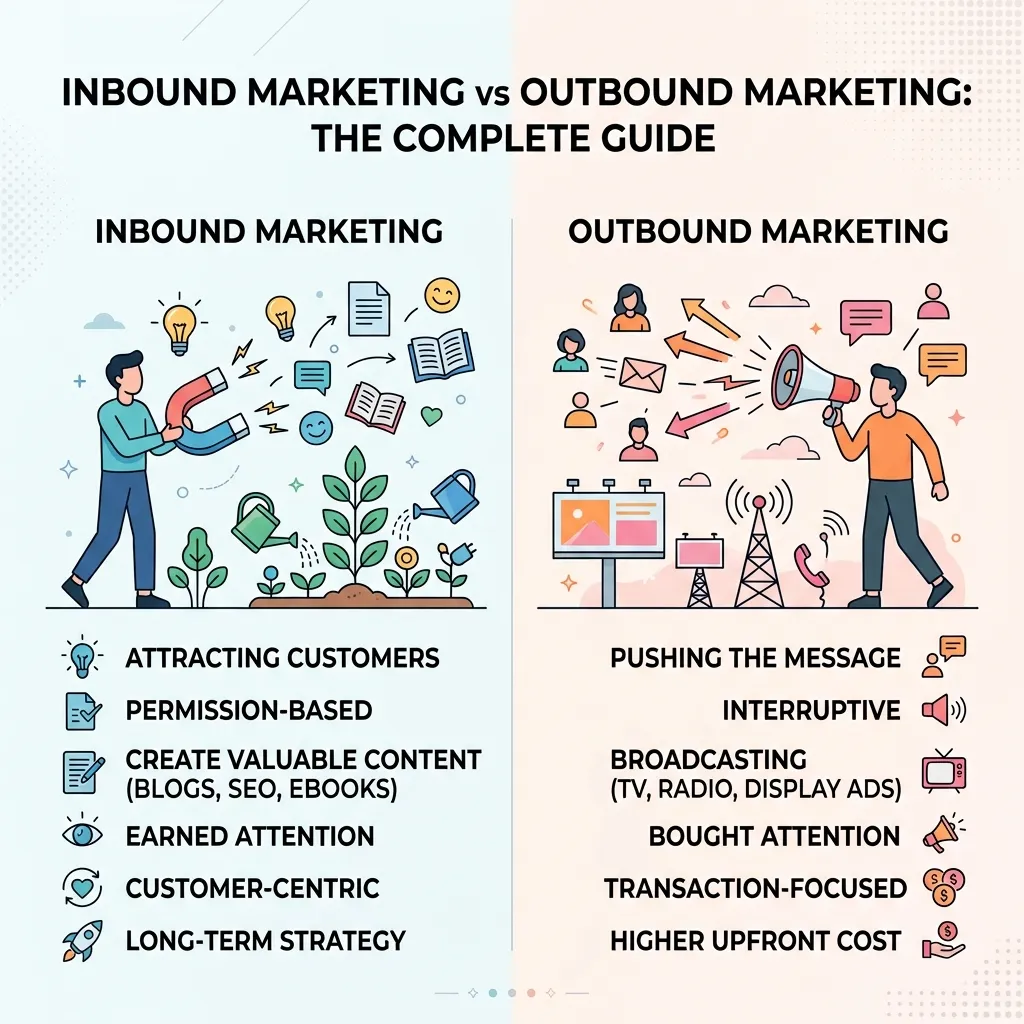
Inbound marketing vs outbound marketing is one of the most debated topics in digital marketing. Inbound marketing attracts customers through valuable content like SEO, blogs, and social media, while outbound marketing pushes messages out through ads, cold calls, and direct mail. This guide breaks down the real differences, costs, pros, cons, and how to combine both strategies for the best results in 2026.
If you have ever wondered whether to invest in content and SEO or to spend your budget on ads and cold outreach, you have already run into the inbound marketing vs outbound marketing debate. Both approaches aim to bring in customers, but they take almost opposite paths to get there.
Inbound marketing is about earning attention. You create genuinely useful content, and people find you through search engines, social media, or word of mouth. Outbound marketing is about buying or demanding attention. You interrupt your audience with an ad, a cold call, or a direct mail piece, whether they were looking for you or not.
Neither strategy is automatically “better.” The right mix depends on your budget, your sales cycle, your industry, and how fast you need results. In this guide, we will walk through what inbound marketing and outbound marketing actually mean, how they compare on cost and results, when each one makes sense, and how smart brands blend the two into a single digital marketing strategy.
What Is Inbound Marketing?
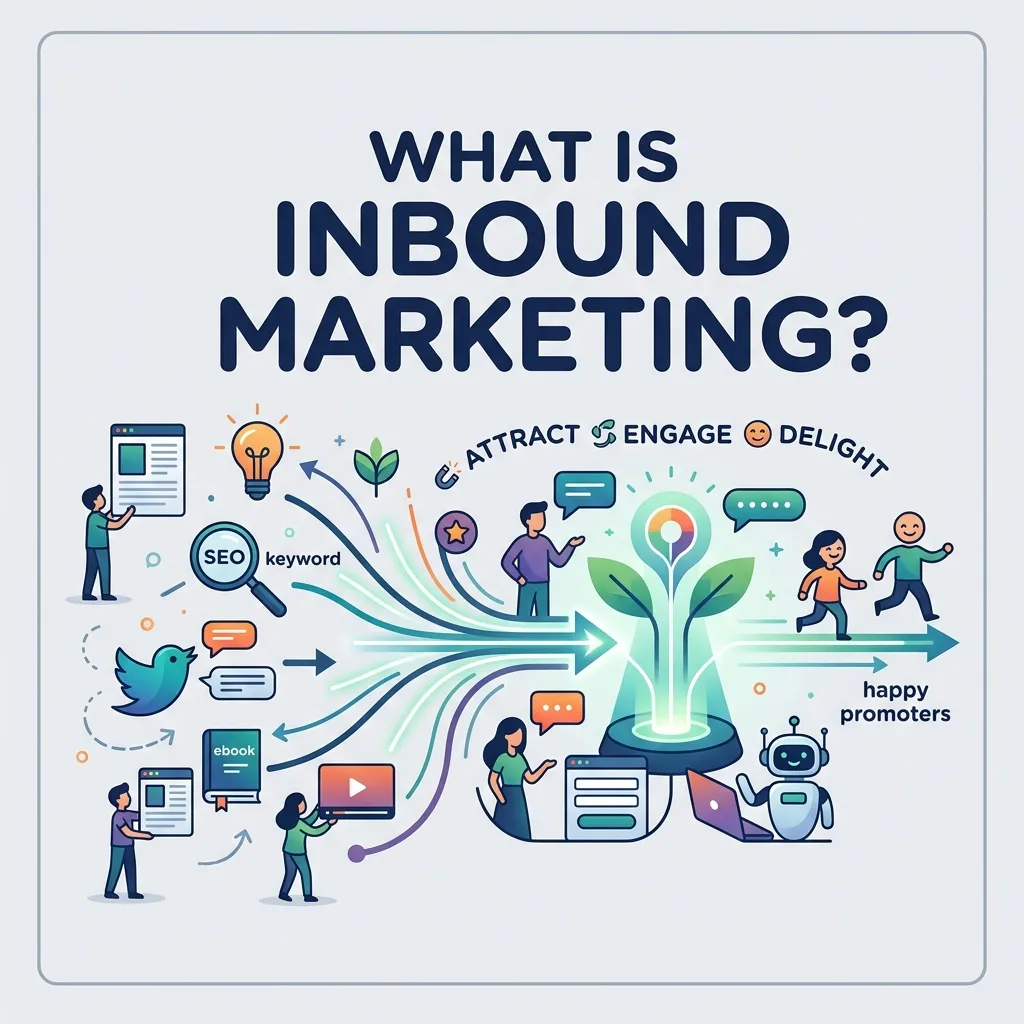
Inbound marketing is a customer-centric approach that focuses on attracting people to your brand by providing content and experiences they actually want. Instead of chasing prospects, you create something valuable enough that they come looking for you.
Common inbound marketing channels include:
- Search engine optimization (SEO) — ranking on Google for the questions your audience is already asking
- Blogging and content marketing — guides, tutorials, and articles that solve real problems
- Social media marketing — organic posts, community building, and engagement
- Email newsletters — nurturing people who have opted in
- Video and podcasts — educational or entertaining content that builds trust over time
The logic behind inbound marketing follows a simple loop: attract strangers with helpful content, convert them into leads, close them into customers, and delight them so they become advocates. This is why inbound marketing pairs so closely with a well-mapped marketing funnel and a clear understanding of core digital marketing metrics, since every stage of the loop needs to be measured to know what is actually working.
Because inbound marketing relies on organic discovery, it usually takes longer to build momentum than a paid campaign. But once a piece of content ranks or a community forms around your brand, it tends to keep generating leads with very little ongoing spend — which is exactly why so many businesses treat inbound as a long-term asset rather than a short-term campaign.
What Is Outbound Marketing?
Outbound marketing, sometimes called traditional marketing, is the more direct, interruption-based approach. Instead of waiting for people to find you, you push your message out to a broad or targeted audience.
Common outbound marketing tactics include:
- Paid advertising — search ads, display ads, social media ads, and programmatic ads
- Cold calling and cold emailing — direct outreach to prospects who have not engaged with you yet
- Direct mail — physical mailers, brochures, and catalogs
- TV, radio, and print ads — mass-market advertising
- Trade shows and sponsorships — buying visibility at events
Outbound marketing shines when you need visibility fast. A well-targeted ad campaign can put your brand in front of thousands of relevant people within hours, which makes it useful for product launches, seasonal promotions, or filling a sales pipeline quickly. It is also easier to test at a small scale before scaling spend up, since most paid channels let you set a fixed budget and measure results almost immediately.
The tradeoff is that outbound results usually stop the moment you stop paying, and audiences have grown increasingly skilled at tuning out ads and ignoring cold outreach — which is part of why outbound campaigns need constant creative refreshes to stay effective.
Inbound Marketing vs Outbound Marketing: Key Differences
| Factor | Inbound Marketing | Outbound Marketing |
|---|---|---|
| Approach | Attracts the audience | Interrupts the audience |
| Cost over time | Lower long-term cost, higher upfront effort | Ongoing spend required |
| Speed of results | Slow to build, compounds over time | Fast, but temporary |
| Targeting | Self-selected, high intent | Demographic or interest-based |
| Trust building | High — audience chooses to engage | Lower — audience did not ask for it |
| Examples | SEO, blogs, social media, email | Ads, cold calls, direct mail, TV |
| Measurability | Strong with the right analytics setup | Generally easy to track spend-to-result |
Understanding these differences is much easier once you have clear digital marketing objectives in place, because the “right” answer often depends on what you are actually optimizing for: brand awareness, immediate sales, or long-term lead generation. It also helps to have a firm grasp of core digital marketing metrics so you can judge each channel by the same yardstick.
Advantages and Disadvantages of Inbound Marketing
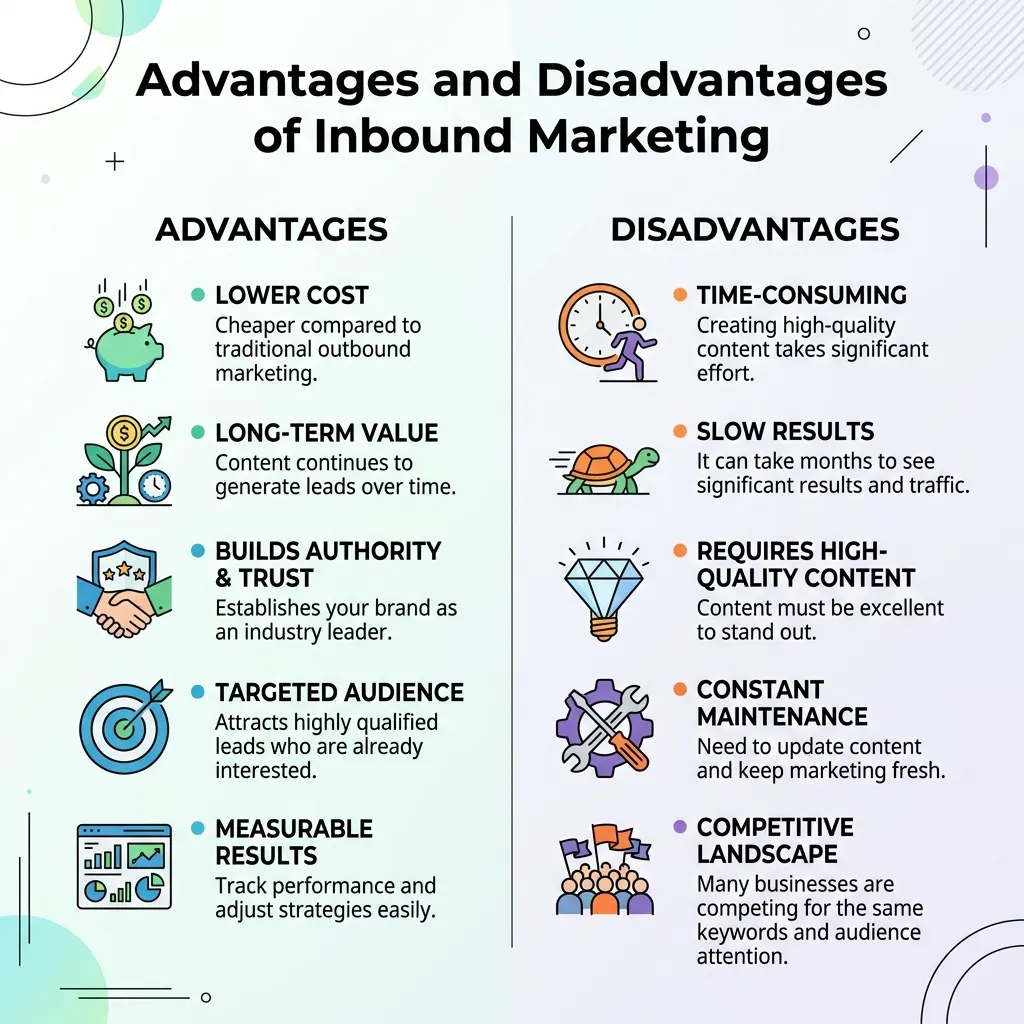
Advantages:
- Builds long-term organic traffic that does not disappear when you pause spending
- Establishes authority and trust with your audience
- Tends to produce higher-quality, better-qualified leads
- More cost-efficient over a longer time horizon
Disadvantages:
- Takes months to show meaningful results
- Requires consistent content production and SEO work
- Harder to predict exact timelines for ranking or traffic growth
- Needs ongoing competitor analysis to stay ahead in search results
Advantages and Disadvantages of Outbound Marketing
Advantages:
- Delivers fast visibility and quick pipeline generation
- Easy to control reach through budget and targeting
- Works well for time-sensitive promotions or launches
- Simple to A/B test creative and messaging
Disadvantages:
- Costs stop producing results the moment spending stops
- Audiences are increasingly skilled at ignoring ads and cold outreach
- Can feel intrusive, which may hurt brand perception
- Generally has a higher customer acquisition cost over time
Inbound vs Outbound Marketing: Cost Comparison
Cost is usually where the inbound marketing vs outbound marketing conversation gets the most attention. According to benchmark data from the Content Marketing Institute, content marketing generates roughly three times more leads at around 62% lower cost than traditional outbound channels. That gap has widened in recent years as paid advertising costs continue to climb and AI tools make content production more efficient.
That said, outbound is not “wasted” money. It is simply a different kind of investment — you are paying for speed and predictability rather than compounding, long-term reach. This is why tracking customer acquisition cost side by side with your return on ad spend matters so much: it tells you exactly where your budget is working hardest, channel by channel.
When to Use Inbound Marketing
Inbound marketing tends to work best when:
- You are building a long-term brand and can invest months into content and SEO
- Your product has a longer sales cycle that benefits from education and trust-building
- You want to lower your cost per lead over time
- Your audience actively searches for solutions to their problems online
A solid starting point is thorough market research so you know exactly which questions your audience is asking and which content gaps your competitors have left open.
When to Use Outbound Marketing
Outbound marketing tends to work best when:
- You need leads or sales quickly, such as during a product launch
- You have a well-defined target audience that is easy to reach through ads or lists
- Your budget allows for ongoing ad spend
- You are entering a new market where nobody knows your brand yet and organic discovery would take too long
Can You Combine Inbound and Outbound Marketing?
Yes — and most successful brands do exactly this. A hybrid strategy typically uses outbound channels to generate quick wins and immediate pipeline while inbound assets mature in the background. For example, a company might run paid search ads to drive traffic today while simultaneously publishing SEO content that will rank organically six months from now.
Combining both approaches also gives you more complete performance data, since you can compare cost, lead quality, and conversion rates across digital marketing channels using the same dashboard and reporting structure. Over time, many teams shift budget away from outbound and toward inbound as their organic content library grows and starts carrying more of the lead-generation load on its own.
Real-World Examples
- A SaaS company might use outbound cold email outreach to book demos with enterprise prospects while building an inbound library of comparison guides and tutorials that rank for bottom-of-funnel search terms.
- An e-commerce brand might run outbound paid social ads for a seasonal sale while growing an inbound email list through blog content and lead magnets.
- A financial services firm might sponsor an industry event (outbound) while publishing educational content that nurtures leads long after the event ends (inbound).
How to Choose the Right Strategy for Your Business
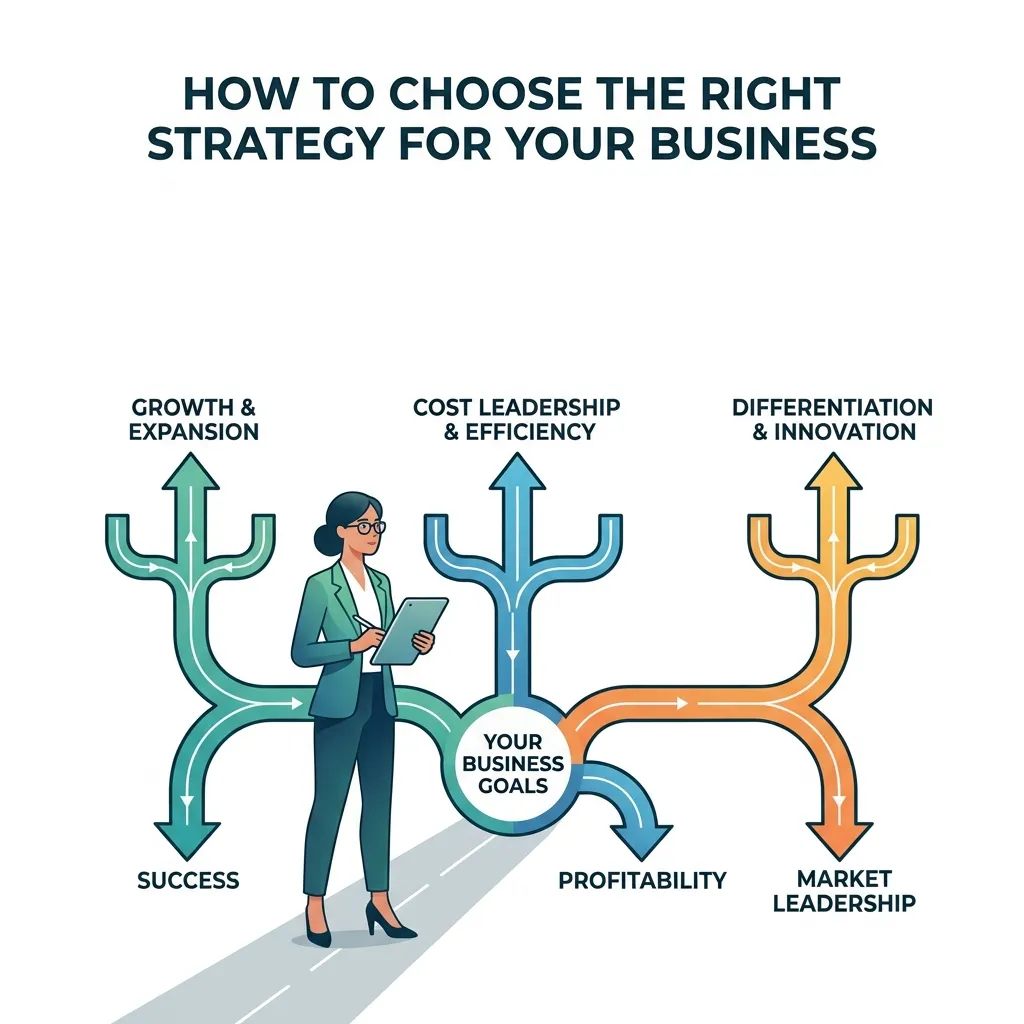
Ask yourself these questions before deciding where to focus your budget:
- How fast do I need results?
- What is my available budget, and can I sustain ongoing ad spend?
- How long is my typical sales cycle?
- Does my audience actively search for what I offer, or do I need to create demand?
- Do I have the resources to produce consistent, high-quality content?
Most businesses find that starting with a documented digital marketing strategy that blends both channels — with clear KPIs for each — produces the most balanced, sustainable results.
Conclusion
The inbound marketing vs outbound marketing debate is not really about picking a winner. Inbound marketing earns attention through content, SEO, and trust, while outbound marketing buys attention through ads and direct outreach. Inbound tends to be more cost-efficient over time and builds a compounding asset, while outbound delivers speed and predictability when you need results now.
The smartest approach for most businesses in 2026 is not choosing one over the other, but sequencing them well: use outbound to generate momentum today, and invest in inbound so that momentum keeps growing long after the ad budget runs out.
Frequently Asked Questions About Inbound vs Outbound Marketing
1. What Is the Main Difference Between Inbound and Outbound Marketing?
Inbound marketing attracts customers through valuable content they seek out, while outbound marketing pushes messages to audiences through ads, calls, or direct mail, whether they asked for it or not.
2. Which Is More Cost-Effective, Inbound or Outbound Marketing?
Inbound marketing is generally more cost-effective over the long run because content and SEO assets can keep generating traffic without ongoing ad spend, while outbound results typically stop once you stop paying.
3. Is Outbound Marketing Still Effective in 2026?
Yes. Outbound marketing remains effective for fast visibility, product launches, and reaching audiences who are not yet searching for your solution, especially when paired with precise targeting.
4. Can a Small Business Use Both Inbound and Outbound Marketing?
Absolutely. Many small businesses use light outbound campaigns to generate early traction while building an inbound content and SEO foundation for long-term growth.
5. How Long Does Inbound Marketing Take to Show Results?
Inbound marketing typically takes three to six months or longer to show meaningful traffic and lead growth because it depends on search rankings, content visibility, and audience trust building over time.
6. Is SEO Part of Inbound or Outbound Marketing?
SEO is a core inbound marketing tactic because it focuses on attracting organic traffic from people already searching for relevant answers, products, or services.
7. What Is an Example of Outbound Marketing?
Common examples include cold calling, paid social ads, direct mail campaigns, TV commercials, and trade show sponsorships.
8. Does Inbound Marketing Work for B2B Companies?
Yes, inbound marketing works particularly well for B2B companies because buyers typically research extensively online before speaking to sales representatives.
9. Which Strategy Generates Higher-Quality Leads?
Inbound marketing often produces higher-quality leads because prospects usually have existing intent and interest rather than being interrupted while doing something else.
10. How Do You Measure Inbound vs Outbound Marketing Success?
Both strategies should be measured using consistent metrics such as customer acquisition cost, conversion rate, and return on investment so you can compare performance across channels fairly.
11. Should Startups Focus on Inbound or Outbound Marketing First?
Startups often use outbound marketing to generate quick feedback and initial customers while building their inbound foundation. As they learn what messaging and content resonates, they can adjust their channel mix accordingly.
12. What Industries Benefit Most From Inbound Marketing?
Industries with longer research and sales cycles, such as SaaS, financial services, healthcare, and B2B services, can benefit from a strong inbound marketing strategy.
Further reading: HubSpot’s inbound marketing methodology offers a deeper look at the attract-engage-delight framework, and the Content Marketing Institute publishes annual benchmark research on content and inbound performance.



Leave a Reply