

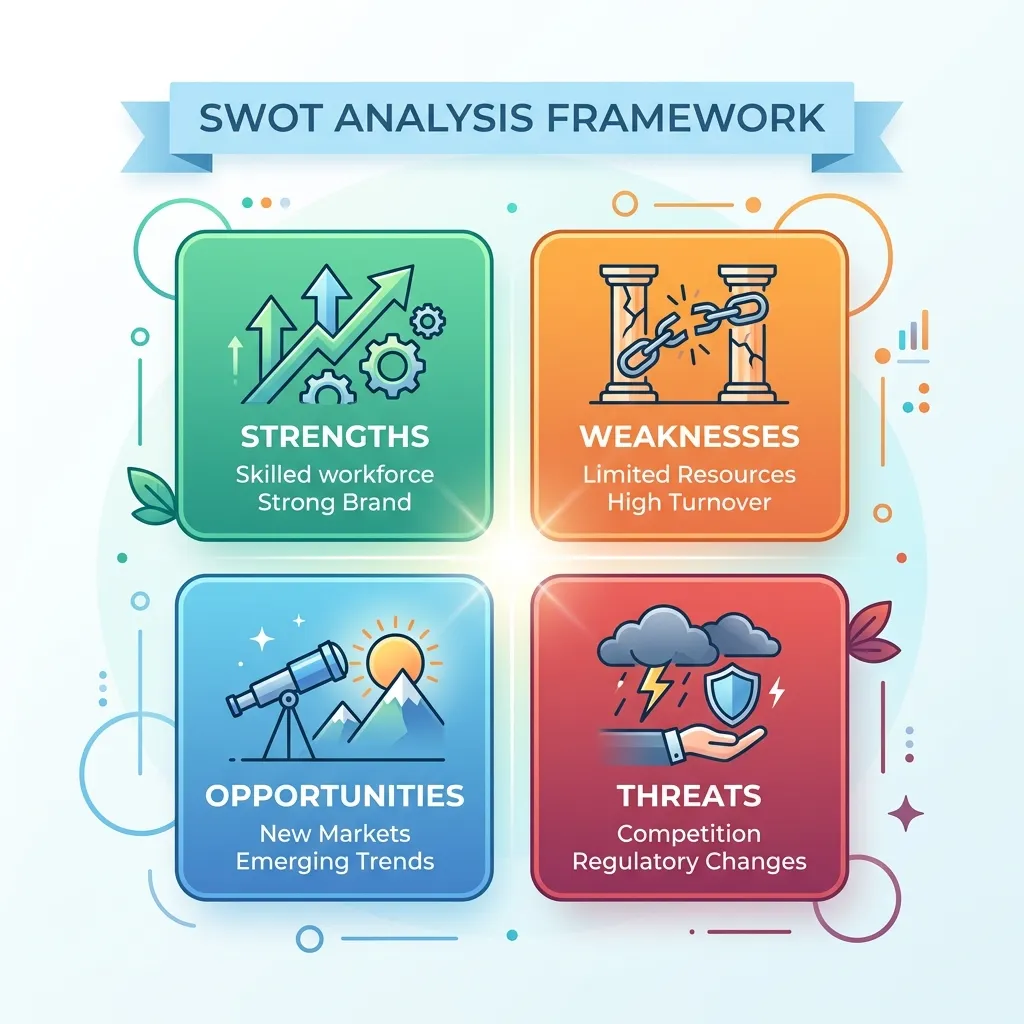
The components of SWOT analysis — Strengths, Weaknesses, Opportunities, and Threats — form the backbone of one of the most widely used strategic planning frameworks in business. This guide breaks down each of the four components of SWOT analysis, explains how internal and external factors shape strategy, and shows you exactly how to apply the components of SWOT analysis to your own business or marketing plan.
Every successful business decision starts with a clear understanding of where a company stands — and that’s exactly what the components of SWOT analysis are designed to reveal. Whether you’re launching a startup, planning a marketing campaign, or evaluating a new product line, breaking your situation down into the four components of SWOT analysis gives you a structured way to think about internal capabilities and external realities at the same time.
In this guide, we’ll walk through each of the components of SWOT analysis in detail, explain how they connect to one another, and show you practical ways to apply them. If you’re new to the framework itself, our complete guide to what SWOT analysis is is a great place to start before diving into the individual components.
What Is SWOT Analysis? A Quick Recap
SWOT is an acronym that stands for Strengths, Weaknesses, Opportunities, and Threats. Together, these four components of SWOT analysis create a simple two-by-two grid: Strengths and Weaknesses sit on the internal side (factors within your control), while Opportunities and Threats sit on the external side (factors shaped by the market, competitors, and environment around you).
According to Wikipedia, the framework was developed to help organizations identify internal and external factors that are favorable or unfavorable to achieving an objective. That balance between internal and external thinking is what makes the components of SWOT analysis so useful — they force you to look both inward and outward before making a decision.
The Four Core Components of SWOT Analysis
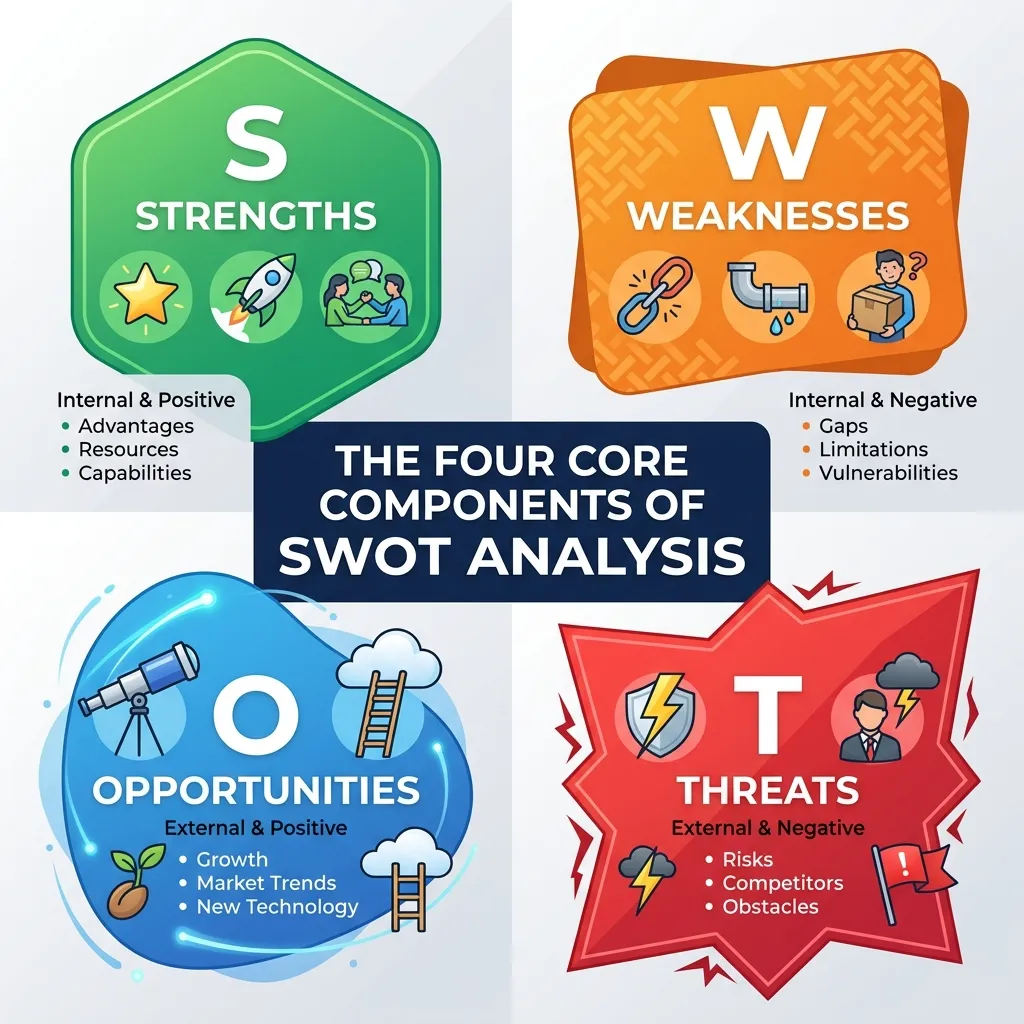
Let’s break down each of the four components of SWOT analysis individually, since understanding them in isolation makes it much easier to combine them into a full strategy later.
1. Strengths
Strengths are the internal components of SWOT analysis that give your business a competitive edge. These are the things you do well, the resources you own, and the advantages that set you apart from competitors. Common examples include:
- A strong brand reputation
- Skilled and experienced staff
- Proprietary technology or patents
- A loyal customer base
- Efficient internal processes
When identifying this component, ask yourself: what do we do better than anyone else in our space? What resources do we have that competitors don’t?
2. Weaknesses
Weaknesses are the other internal component of SWOT analysis, and they represent areas where your business falls short. Being honest about weaknesses is often harder than listing strengths, but it’s just as important for a realistic strategy. Typical weaknesses include:
- Limited budget or cash flow
- Gaps in skills or staffing
- Outdated technology or systems
- Weak brand awareness
- Inefficient internal workflows
A good exercise for this component is to review customer complaints, employee feedback, and performance data to surface weaknesses you might otherwise overlook.
3. Opportunities
Opportunities are the first of the two external components of SWOT analysis. They represent trends, gaps, or changes in the market that your business could take advantage of. Examples include:
- Emerging market trends
- Changes in consumer behavior
- New technology adoption
- Weaknesses in a competitor’s offering
- Regulatory changes that open new markets
Understanding this component often requires solid market research so you can spot opportunities before your competitors do.
4. Threats
Threats are the final external component of SWOT analysis, covering anything outside your control that could negatively affect your business. Common threats include:
- New or aggressive competitors
- Economic downturns
- Rising costs of materials or labor
- Changing regulations
- Shifts in customer preferences
This component works closely with competitor analysis, since many threats come directly from what rival companies are doing in your market.
Internal vs External Components of SWOT Analysis
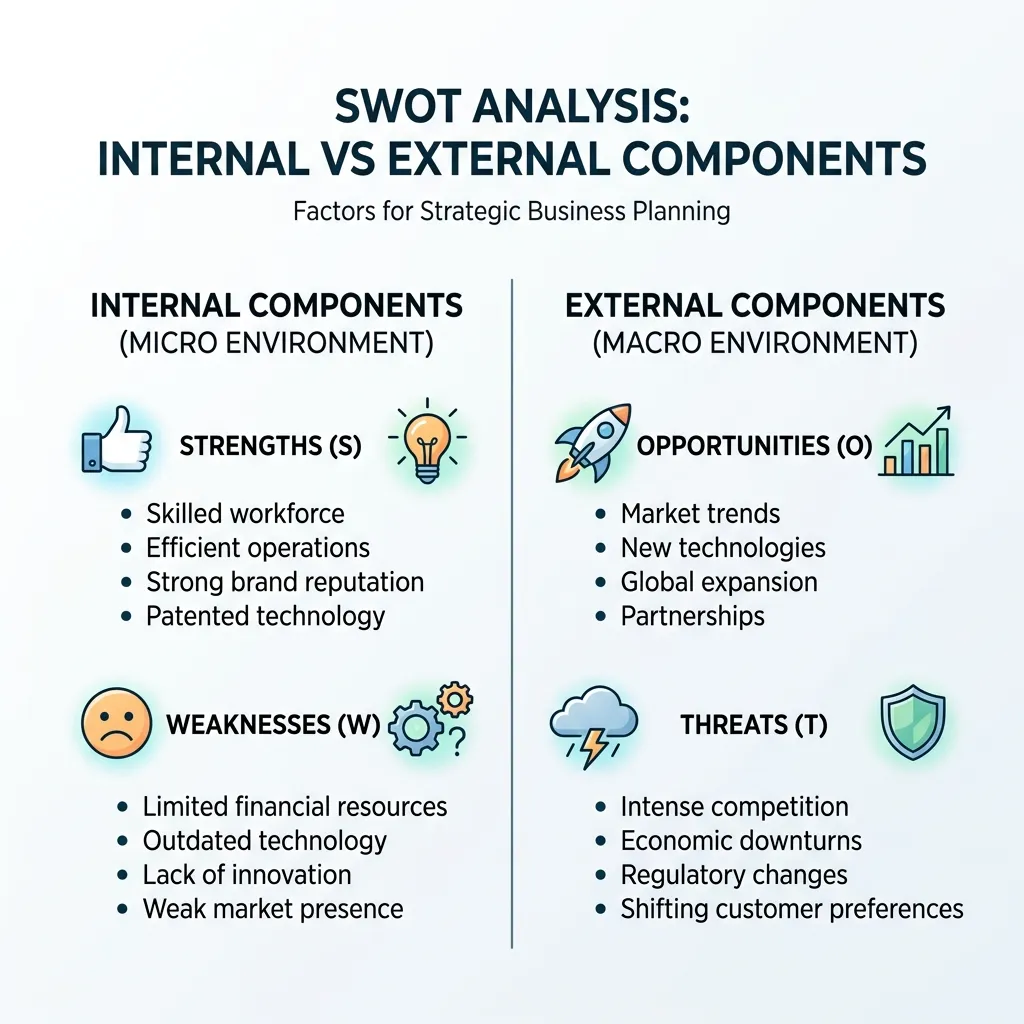
One of the most important things to understand about the components of SWOT analysis is the internal-external divide. Strengths and Weaknesses are internal — they describe your organization itself and are generally within your control to change over time. Opportunities and Threats are external — they come from the market, economy, competitors, and broader environment, and are largely outside your direct control.
This distinction matters because it changes how you respond to each component. Internal components can be improved through training, investment, or process changes. External components require you to adapt, position yourself defensively, or move quickly to capture an advantage before it disappears.
Why Each Component of SWOT Analysis Matters
Each of the four components of SWOT analysis plays a distinct role in shaping strategy:
- Strengths tell you what to build on and promote.
- Weaknesses tell you what to fix or work around.
- Opportunities tell you where to grow.
- Threats tell you what to guard against.
Skipping any single component of SWOT analysis leaves a blind spot in your strategy. A business that only focuses on strengths and opportunities, for example, may be caught off guard by a threat it never planned for.
SWOT Analysis Components in Digital Marketing
The components of SWOT analysis aren’t limited to overall business strategy — they’re just as useful in a marketing context. For instance, a strong social media following could be a strength, an outdated website could be a weakness, a rising platform like short-form video could be an opportunity, and a competitor’s aggressive ad spend could be a threat. Our detailed breakdown of SWOT analysis in digital marketing explores this application further, including how the components tie into broader digital marketing objectives.
How to Identify Each Component of SWOT Analysis
Here’s a practical process for working through the components of SWOT analysis:
- Gather your team — different departments often see different strengths and weaknesses.
- Review data — sales figures, customer feedback, and website analytics reveal patterns you might miss.
- Study the market — competitor moves and industry trends help surface opportunities and threats.
- List honestly — don’t inflate strengths or downplay weaknesses.
- Prioritize — not every item carries equal weight; rank each component by potential impact.
Running a full digital marketing audit alongside this process can surface additional internal weaknesses and external opportunities that a quick brainstorm might miss.
Common Mistakes When Analyzing the Components of SWOT Analysis
Even experienced teams make mistakes when working through the components of SWOT analysis:
- Confusing internal and external factors — for example, listing “increased competition” as a weakness instead of a threat.
- Being too vague — “we have good marketing” isn’t actionable; “we have a 40% higher email open rate than the industry average” is.
- Ignoring weaknesses — teams often gloss over weaknesses to avoid uncomfortable conversations.
- Treating it as a one-time exercise — the components of SWOT analysis shift as markets change, so it should be revisited regularly.
- Skipping prioritization — listing everything without ranking importance makes the analysis hard to act on.
Tools That Help You Map the Components of SWOT Analysis
While a simple four-quadrant grid on paper works fine, several digital marketing tools can make the process faster and more data-driven — from analytics platforms that reveal weaknesses in website performance to social listening tools that surface emerging opportunities and threats in real time.
SWOT vs Competitor Analysis: How the Components Connect
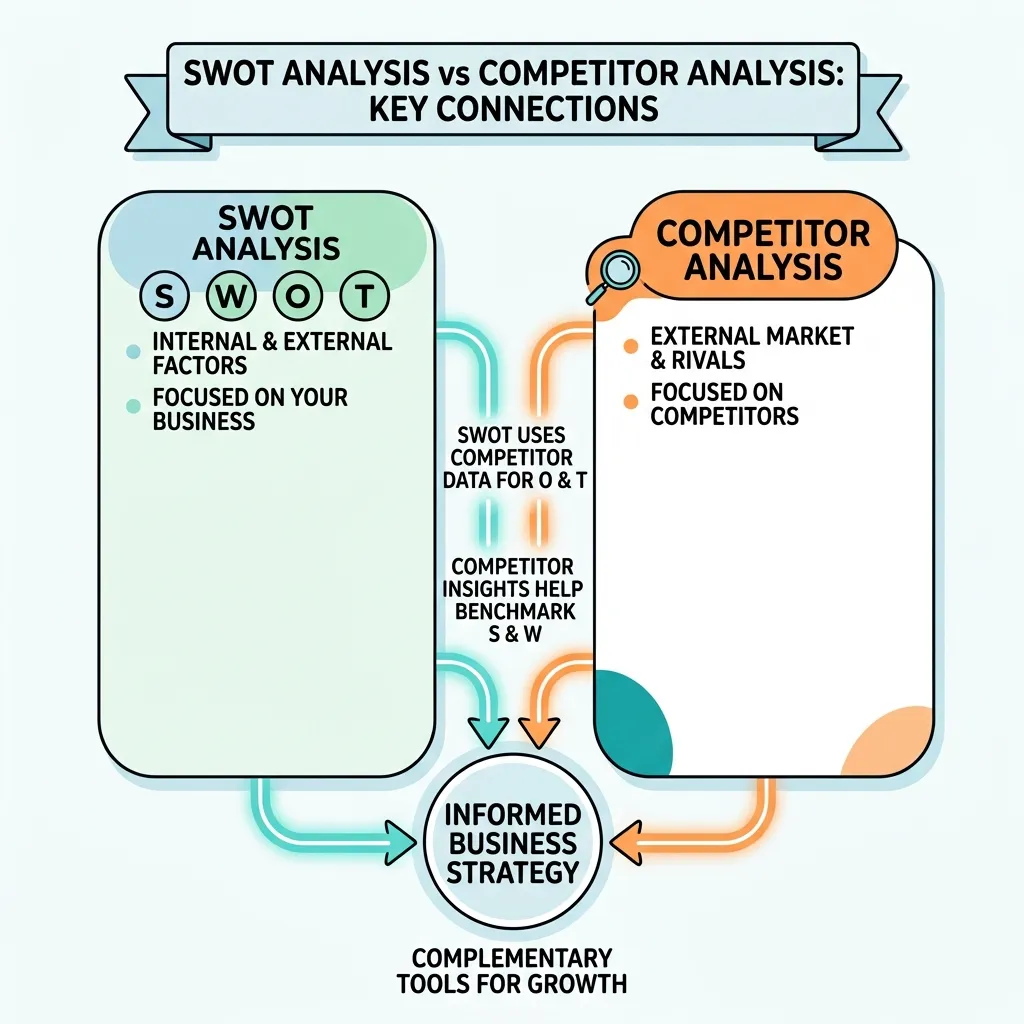
It’s worth noting how the components of SWOT analysis relate to competitor analysis. While competitor analysis focuses specifically on what rivals are doing, its findings feed directly into two components of SWOT analysis: opportunities (gaps competitors leave open) and threats (advantages competitors hold over you). Running both analyses together gives you a much fuller strategic picture than either one alone.
A Step-by-Step Example
Imagine a small e-commerce brand working through the components of SWOT analysis:
- Strength: A highly engaged Instagram following of 50,000 people.
- Weakness: Slow website load times causing cart abandonment.
- Opportunity: Growing consumer interest in sustainable packaging.
- Threat: A larger competitor entering the same product category.
From here, the brand can build a strategy: use its social strength to promote a new sustainable packaging line (capturing the opportunity), while fixing site speed (addressing the weakness) to reduce the impact of increased competition (the threat).
Key Takeaways on the Components of SWOT Analysis
Before wrapping up, here’s a quick recap of the components of SWOT analysis and why each one matters:
- The components of SWOT analysis are Strengths, Weaknesses, Opportunities, and Threats.
- Strengths and Weaknesses are internal components of SWOT analysis, meaning they describe your organization itself.
- Opportunities and Threats are external components of SWOT analysis, shaped by the market around you.
- Reviewing all four components of SWOT analysis together — rather than in isolation — is what turns the exercise into an actionable strategy.
- The components of SWOT analysis should be revisited regularly, since strengths can fade and new threats can emerge as the market shifts.
Keeping these components of SWOT analysis front and center whenever you plan a new campaign, product launch, or business decision will help you avoid strategic blind spots.
Conclusion
The four components of SWOT analysis — Strengths, Weaknesses, Opportunities, and Threats — remain one of the simplest yet most powerful ways to evaluate a business or marketing strategy. By separating internal factors from external ones and reviewing all four components together, you get a balanced, realistic view of where you stand and where you can grow. Whether you’re building a full business plan or refining a single marketing campaign, revisiting the components of SWOT analysis regularly will keep your strategy grounded in reality rather than guesswork.
Frequently Asked Questions (FAQs)
1. What are the four main components of SWOT analysis?
The four main components of SWOT analysis are Strengths, Weaknesses, Opportunities, and Threats. Strengths and Weaknesses are internal factors, while Opportunities and Threats are external factors.
2. Which components of SWOT analysis are internal?
Strengths and Weaknesses are the internal components of SWOT analysis, since they describe factors within the organization’s direct control.
3. Which components of SWOT analysis are external?
Opportunities and Threats are the external components of SWOT analysis, shaped by the market, competitors, and broader environment rather than the organization itself.
4. Why is it important to separate internal and external components of SWOT analysis?
Separating them helps you respond appropriately — internal components can often be changed directly, while external components usually require adaptation or timing rather than direct control.
5. Can a factor be both a strength and a weakness?
Not at the same time, but a factor can shift categories over time. For example, a large workforce might be a strength during growth but become a weakness if it leads to high fixed costs during a downturn.
6. How often should I update the components of SWOT analysis?
Most businesses benefit from revisiting the components of SWOT analysis at least once or twice a year, or whenever a major market shift, product launch, or new competitor appears.
7. What’s the difference between opportunities and strengths?
Strengths are things your business already has or does well internally, while opportunities are external conditions in the market that you could take advantage of.
8. How do threats differ from weaknesses?
Weaknesses are internal shortcomings you can work to fix, while threats are external risks largely outside your control that you need to plan around or defend against.
9. Do all four components of SWOT analysis carry equal weight?
Not necessarily. Depending on your industry and goals, some components may deserve more attention than others, which is why prioritizing items within each component matters.
10. Can SWOT analysis components be used for personal career planning?
Yes. Many professionals apply the same four components — personal strengths, weaknesses, career opportunities, and job market threats — to plan career moves.
11. How does competitor analysis relate to the components of SWOT analysis?
Competitor analysis often reveals opportunities (gaps competitors haven’t filled) and threats (advantages competitors hold), making it a useful input for two of the four components.
12. What’s a common mistake people make with the components of SWOT analysis?
A common mistake is confusing internal and external factors, such as listing a competitor’s action as a weakness instead of correctly categorizing it as a threat.



Leave a Reply