

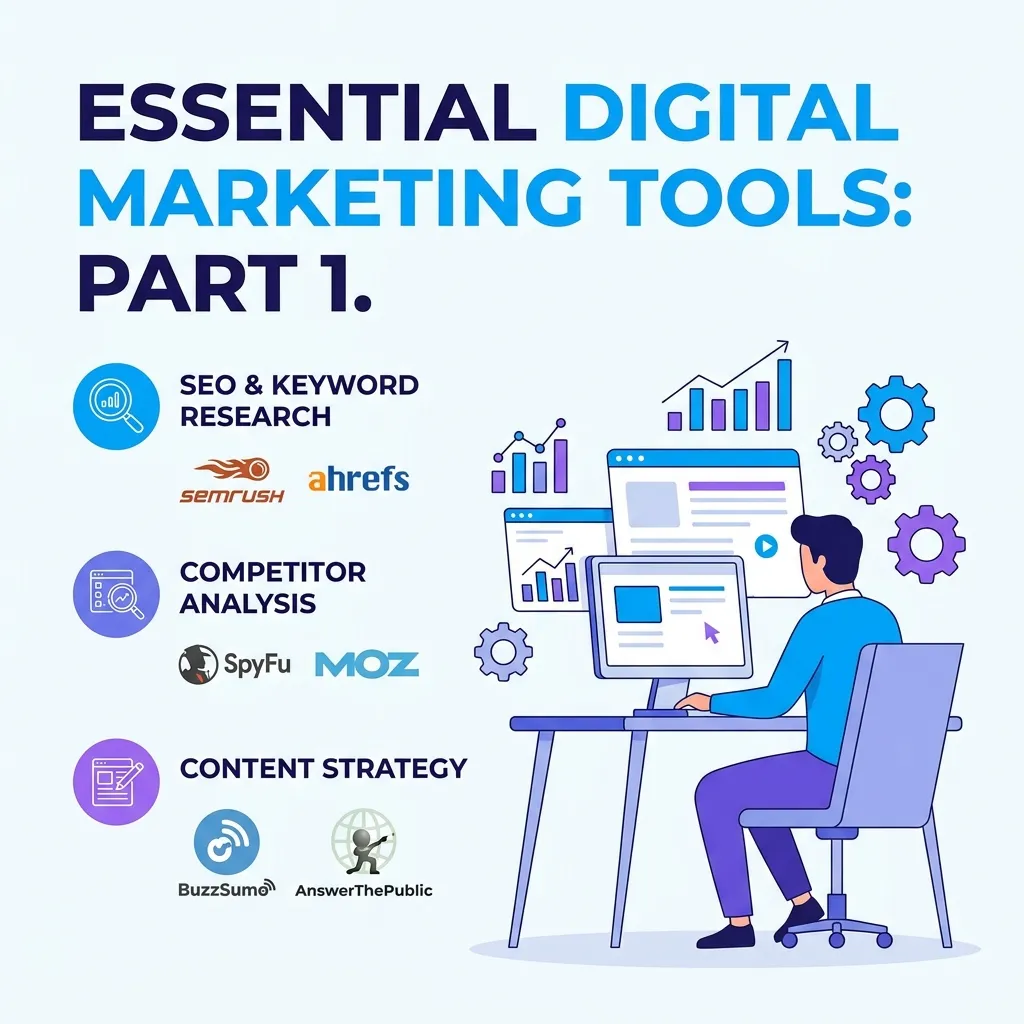
The best digital marketing tools help businesses research keywords, analyze website traffic, manage social media, create content, automate campaigns, track conversions, and measure ROI. From Google Analytics and Search Console to Semrush, HubSpot, Canva, and Mailchimp, the right tools can make digital marketing faster, more measurable, and easier to scale.
Digital marketing involves many moving parts, including SEO, content creation, social media, email campaigns, paid advertising, analytics, and customer relationship management. Managing all these activities manually can consume significant time and make it difficult to understand what is actually producing results. This is where the best digital marketing tools become valuable.
The right tools can help marketers discover profitable keywords, monitor website performance, understand customer behavior, create engaging content, automate repetitive tasks, and measure campaign performance. However, you do not need dozens of platforms to build an effective marketing stack. The goal is to choose tools that match your objectives, budget, team size, and marketing channels.
This guide explores the best digital marketing tools for different areas of online marketing and explains what each tool can help you accomplish.
What Are Digital Marketing Tools?
Digital marketing tools are software platforms, applications, and services designed to help businesses plan, execute, automate, analyze, and improve their online marketing activities.
Depending on their purpose, these tools can support:
- Search engine optimization
- Keyword research
- Website analytics
- Content marketing
- Social media management
- Email marketing
- Marketing automation
- Paid advertising
- Conversion optimization
- Customer relationship management
- Graphic and video creation
- Competitor research
- Reporting and performance tracking
Instead of relying on one platform for everything, many marketers create a marketing technology stack consisting of several specialized tools.
For example, a business might use Google Analytics for website analytics, Search Console for search performance, Semrush for SEO research, Canva for visual content, and HubSpot for CRM and marketing automation.
Why Do You Need Digital Marketing Tools?
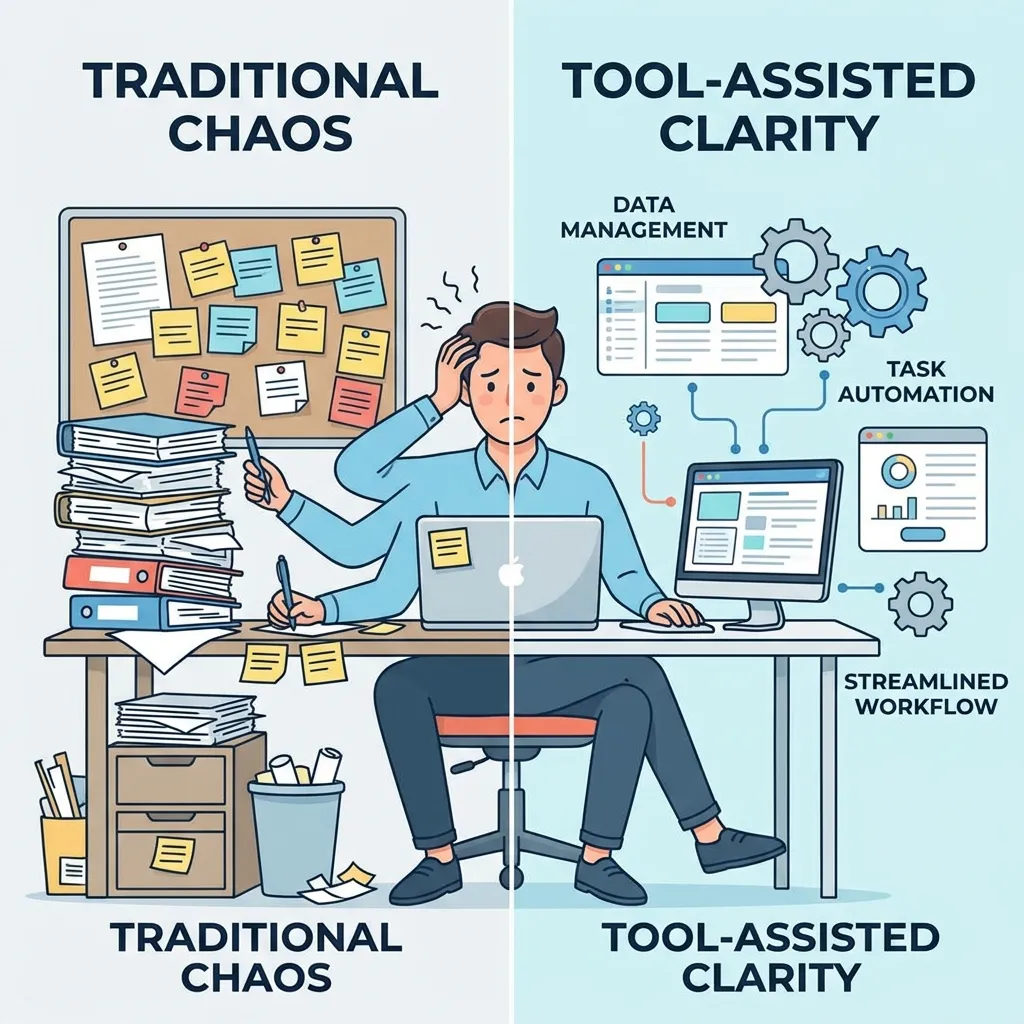
Choosing the right tools can significantly improve the efficiency and accuracy of your marketing campaigns.
1. Save Time
Automation eliminates many repetitive tasks. Scheduling social posts, sending email sequences, generating reports, and monitoring rankings can all be streamlined with the right software.
2. Make Better Decisions
Marketing tools provide data that can reveal which channels, campaigns, keywords, and content are producing results. Instead of making decisions based only on assumptions, marketers can use measurable evidence.
3. Improve SEO Performance
SEO platforms can identify keyword opportunities, technical issues, backlinks, ranking changes, and competitor strategies.
For example, Semrush provides keyword research capabilities, competitor analysis, position tracking, and other SEO functions that can support an organic search strategy.
4. Understand Your Audience
Analytics and CRM platforms help businesses understand how users interact with websites, campaigns, emails, and products.
5. Measure Marketing ROI
A good marketing tool should help connect activities with meaningful outcomes such as leads, sales, conversions, revenue, and customer retention.
If you are building a measurement framework, you can also explore this guide to digital marketing performance metrics and KPIs.
Best Digital Marketing Tools for SEO
SEO requires research, optimization, monitoring, and continuous improvement. The following platforms are among the most useful options.
1. Semrush
Semrush is an all-in-one SEO and digital marketing platform used for keyword research, competitor analysis, backlink research, site audits, rank tracking, and content optimization.
Its keyword research tools can help marketers identify search terms, evaluate competition, analyze ranking pages, and discover opportunities.
Best for: SEO professionals, agencies, content marketers, and businesses conducting competitor research.
2. Ahrefs
Ahrefs is particularly well known for SEO research, backlink analysis, keyword research, competitor analysis, and site auditing.
Its backlink database makes it useful when marketers want to understand which websites are linking to competitors and identify potential link-building opportunities.
Best for: SEO specialists and businesses focused heavily on organic search growth.
3. Google Search Console
Google Search Console is an essential tool for website owners and SEO professionals. It helps monitor how a website performs in Google Search and can provide valuable information about search queries, indexing, pages, and search visibility.
It is especially useful because it provides first-party search performance information directly from Google.
Best for: Every website owner and SEO professional.
4. Google Keyword Planner
Google Keyword Planner is primarily designed for Google Ads keyword research, but it can also provide useful insights into keyword ideas, search demand, and advertising competition.
Best for: PPC marketers, advertisers, and businesses researching search terms.
Best Digital Marketing Tools for Analytics
Analytics tools allow marketers to understand what visitors do after reaching a website.
5. Google Analytics
Google Analytics is one of the most widely used website analytics platforms. It helps marketers understand traffic sources, user behavior, conversions, engagement, and customer journeys.
Google describes Analytics as a way to understand how users come to and interact with a website and to improve marketing ROI through data and reporting.
Best for: Website analytics, conversion tracking, campaign measurement, and performance analysis.
6. Looker Studio
Looker Studio can transform data from different sources into customizable reports and dashboards.
Marketers can use dashboards to monitor traffic, leads, conversions, advertising performance, and other important KPIs in one place.
Best for: Marketing reporting and data visualization.
7. Microsoft Clarity
Microsoft Clarity provides behavioral insights such as session recordings and heatmaps. These insights can help marketers understand where users click, scroll, hesitate, or leave a page.
Best for: User experience analysis and conversion optimization.
Best Digital Marketing Tools for Content Marketing
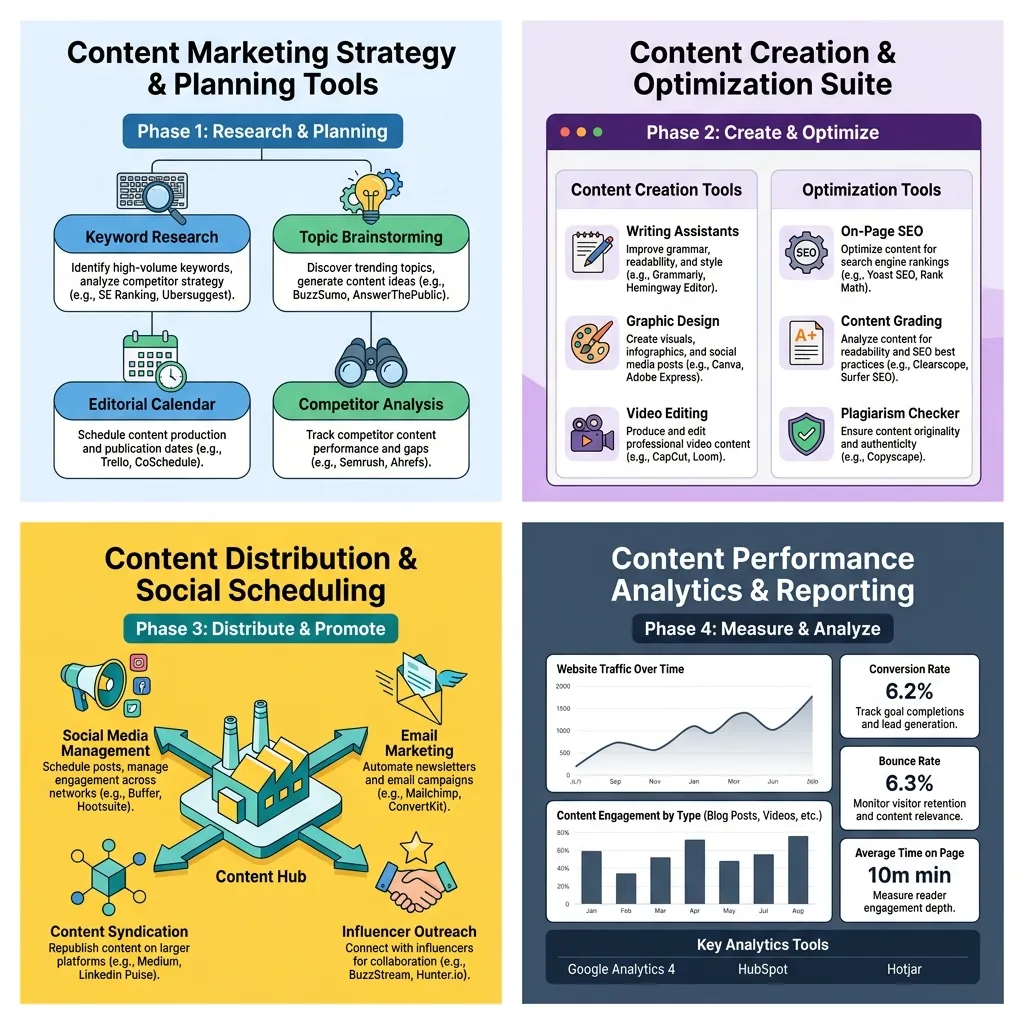
Content marketing requires research, writing, editing, design, distribution, and measurement.
8. Canva
Canva is a popular visual design platform that helps marketers create social media graphics, presentations, infographics, advertisements, thumbnails, and other marketing assets.
Its templates make visual content creation accessible even for people without professional graphic design experience.
Best for: Social media graphics, blog visuals, presentations, and promotional designs.
9. Grammarly
Grammarly helps writers identify grammar, spelling, punctuation, clarity, and style issues.
It can be useful when creating blog posts, landing pages, emails, advertisements, and social media content.
Best for: Editing and improving written marketing content.
10. ChatGPT
AI assistants can support marketers with brainstorming, content outlines, keyword clustering, ad copy ideas, email drafts, social media concepts, and research assistance.
However, AI-generated content should be reviewed and improved by humans. Marketers should verify facts, add original insights, maintain brand consistency, and ensure that the final content genuinely helps the audience.
Best for: Content ideation, research assistance, copywriting support, and marketing workflows.
If you want to explore AI’s role in marketing further, see this guide on AI-powered digital marketing strategies.
Best Digital Marketing Tools for Social Media
Social media marketing can become difficult to manage when a business operates across several platforms.
11. Hootsuite
Hootsuite allows marketers to manage and schedule social media content from a centralized platform.
It can help teams plan content calendars, monitor social activity, and manage multiple accounts.
Best for: Social media scheduling and management.
12. Buffer
Buffer is another popular social media management platform. It focuses on publishing, scheduling, and managing social content across multiple networks.
Best for: Small businesses, creators, and marketing teams looking for straightforward social scheduling.
13. Meta Business Suite
Meta Business Suite helps businesses manage Facebook and Instagram marketing activities from a centralized environment.
It can be useful for publishing content, managing messages, reviewing insights, and handling business-related social activity.
Best for: Businesses heavily focused on Facebook and Instagram.
Best Digital Marketing Tools for Email Marketing
Email remains an important channel for nurturing leads, retaining customers, and communicating with subscribers.
14. Mailchimp
Mailchimp provides tools for email campaigns, audience management, automation, and campaign analytics.
It can be useful for businesses that want to build email lists and communicate with subscribers through newsletters and automated campaigns.
Best for: Small businesses, newsletters, and email campaigns.
15. HubSpot
HubSpot combines marketing, sales, customer service, CRM, automation, and analytics capabilities.
Its marketing tools include email marketing, automation, social media management, analytics, SEO recommendations, lead management, and other functions.
Best for: Businesses that want CRM, marketing automation, lead management, and analytics in a connected platform.
Best Digital Marketing Tools for Paid Advertising
Paid advertising requires campaign management, keyword research, audience targeting, conversion tracking, and performance analysis.
16. Google Ads
Google Ads allows businesses to advertise across Google’s search and advertising ecosystem.
Marketers can use it to target people based on search intent, interests, audiences, locations, and other campaign criteria.
Best for: Search advertising, lead generation, ecommerce, and performance marketing.
For a deeper understanding of paid search, read this guide on SEO vs. PPC.
17. Meta Ads Manager
Meta Ads Manager provides campaign management and advertising tools for Facebook and Instagram.
It can support different campaign objectives, audience targeting options, creative testing, and performance measurement.
Best for: Social advertising and audience-based campaigns.
Best Digital Marketing Tools for CRM and Automation
Customer relationship management becomes increasingly important as a business grows.
18. HubSpot CRM
HubSpot CRM helps businesses organize contacts, leads, customer interactions, sales activities, and marketing information in a centralized system.
This makes it easier for marketing and sales teams to understand where prospects are within the customer journey.
Best for: Lead management, CRM, sales alignment, and marketing automation.
19. Zapier
Zapier connects different applications and automates workflows between them.
For example, a company could create an automation that sends new website leads into a CRM, adds subscribers to an email list, or notifies a sales team when a new form is submitted.
Best for: Workflow automation and connecting marketing applications.
Best Digital Marketing Tools for Project Management
Marketing campaigns often involve writers, designers, SEO specialists, social media managers, developers, and clients.
20. Trello
Trello uses boards, lists, and cards to organize tasks and workflows.
It can be useful for editorial calendars, campaign planning, content production, and team collaboration.
Best for: Simple marketing project management.
21. Asana
Asana provides more advanced project management features for teams managing multiple projects, deadlines, tasks, and responsibilities.
Best for: Marketing teams managing complex campaigns.
How to Choose the Best Digital Marketing Tools
There is no single tool that is best for every business. Your choice should depend on your goals and resources.
Consider Your Marketing Goals
First, identify what you want to achieve.
For example:
- Increase organic traffic
- Generate leads
- Improve conversion rates
- Grow social media reach
- Increase email engagement
- Reduce customer acquisition costs
- Improve marketing ROI
Once your goal is clear, selecting software becomes much easier.
Consider Your Budget
Many marketing platforms offer free versions, trials, or limited plans. Start with tools that provide the features you actually need rather than paying for advanced features that your team will not use.
Consider Integration
Your marketing platforms should work together whenever possible. Connecting analytics, CRM, advertising, email, and reporting systems can reduce manual work and improve data consistency.
Consider Ease of Use
A powerful platform is not useful if your team cannot operate it efficiently. Consider the learning curve, documentation, support, and user experience before committing to a tool.
Consider Scalability
Choose tools that can grow with your business. Switching platforms repeatedly can create unnecessary costs and data-management problems.
A Simple Digital Marketing Tool Stack
A small business does not need all 20+ tools listed above.
A practical starter stack could look like this:
| Marketing Need | Recommended Tool |
|---|---|
| Website analytics | Google Analytics |
| Search performance | Google Search Console |
| SEO research | Semrush |
| Visual design | Canva |
| Content assistance | ChatGPT |
| Email marketing | Mailchimp |
| CRM | HubSpot |
| Social scheduling | Buffer |
| Advertising | Google Ads |
| Automation | Zapier |
| Reporting | Looker Studio |
| User behavior | Microsoft Clarity |
As the business grows, additional platforms can be introduced based on specific requirements.
How to Use Digital Marketing Tools Effectively
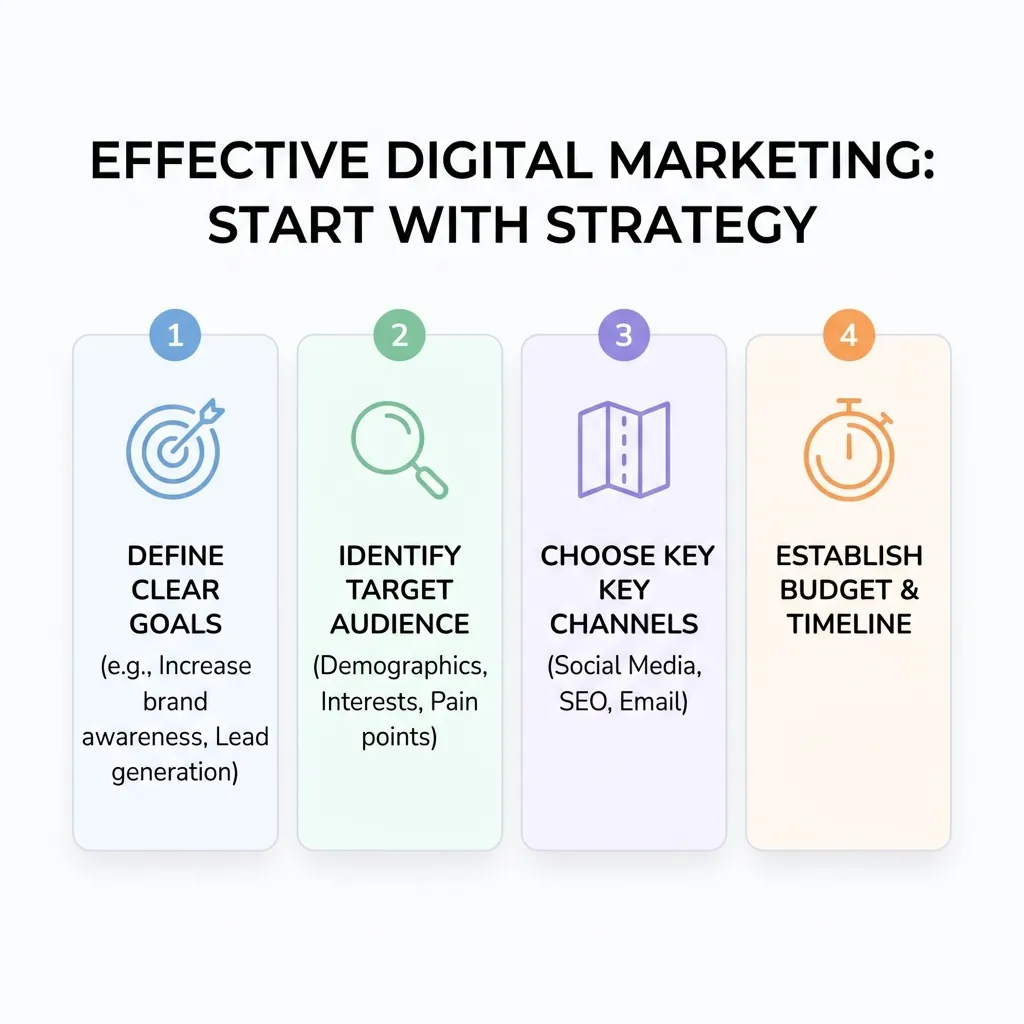
Simply subscribing to multiple platforms does not guarantee better marketing results. Tools become valuable when they are connected to a clear strategy.
Start by defining your objectives and KPIs. Then select a small number of tools that provide the data and functionality required to reach those objectives.
Review your data regularly and look for patterns. For example, if analytics shows that organic traffic is increasing but conversions remain low, you may need to improve landing pages, calls to action, targeting, or user experience.
Similarly, if paid advertising produces clicks but few sales, examine your audience targeting, ad messaging, landing page experience, and conversion tracking.
You can also use a digital marketing dashboard to bring important performance indicators together and make reporting easier.
Common Mistakes When Choosing Marketing Tools
Using Too Many Tools
More software does not necessarily mean better marketing. Too many platforms can create duplicated data, unnecessary costs, and complicated workflows.
Focusing Only on Features
A platform may offer hundreds of features, but that does not mean you need all of them. Focus on the problems you need to solve.
Ignoring Data Quality
Incorrect tracking can produce misleading conclusions. Make sure analytics, conversion tracking, campaign parameters, and reporting systems are configured properly.
Choosing Tools Without a Strategy
Tools should support a marketing strategy rather than replace one. Define your audience, objectives, channels, content strategy, and KPIs before building your technology stack.
Conclusion
The best digital marketing tools can make modern marketing more efficient, measurable, and scalable. SEO platforms can uncover keyword opportunities, analytics tools can reveal user behavior, content platforms can simplify creation, social media software can streamline publishing, and CRM systems can help businesses manage leads and customer relationships.
However, the ideal technology stack depends on your business goals. A small business may only need Google Analytics, Search Console, Canva, an email platform, and one SEO solution. A larger organization may require CRM software, marketing automation, advanced analytics, advertising platforms, project management software, and several specialized tools.
The key is not to collect as many platforms as possible. Instead, choose the best digital marketing tools that solve your specific problems, integrate with your existing workflow, provide useful data, and support measurable business outcomes. When technology and strategy work together, marketing teams can spend less time on repetitive tasks and more time improving campaigns and growing the business.
Frequently Asked Questions
1. What are the best digital marketing tools for beginners?
Google Analytics, Google Search Console, Canva, Google Keyword Planner, and a basic email marketing platform are good starting points for beginners.
2. Which is the best digital marketing tool for SEO?
Semrush and Ahrefs are strong choices for SEO research, while Google Search Console is essential for monitoring Google Search performance.
3. Is Google Analytics a digital marketing tool?
Yes. Google Analytics is an important analytics platform that helps marketers understand website traffic, user behavior, conversions, and marketing performance.
4. What tools are used for digital marketing analytics?
Popular analytics and reporting options include Google Analytics, Looker Studio, Microsoft Clarity, and analytics features built into advertising and CRM platforms.
5. What is the best tool for keyword research?
Semrush, Ahrefs, and Google Keyword Planner are commonly used for keyword research. The right choice depends on your SEO goals, budget, and required features.
6. What is the best digital marketing tool for social media?
Hootsuite, Buffer, and Meta Business Suite are popular options. Your choice should depend on the social platforms you manage and the scheduling and reporting features you need.
7. Which tool is best for email marketing?
Mailchimp and HubSpot are popular choices. Small businesses may prefer a simpler email platform, while organizations needing CRM and automation may benefit from HubSpot.
8. Can ChatGPT be used for digital marketing?
Yes. ChatGPT can assist with content ideas, outlines, copywriting, research assistance, campaign concepts, customer messaging, and workflow development. Human review remains important.
9. Are free digital marketing tools enough?
Free tools can be enough for beginners and small businesses. As marketing activities become more complex, paid platforms may provide additional data, automation, integrations, and reporting capabilities.
10. How many digital marketing tools does a business need?
There is no fixed number. A small business may need only five to seven core tools, while a larger marketing team may require a much broader technology stack.
11. How do digital marketing tools improve ROI?
They can improve ROI by helping marketers identify profitable channels, automate repetitive tasks, monitor campaigns, understand customer behavior, reduce wasted spending, and optimize conversion performance.
12. What should I consider before buying a marketing tool?
Consider your goals, budget, required features, integrations, ease of use, data quality, team capabilities, scalability, and expected return on investment before choosing a platform.



Leave a Reply