

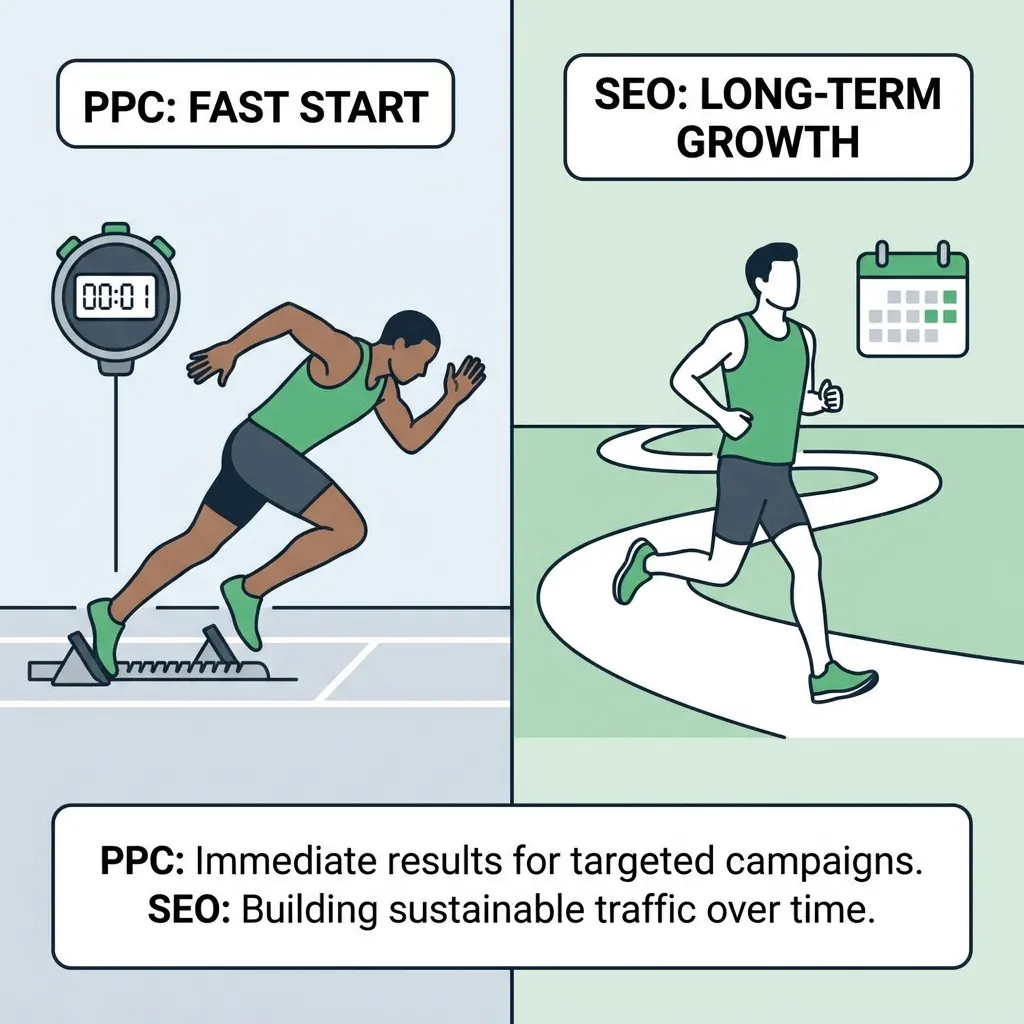
SEO and PPC are two powerful ways to attract customers through search engines, but they work differently. SEO focuses on earning organic visibility over time, while PPC uses paid advertising to generate targeted traffic quickly. This guide compares SEO vs PPC, including their costs, benefits, drawbacks, results, ROI, and ideal use cases, so you can choose the right strategy or combine both for stronger digital marketing performance.
What Is SEO?
SEO, or Search Engine Optimization, is the process of improving a website and its content so search engines can better understand and display its pages for relevant searches.
SEO focuses primarily on organic search visibility. Instead of paying for every click, businesses optimize their websites, create useful content, improve technical performance, build authority, and satisfy search intent.
Google describes SEO as helping search engines understand your content and helping users discover your website through search. Google Search Central SEO Starter Guide
Common SEO activities include:
- Keyword research
- On-page optimization
- Technical SEO
- Content creation
- Internal linking
- Link building
- Website speed optimization
- Mobile optimization
- Search intent optimization
- Local SEO
- Content updates
- Performance monitoring
For a deeper understanding of SEO’s role in digital marketing, you can also explore this SEO in digital marketing guide
What Is PPC?
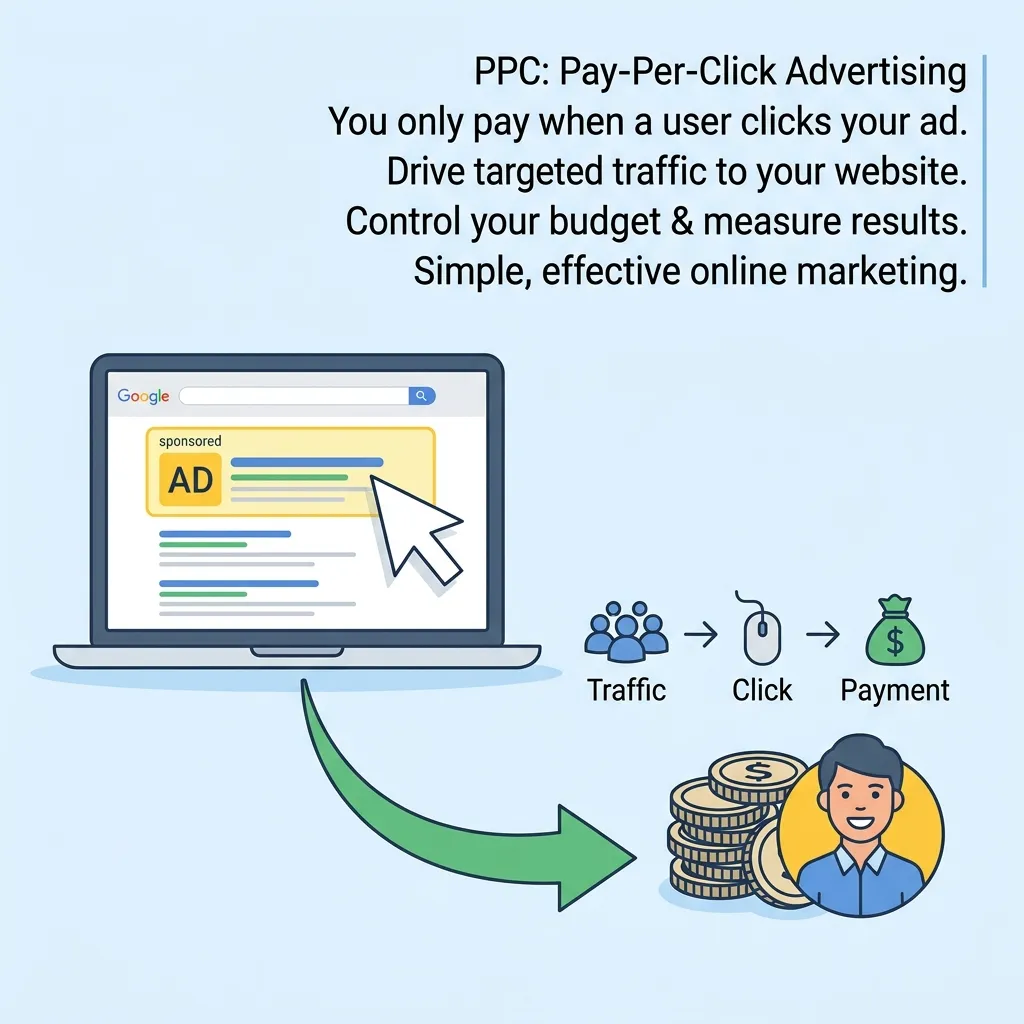
PPC stands for Pay-Per-Click advertising. It is a paid digital marketing model where advertisers pay when users click their ads or, depending on the campaign type and platform, when specific advertising actions occur.
Search PPC commonly places paid advertisements above or around organic search results for targeted keywords.
Google Ads, for example, supports cost-per-click bidding, where advertisers can set the maximum amount they are willing to pay for a click. Google Ads Help
PPC campaigns can target users based on factors such as:
- Search keywords
- Location
- Device
- Audience characteristics
- Interests
- Remarketing lists
- Demographic signals
- Search intent
The major advantage is speed. Once a campaign is approved and running, businesses can potentially start receiving targeted traffic much faster than with a newly launched SEO campaign.
SEO vs PPC: Key Differences
The biggest difference between SEO vs PPC is how businesses obtain search visibility.
SEO earns visibility through organic search rankings, while PPC purchases advertising placements.
| Factor | SEO | PPC |
|---|---|---|
| Traffic type | Organic | Paid |
| Initial speed | Slow to moderate | Fast |
| Long-term potential | High | Depends on continued spending |
| Cost model | Investment in optimization/content | Usually pay per click or campaign action |
| Keyword targeting | Yes | Yes |
| Control over placement | Limited | Greater |
| Immediate traffic | Usually no | Yes |
| Results after stopping investment | Can continue | Paid traffic generally stops |
| Best for | Sustainable growth | Immediate traffic and campaigns |
| Testing speed | Slower | Faster |
| Brand visibility | Long-term | Immediate |
| Scalability | Gradual | Often faster with budget |
Neither channel is automatically better for every business. The right choice depends on your goals, budget, competition, timeline, and customer journey.
SEO vs PPC: How Do They Work?
Understanding how each channel works makes the comparison easier.
How SEO Works
SEO generally involves several interconnected processes.
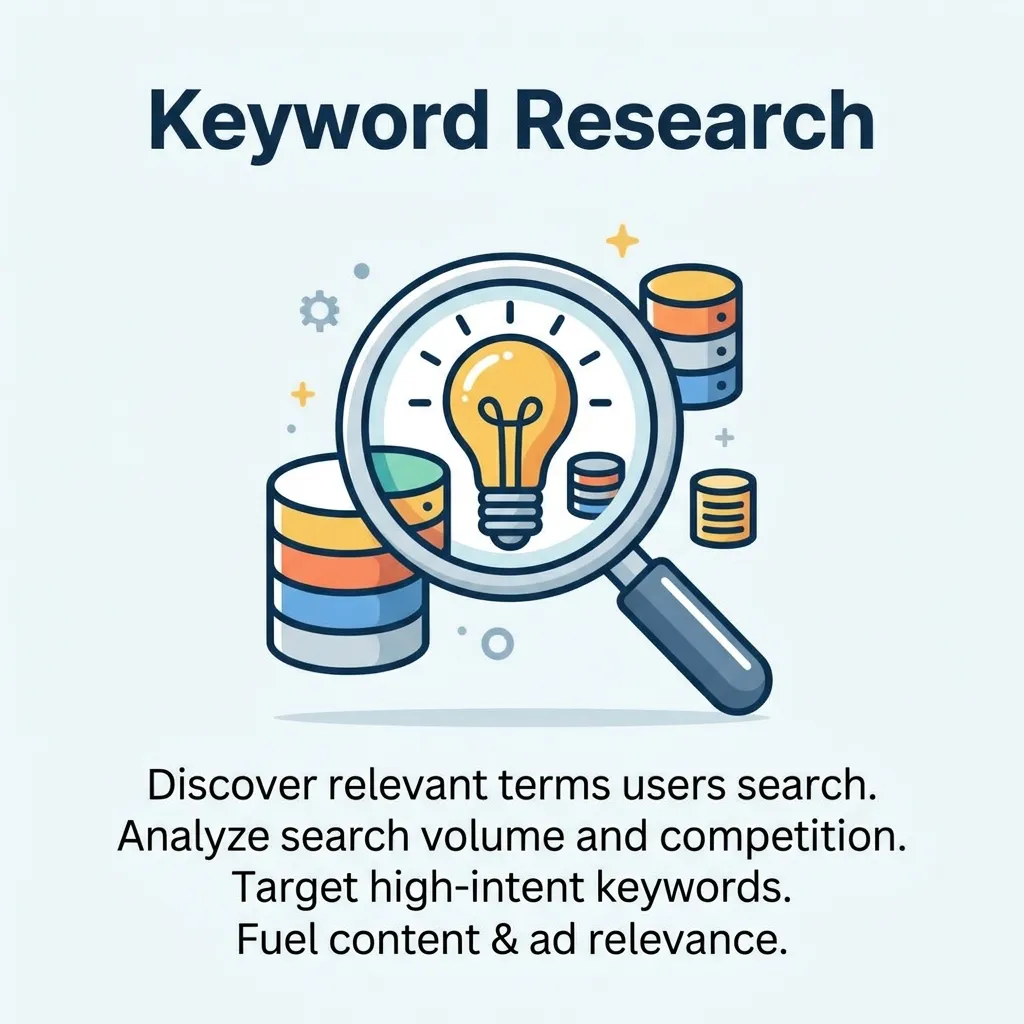
Keyword Research
Businesses identify search terms their target audience uses.
For example, a digital marketing agency might target:
- Digital marketing agency
- SEO services
- PPC management
- Digital marketing strategy
Content Optimization
The website then creates useful content that addresses the intent behind those searches.
Technical Optimization
Search engines need to crawl, understand, and index website content effectively. Technical SEO can include improving site structure, page speed, mobile usability, URLs, indexing, and internal links.
Authority Building
Businesses can strengthen their visibility by earning relevant links, mentions, and recognition from other websites.
Ongoing Improvement
SEO is not a one-time task. Search visibility can change as competitors publish content, search behavior changes, and search engines update their systems.
Google notes that changes to a site can take anywhere from hours to several months to show their impact in Search, which is one reason SEO requires patience. Google SEO Starter Guide
How PPC Works
PPC starts with creating a paid advertising campaign.
A typical process includes:
- Define the campaign objective.
- Identify target keywords or audiences.
- Create advertisements.
- Select a landing page.
- Set a budget.
- Choose bidding strategies.
- Launch the campaign.
- Monitor performance.
- Optimize bids, targeting, ads, and landing pages.
PPC allows businesses to control campaign budgets and bidding settings. Google Ads explains that advertisers establish an average daily budget and can set maximum CPC bids for their campaigns. Google Ads Budget and Bidding Guide
SEO vs PPC Cost
Cost is one of the most important considerations when comparing SEO vs PPC.
SEO Costs
SEO does not generally charge a search engine for each organic click. However, SEO still requires investment.
Potential costs include:
- SEO professionals
- Content writers
- SEO tools
- Website development
- Technical optimization
- Link acquisition
- Content updates
- Analytics and reporting
The investment is usually focused on building an asset that can continue generating organic visibility.
PPC Costs
PPC requires an advertising budget. Depending on the campaign, you may pay for clicks or other defined advertising outcomes.
Your costs can include:
- Ad spend
- Campaign management
- Keyword research
- Ad copywriting
- Landing page development
- Conversion tracking
- Creative production
- Agency or freelancer fees
The key difference is that PPC traffic is directly tied to advertising expenditure.
If you stop running the campaign, you generally stop receiving traffic generated by that campaign.
SEO vs PPC: Which Gives Faster Results?
PPC usually produces faster traffic.
Once a campaign is approved and properly configured, paid advertisements can begin appearing for relevant searches.
SEO generally takes longer because search engines need to discover, crawl, index, evaluate, and rank content. Competition and website authority also influence how quickly pages gain visibility.
This makes PPC particularly useful when a business needs:
- Immediate leads
- Product launches
- Seasonal promotions
- Event registrations
- Limited-time offers
- New product testing
- Rapid market validation
SEO is better suited to businesses willing to build organic visibility over time.
SEO vs PPC for Long-Term Growth
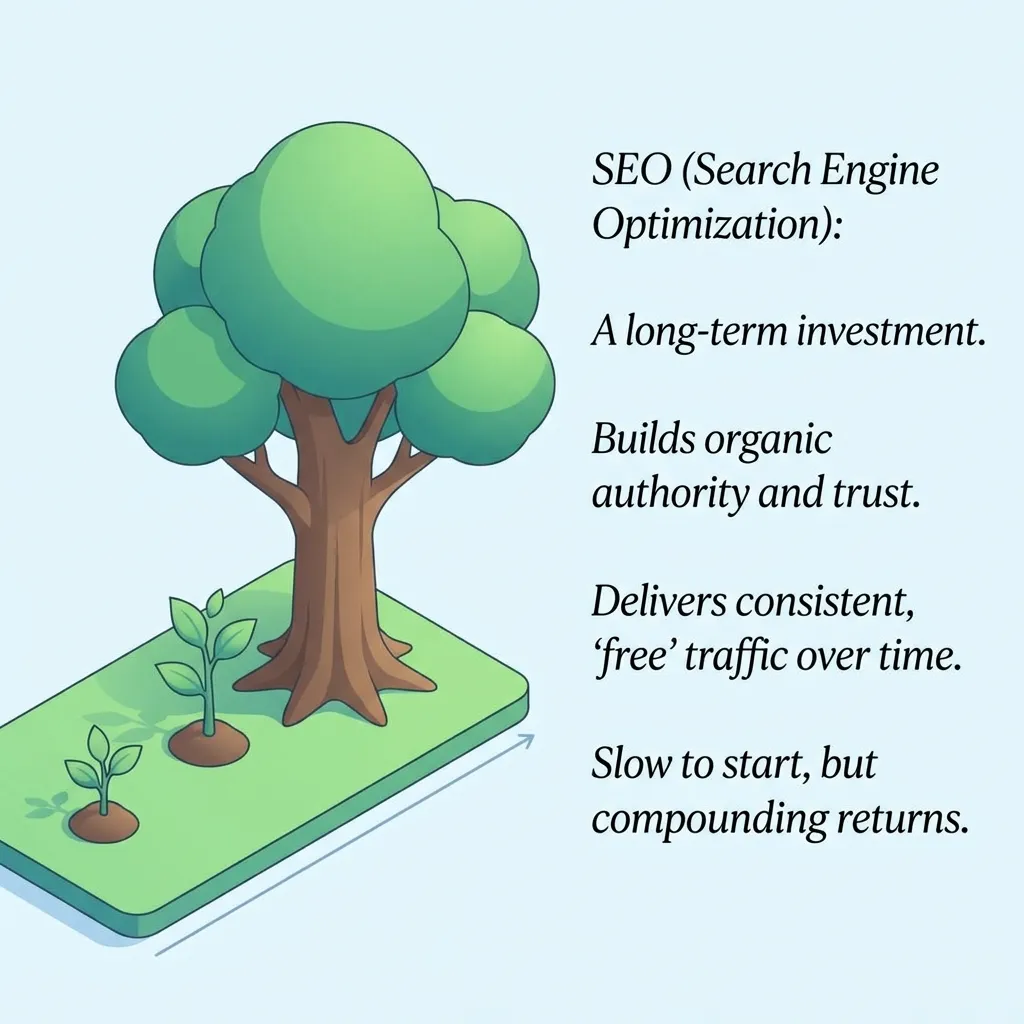
For long-term growth, SEO can provide significant value because successful pages can continue attracting organic traffic after the initial content and optimization work.
For example, a well-optimized educational article may generate search traffic for months or years if it remains useful and competitive.
PPC can also support long-term growth, but its traffic generally requires ongoing advertising expenditure.
This does not mean PPC is only a short-term strategy. Businesses can run PPC campaigns continuously when the economics make sense. The difference is that the traffic remains dependent on campaign funding.
SEO vs PPC ROI
Return on investment should be evaluated based on business outcomes rather than traffic alone.
For SEO, useful metrics include:
- Organic traffic
- Organic conversions
- Keyword visibility
- Leads
- Revenue
- Conversion rate
- Customer acquisition cost
- Customer lifetime value
For PPC, businesses can track:
- Clicks
- Impressions
- CTR
- CPC
- Conversion rate
- Cost per acquisition
- Ad spend
- Revenue
- ROAS
For example, if you spend $1,000 on PPC and generate $4,000 in attributable revenue, your ROAS is 4:1.
You can learn more about this measurement approach through the [ROAS complete guide].
SEO can become increasingly efficient as a site builds strong organic visibility, while PPC can be highly measurable and scalable when campaigns generate profitable conversions.
Advantages of SEO
1. Builds Long-Term Visibility
Strong organic rankings can continue attracting visitors without paying for every individual click.
2. Supports Brand Authority
Publishing useful, relevant content can establish a company as a knowledgeable resource in its industry.
3. Can Reduce Dependence on Paid Traffic
A strong organic presence can diversify a business’s acquisition channels.
4. Supports the Entire Customer Journey
SEO content can target informational, commercial, navigational, and transactional searches.
5. Creates Compounding Value
A growing library of useful content can generate visibility across many search queries.
Disadvantages of SEO
1. Takes Time
SEO rarely provides instant results for a new website.
2. Competition Can Be Strong
Competitive keywords may require significant content, technical improvements, authority, and time.
3. Rankings Are Not Guaranteed
Following SEO best practices does not guarantee a specific ranking position. Google itself states that there are no secrets that automatically guarantee a first-place ranking. Google Search Central
4. Requires Ongoing Work
Content can become outdated, competitors can improve, and search behavior can change.
Advantages of PPC
1. Fast Visibility
PPC can place your offer in front of relevant searchers quickly.
2. Precise Targeting
Advertisers can control keywords, locations, audiences, budgets, and other campaign settings.
3. Easy Performance Tracking
PPC platforms provide detailed campaign data that marketers can use for optimization.
4. Excellent for Testing
Businesses can test:
- Headlines
- Offers
- Landing pages
- Keywords
- Audiences
- Calls to action
5. Scalable
If a campaign consistently generates profitable conversions, increasing the budget can potentially expand reach.
Disadvantages of PPC
1. Continuous Spending
PPC requires ongoing advertising expenditure.
2. Competition Can Increase Costs
Highly competitive keywords may have expensive clicks.
3. Traffic Stops When Campaigns Stop
Unlike organic content, PPC traffic is directly dependent on active campaigns.
4. Poor Campaign Management Can Waste Budget
Irrelevant keywords, weak ads, poor landing pages, and incorrect targeting can reduce performance.
SEO vs PPC for Small Businesses
Small businesses often need to consider both budget and timeline.
SEO can be attractive when a small business wants to build sustainable visibility without paying for every visitor.
PPC can be useful when the business needs immediate leads or has a proven offer with positive advertising economics.
A practical approach may be:
Short term: Use PPC to generate targeted traffic.
Long term: Build SEO assets to increase organic visibility.
This combination can create a more balanced acquisition strategy.
For broader planning, businesses can also review this [digital marketing checklist].
SEO vs PPC for New Websites
New websites often face a difficult choice.
They have limited authority and may need time to establish organic rankings, but they also need traffic.
PPC can help generate initial visitors while SEO work begins in parallel.
For example:
Month 1–3:
PPC + technical SEO + keyword research + foundational content
Month 3–6:
Continue PPC while expanding organic content and improving existing pages
Month 6+:
Analyze which organic and paid channels generate the strongest conversions and adjust the budget accordingly
The exact timeline varies significantly by industry, competition, website quality, content quality, and budget.
Can SEO and PPC Work Together?
Yes. In many cases, SEO and PPC work better together than separately.
PPC can provide fast data that helps marketers understand which keywords, offers, and messages generate conversions.
That information can then inform SEO content and landing-page strategy.
Likewise, strong organic pages can support PPC campaigns by providing useful destinations for paid traffic.
For example:
PPC identifies a high-converting keyword → SEO creates comprehensive content around that search intent → organic rankings grow → PPC and SEO work together.
This creates a feedback loop between paid and organic search.
SEO vs PPC: Which One Should You Choose?
There is no universal winner.
Choose SEO when:
- You want long-term organic visibility.
- You can invest in content and optimization.
- Your customers frequently search for solutions online.
- You want to build topical authority.
- You have a longer growth timeline.
Choose PPC when:
- You need traffic quickly.
- You have a time-sensitive promotion.
- You want to test an offer.
- You have a measurable conversion funnel.
- Your business can profitably acquire customers through paid advertising.
Choose both when:
- You want immediate and long-term visibility.
- You have sufficient resources.
- Search is an important acquisition channel.
- You want to diversify traffic sources.
- You want to use PPC data to inform SEO decisions.
SEO vs PPC: A Simple Decision Framework
Use these questions to determine which strategy fits your business.
Do You Need Results Immediately?
If yes, PPC may be the better starting point.
Are You Building for Long-Term Growth?
If yes, prioritize SEO.
Is Your Offer Already Proven?
If yes, PPC can help scale it.
Do Customers Search for Your Products or Services?
If yes, both SEO and PPC may be valuable.
Do You Have Limited Budget?
Focus your resources on the channel most closely aligned with your business model and timeline rather than spreading your budget too thin.
Can You Wait for Organic Growth?
If yes, SEO may provide stronger long-term value.
Best Practices for SEO and PPC
Regardless of which channel you choose, focus on the customer rather than simply chasing traffic.
Match Search Intent
Your content or advertisement should answer what the searcher actually wants.
Optimize Landing Pages
A great advertisement cannot compensate for a confusing landing page.
Track Conversions
Traffic and clicks are useful, but revenue and qualified leads are more meaningful business outcomes.
Test and Improve
Both SEO and PPC require continuous optimization.
Understand Your Audience
Use customer behavior, search data, analytics, and market research to understand what your audience needs.
Connect SEO and PPC Data
Search queries, conversion data, and audience behavior from PPC can provide valuable insights for organic content planning.
Conclusion
The SEO vs PPC debate is not really about finding a single winner. It is about choosing the right acquisition strategy for your business goals.
SEO is a long-term investment in organic visibility, content, authority, and sustainable search traffic. PPC is a paid acquisition channel designed to generate targeted visibility and traffic quickly.
If your priority is immediate results, PPC may be the stronger starting point. If your goal is long-term organic growth, SEO deserves consistent investment.
For many businesses, however, the strongest approach is to use both. PPC can deliver immediate traffic and valuable testing data, while SEO builds an organic asset that can continue generating visibility over time.
The best strategy is ultimately the one that produces qualified traffic, conversions, customers, and profitable growth—not simply the one that generates the most clicks.
Frequently Asked Questions
1. What is the difference between SEO and PPC?
SEO generates organic search visibility, while PPC generates paid search visibility. SEO generally focuses on long-term growth, whereas PPC can provide faster traffic through advertising.
2. Is SEO better than PPC?
Neither is universally better. SEO is often better for long-term organic growth, while PPC is useful for immediate visibility, testing, and targeted campaigns.
3. Is PPC faster than SEO?
Yes. PPC can generate paid traffic soon after a campaign becomes active, while SEO generally requires more time to build organic visibility.
4. Is SEO cheaper than PPC?
SEO does not charge for each organic click, but it still requires investment in content, technical optimization, tools, and expertise. PPC requires ongoing advertising spend.
5. Can SEO and PPC be used together?
Yes. Combining SEO and PPC can provide immediate paid visibility while building long-term organic search performance.
6. Which is better for a new website, SEO or PPC?
PPC can help a new website generate immediate traffic, while SEO builds the foundation for long-term organic growth. Using both can be effective when resources allow.
7. Which provides better ROI, SEO or PPC?
ROI depends on the business, competition, conversion rate, customer value, costs, and execution. Neither channel guarantees better ROI in every situation.
8. Does PPC improve SEO rankings?
PPC advertising does not directly make a website rank organically higher. Paid and organic search are separate systems, although PPC data can provide useful marketing insights.
9. How long does SEO take to work?
There is no fixed timeline. Results can vary from weeks to months or longer depending on competition, website authority, technical condition, content quality, and search demand.
10. Is PPC worth it for small businesses?
PPC can be worthwhile when campaigns target relevant audiences and generate conversions at a profitable cost. Careful targeting, tracking, and budget management are important.
11. What should I track for SEO?
Important SEO metrics include organic traffic, rankings, impressions, clicks, conversions, leads, revenue, and customer acquisition metrics.
12. What should I track for PPC?
Important PPC metrics include impressions, clicks, CTR, CPC, conversion rate, cost per acquisition, conversion value, and ROAS.



Leave a Reply