


Cost Per Acquisition (CPA) measures how much you spend to convert a prospect into a paying customer. Calculated by dividing total campaign spend by the number of acquisitions, CPA is one of the most direct indicators of campaign profitability—and a cornerstone metric in any digital marketing process.
Every dollar you spend on advertising should do a job. The question is: are you measuring whether it actually does?
Cost Per Acquisition (CPA) answers that question directly. Unlike vanity metrics that track impressions or clicks, CPA cuts to the chase—it tells you exactly how much it costs to turn a prospect into a customer. For marketers managing tight budgets, aggressive growth targets, or both, that clarity is invaluable.
But CPA doesn’t operate in isolation. To use it effectively, you need to understand how it interacts with Return on Ad Spend (ROAS), Customer Lifetime Value (CLV), and your broader digital marketing objectives. Get that relationship right, and CPA becomes one of the most powerful levers in your entire digital marketing process.
This guide covers everything: how to calculate CPA, how to benchmark it against your industry, how to reduce it without sacrificing lead quality, and how it fits into the bigger picture of sustainable, profitable growth. Whether you’re running your first paid campaign or auditing a mature marketing stack, what follows will give you a concrete framework for making CPA work harder.
What is Cost Per Acquisition (CPA)?
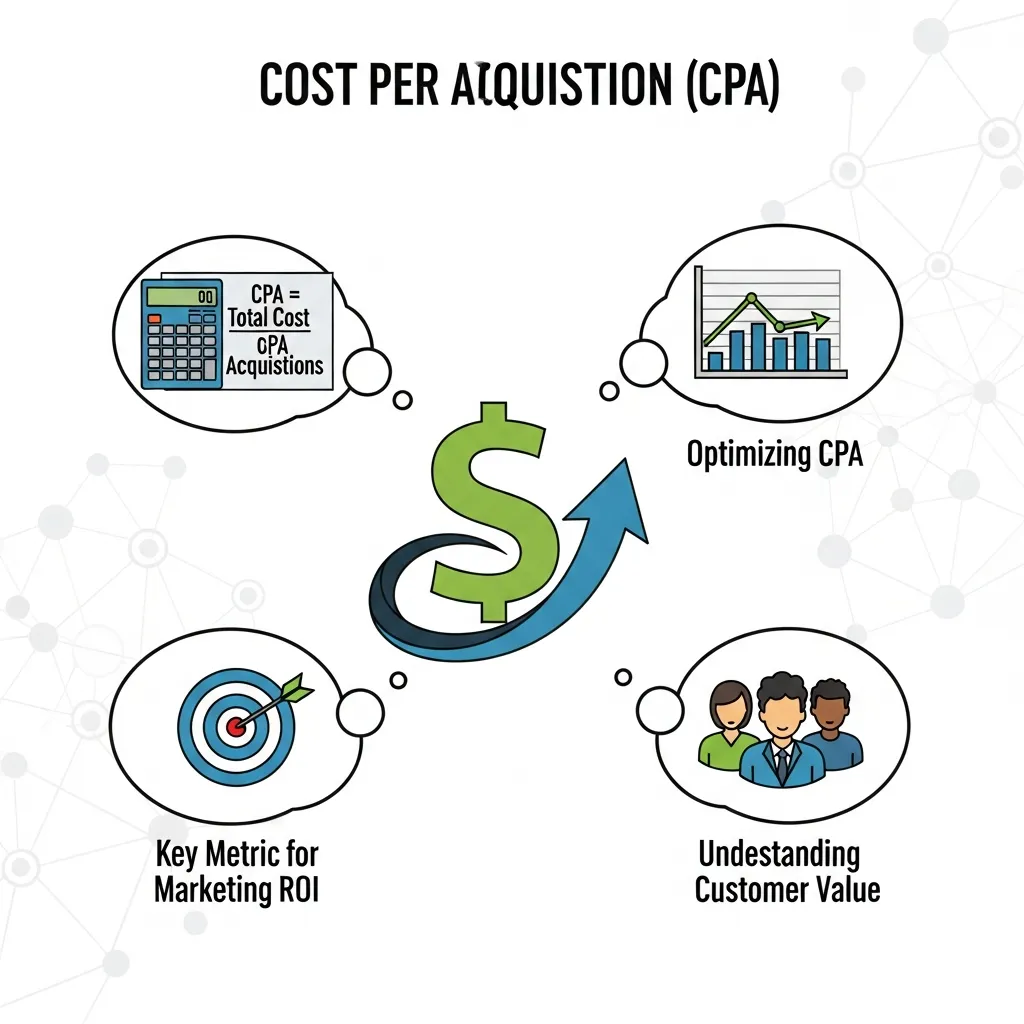
Definition and core concept of Cost Per Acquisition
Cost Per Acquisition (CPA) is a performance marketing metric that measures the average cost of acquiring one customer—or completing one desired action—through a specific campaign or channel. That “action” could be a purchase, a form submission, a free trial signup, or any conversion event that matters to your business.
The core appeal of CPA is its directness. Rather than measuring how many people saw your ad (impressions) or clicked on it (click-through rate), CPA measures outcomes. It answers the only question that ultimately matters in paid marketing: what did this actually cost us to get a customer?
How Cost Per Acquisition (CPA) is calculated
The formula is straightforward:
CPA = Total Campaign Spend ÷ Number of Acquisitions
For example, if you spend $5,000 on a Google Ads campaign and generate 100 conversions, your CPA is $50.
The simplicity of this formula is deceptive, though. The real work lies in defining what counts as an “acquisition” and ensuring your tracking accurately captures every conversion. A misaligned attribution model or a broken conversion pixel can make your CPA look far better—or far worse—than it really is.
Why Cost Per Acquisition (CPA) matters for digital marketing objectives
CPA matters because it ties marketing spend directly to business outcomes. Most digital marketing objectives—whether awareness, lead generation, or revenue growth—eventually need to be justified in terms of cost efficiency. CPA provides that justification.
For performance marketers, a rising CPA is an early warning sign. It could signal audience fatigue, increased competition, a weakening offer, or a breakdown somewhere in the conversion funnel. Monitoring CPA over time, not just at the campaign level, gives you the diagnostic data to respond before problems compound.
Real-world examples of Cost Per Acquisition (CPA) in action
- An e-commerce brand running Facebook Ads tracks CPA as the cost to generate one completed purchase.
- A B2B SaaS company defines CPA as the cost to acquire one free trial signup, then tracks a separate metric for paid conversions.
- A healthcare provider running Google Ads measures CPA as the cost per appointment booking.
Each of these represents a different stage in the customer journey, but the underlying logic is the same: how much did it cost to make something valuable happen?
Cost Per Acquisition (CPA) vs. Other Digital Marketing Metrics
Cost Per Acquisition (CPA) vs. Return on Ad Spend
Return on Ad Spend (ROAS) measures revenue generated per dollar spent on advertising. The formula is:
ROAS = Revenue from Ads ÷ Ad Spend
CPA and ROAS are complementary, not competing. CPA tells you what it costs to acquire a customer; ROAS tells you how much revenue that customer generates relative to your spend. A low CPA with a low ROAS might indicate you’re attracting customers who spend very little. Conversely, a high CPA can be entirely justified when ROAS is strong.
The key is to evaluate both metrics together. Optimizing CPA without tracking ROAS can lead you to cut costs in ways that also cut revenue—a false economy that undermines your digital marketing objectives.
Cost Per Acquisition (CPA) vs. Customer Lifetime Value
Customer Lifetime Value (CLV) is the total revenue a business expects from a single customer account. CLV reframes the CPA conversation entirely.
A CPA of $200 might seem high—until you know that the average customer spends $2,000 over their lifetime with your brand. In that context, a $200 acquisition cost is a bargain. The formula most marketers use to evaluate this relationship is:
Target CPA = CLV × Acceptable Profit Margin
Businesses with high CLV can afford higher CPAs and still operate profitably. Businesses with low CLV must keep CPA tightly controlled. Understanding this dynamic is fundamental to setting CPA targets that are both realistic and strategically sound.
How Cost Per Acquisition (CPA) fits into the broader digital marketing process
CPA doesn’t sit at the end of the digital marketing process—it threads through it. During campaign planning, CPA targets shape budget allocation. During execution, CPA benchmarks guide bid strategies and audience targeting. During review, CPA trends inform decisions about scaling, pausing, or restructuring campaigns.
When CPA is treated as a core KPI rather than an afterthought, it forces discipline across the entire digital marketing process: clearer campaign briefs, tighter audience definitions, stronger landing pages, and more rigorous post-campaign analysis.
How to Calculate and Optimize Cost Per Acquisition (CPA)
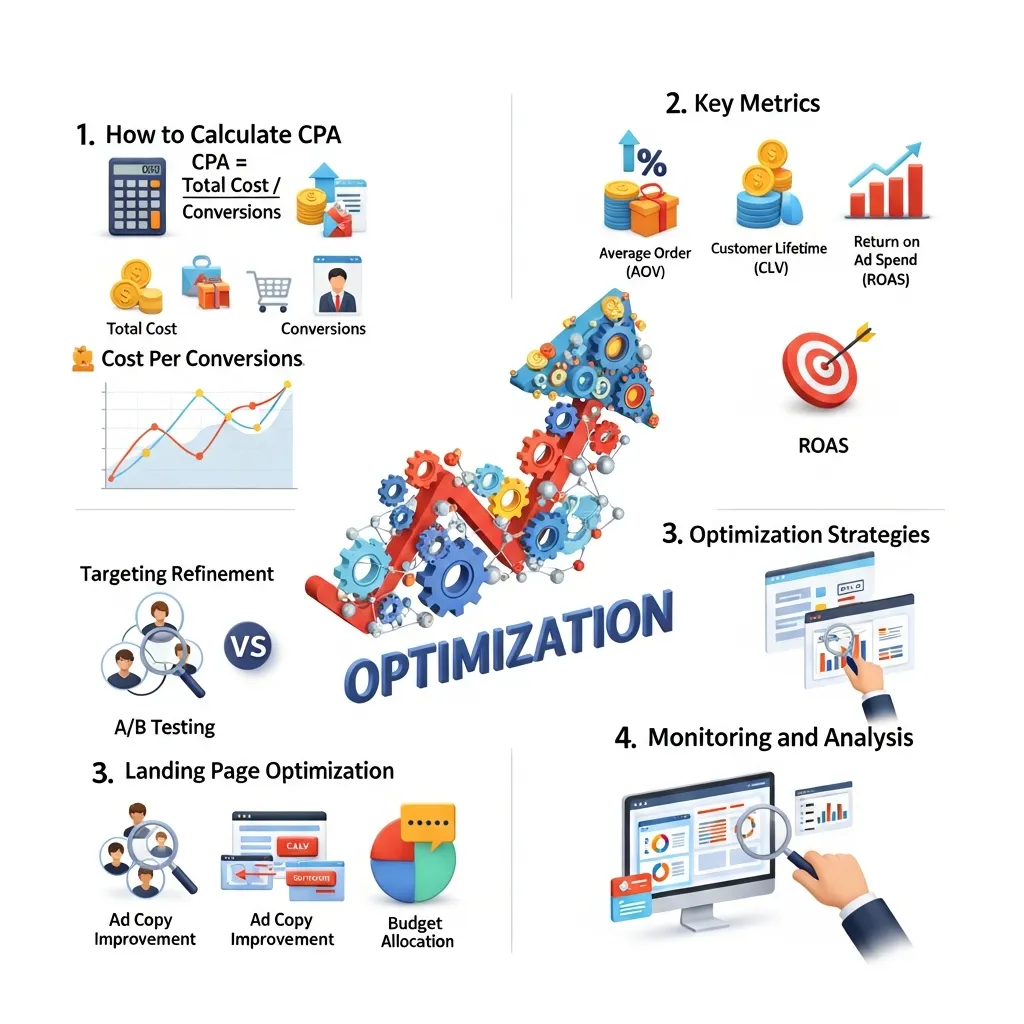
Step-by-step Cost Per Acquisition (CPA) calculation
- Define your conversion event. Be specific. A “conversion” means something different to every business—make sure your team and your tracking platform agree on the definition.
- Set your tracking. Use platform-native conversion tracking (Google Ads, Meta Ads Manager) and cross-reference with Google Analytics 4 or a third-party attribution tool.
- Run your campaign over a statistically meaningful period—typically at least 30 days for most channels.
- Pull your spend data for the campaign period.
- Divide total spend by confirmed conversions. That’s your CPA.
- Segment by channel, audience, and ad creative to identify which variables are driving your best and worst CPAs.
Strategies to lower your Cost Per Acquisition (CPA)
Reducing CPA doesn’t always mean spending less—it means spending smarter. Here are the most effective levers:
- Improve landing page conversion rates. A landing page that converts at 5% instead of 2% effectively halves your CPA without touching your ad budget.
- Tighten audience targeting. Reaching fewer, more qualified people is almost always more cost-efficient than broad targeting.
- Test ad creative systematically. Fatigued creative is one of the most common drivers of rising CPA. Regular A/B testing keeps performance fresh.
- Use bid strategy automation carefully. Platforms like Google Ads offer Target CPA bidding, which uses machine learning to optimize toward your CPA goal. It works well with enough conversion data—typically 30–50 conversions per month per campaign.
- Shorten the conversion funnel. Every extra step between an ad click and a conversion is an opportunity for drop-off. Audit your funnel and remove friction wherever possible.
Tools and platforms for tracking Cost Per Acquisition (CPA)
- Google Ads: Native CPA tracking and Target CPA smart bidding
- Meta Ads Manager: Cost per result reporting across Facebook and Instagram campaigns
- Google Analytics 4: Cross-channel attribution and conversion path analysis
- HubSpot / Salesforce: CRM-based tracking for longer sales cycles
- Triple Whale / Northbeam: Third-party attribution platforms popular with e-commerce brands
The role of Cost Per Acquisition (CPA) in digital marketing objectives
CPA links campaign-level performance directly to business-level digital marketing objectives. If your objective is profitable customer acquisition, CPA is your primary metric. If your objective is market share growth, CPA might be weighted against volume—accepting a higher CPA in exchange for more conversions. The right approach depends on your growth stage, margin structure, and competitive environment.
Cost Per Acquisition (CPA) Best Practices
Industry benchmarks for Cost Per Acquisition (CPA)
CPA benchmarks vary significantly by industry, channel, and business model. According to WordStream’s industry benchmark data, average CPAs across Google Ads range from approximately $19 in e-commerce to over $100 in legal services. On Facebook, average CPAs tend to be lower but vary widely by niche and offer type.
Use industry benchmarks as a starting point, not a target. Your actual target CPA should be based on your CLV, margin, and business model—not what a competitor in a different market context is achieving.
How to set realistic Cost Per Acquisition (CPA) targets
Start with your economics, not your aspirations.
- Calculate your average CLV.
- Determine your acceptable customer acquisition cost as a percentage of CLV (typically 10–30%, depending on your margins and payback period).
- Cross-reference with channel benchmarks to assess feasibility.
- Set a target CPA range, not a single number—this gives campaign managers room to optimize without chasing an arbitrary figure.
Revisit your CPA targets quarterly or whenever there’s a significant change in your product pricing, audience, or competitive landscape.
Common mistakes when managing Cost Per Acquisition (CPA)
- Optimizing CPA without considering CLV. A low CPA that attracts low-value customers is not a win.
- Comparing CPA across different channels without adjusting for intent. A $30 CPA from branded search and a $30 CPA from display advertising represent very different levels of customer quality.
- Setting CPA targets based on gut feel. Targets should be anchored to real unit economics.
- Ignoring CPA trends over time. A CPA that looks acceptable today might be creeping upward in ways that signal deeper problems.
- Pausing campaigns too quickly. CPA optimization requires data. Pausing a campaign after 10 conversions tells you very little.
Putting CPA to Work: Your Next Steps

Cost Per Acquisition (CPA) is, at its core, a discipline—a commitment to measuring what actually matters and making decisions grounded in real unit economics. It keeps marketing accountable, ties spend to outcomes, and creates a shared language between marketing teams and business leadership.
The marketers who use CPA most effectively don’t treat it as a standalone number. They track it alongside Return on Ad Spend to assess revenue efficiency, benchmark it against Customer Lifetime Value to ensure profitability, and embed it throughout their digital marketing process—from campaign planning to post-campaign analysis.
The strategies in this guide—improving landing page conversion rates, tightening audience targeting, leveraging bid automation, and setting CPA targets based on CLV—are proven levers. But strategy only creates value when executed and measured consistently.
Start by auditing your current CPA across every active channel. Identify where performance is strong, where it’s drifting, and where your tracking might be giving you an incomplete picture. From there, set evidence-based CPA targets, build a regular review cadence, and treat CPA optimization as an ongoing process rather than a one-time fix.
The brands that grow profitably over the long term are those that take acquisition cost seriously—not just when budgets are under pressure, but as a permanent operating discipline. CPA gives you the framework to do exactly that.
Frequently Asked Questions About Cost Per Acquisition (CPA)
What is a good Cost Per Acquisition (CPA) benchmark?
A “good” CPA depends on your industry, channel, and customer lifetime value. According to WordStream, average Google Ads CPAs range from around $19 in e-commerce to over $100 in legal services. Use industry data as a directional guide, then anchor your actual CPA target to your own unit economics—specifically, what you can afford to spend and still generate a profit.
How does Cost Per Acquisition (CPA) impact Return on Ad Spend?
CPA and Return on Ad Spend (ROAS) are closely linked but measure different things. CPA tracks the cost to acquire a customer; ROAS tracks the revenue generated per dollar spent. A lower CPA generally improves ROAS, but only if the quality of acquisitions remains consistent. Aggressively cutting CPA by targeting lower-intent audiences can reduce ROAS even as CPA improves—so always evaluate both metrics together.
Can Cost Per Acquisition (CPA) vary by industry?
Yes, significantly. Industries with longer sales cycles, higher competition, or more complex buying decisions—such as legal, financial services, and healthcare—tend to have higher CPAs. E-commerce and consumer goods typically have lower CPAs. Even within a single industry, CPA can vary by geographic market, audience segment, and ad channel.
What’s the relationship between Cost Per Acquisition (CPA) and Customer Lifetime Value?
Customer Lifetime Value (CLV) sets the ceiling for a profitable CPA. If a customer generates $500 in lifetime revenue and your margin is 40%, you have $200 to spend on acquisition before breaking even. Businesses with high CLV can sustain higher CPAs and still grow profitably. This is why CLV is one of the most important inputs when setting CPA targets.
How do I reduce my Cost Per Acquisition (CPA)?
The most effective ways to reduce CPA include improving landing page conversion rates, tightening audience targeting, refreshing ad creative regularly, shortening the conversion funnel, and using platform-native bid automation (like Google’s Target CPA) once you have sufficient conversion data. Focus on conversion rate optimization before scaling spend—a better-converting funnel reduces CPA structurally, not just temporarily.
Which digital marketing channels tend to have the lowest Cost Per Acquisition (CPA)?
Organic search (SEO) and email marketing typically deliver the lowest CPAs over time, since the marginal cost per conversion decreases as your content and list scale. Among paid channels, branded search often delivers the lowest CPA because users already have high intent. Social media and display advertising tend to have higher CPAs but offer stronger reach and prospecting capabilities.
How does Cost Per Acquisition (CPA) fit into digital marketing objectives?
CPA is one of the clearest bridges between campaign performance and business outcomes. When digital marketing objectives include profitable growth, CPA becomes the primary KPI that keeps spend accountable. It forces alignment between marketing and finance teams by expressing campaign performance in terms that the business—not just the marketing department—can evaluate and act on.
What tools help track Cost Per Acquisition (CPA)?
Key tools include Google Ads (native CPA tracking and smart bidding), Meta Ads Manager, Google Analytics 4 for cross-channel attribution, and CRM platforms like HubSpot or Salesforce for tracking longer sales cycles. E-commerce brands often supplement these with third-party attribution tools such as Triple Whale or Northbeam for more granular multi-touch attribution.
How often should I review my Cost Per Acquisition (CPA)?
For active paid campaigns, review CPA weekly to catch performance shifts early. Conduct a deeper monthly analysis to identify trends, compare against benchmarks, and adjust targeting or creative strategies. Review your CPA targets quarterly—or immediately if there’s a significant change in pricing, audience behavior, or market conditions.
Is Cost Per Acquisition (CPA) the only metric I should track?
No. CPA is most useful when evaluated alongside Return on Ad Spend (ROAS), Customer Lifetime Value (CLV), conversion rate, and customer quality indicators (like churn rate or average order value). Optimizing CPA in isolation can lead to decisions that look efficient on paper but damage long-term profitability—such as acquiring high volumes of low-value customers.
How does seasonality affect Cost Per Acquisition (CPA)?
Seasonality affects CPA through changes in competition and consumer demand. During high-competition periods—such as Q4 for e-commerce or tax season for financial services—ad auction prices rise, which typically pushes CPA higher. Anticipate seasonal CPA fluctuations in your planning, build seasonal benchmarks over time, and adjust CPA targets accordingly rather than treating seasonal spikes as permanent performance problems.
What’s the future of Cost Per Acquisition (CPA) measurement?
Privacy changes—including the deprecation of third-party cookies and iOS tracking restrictions—are making CPA measurement more challenging. The industry is shifting toward privacy-preserving solutions like server-side tracking, first-party data strategies, and AI-driven attribution modeling. Platforms like Google are increasingly promoting Privacy Sandbox and enhanced conversions as alternatives. Marketers who invest in robust first-party data infrastructure now will be best positioned to measure and optimize CPA accurately in a cookieless environment.



Leave a Reply