


Running Google Ads is not simply about choosing keywords and setting a budget. The quality and relevance of your advertisements also play an important role in how your campaigns perform.
One of the most useful diagnostic metrics available in Google Ads is Quality Score.
Google Ads Quality Score helps advertisers understand how relevant and useful their ads and landing pages are compared with other advertisers targeting the same searches. It is measured on a scale from 1 to 10 at the keyword level.
However, there is an important point that many advertisers misunderstand: Quality Score itself is not a direct input into the Google Ads auction. Google describes it as a diagnostic tool that can help advertisers identify areas where ad quality may need improvement.
In this guide, we will explain what Google Ads Quality Score means, how it works, what affects it, how to check it, and practical ways to improve the quality of your Search campaigns.
What Is Google Ads Quality Score?
Google Ads Quality Score is a diagnostic score that indicates how the quality of a keyword’s associated ads and landing page compares with other advertisers.
The score ranges from:
1 = Lowest
10 = Highest
A higher score generally indicates that the ad and landing page are more relevant and useful to people searching for the keyword.
Quality Score is available at the keyword level, which means different keywords in the same campaign can have different scores.
For example:
| Keyword | Quality Score |
|---|---|
| digital marketing agency | 9/10 |
| online marketing services | 7/10 |
| marketing consultant | 5/10 |
| cheap marketing service | 3/10 |
This type of information can help advertisers identify which keywords may need attention.
Is Quality Score a Ranking Factor?
This is one of the most important questions about Google Ads.
Quality Score itself is not an input in the ad auction. Google specifically describes it as a diagnostic tool rather than a KPI that advertisers should attempt to maximize as an isolated number.
However, the underlying aspects of ad quality matter during the auction.
Google’s Ad Rank system considers factors including bid, ad and landing-page quality, auction competitiveness, search context, Ad Rank thresholds, and expected impact of ad assets.
Therefore, advertisers should not simply chase a “10/10” Quality Score.
Instead, use Quality Score to identify opportunities to improve:
- Ad relevance
- Expected CTR
- Landing page experience
- Keyword-to-ad alignment
- Overall user experience
The Three Main Components of Quality Score
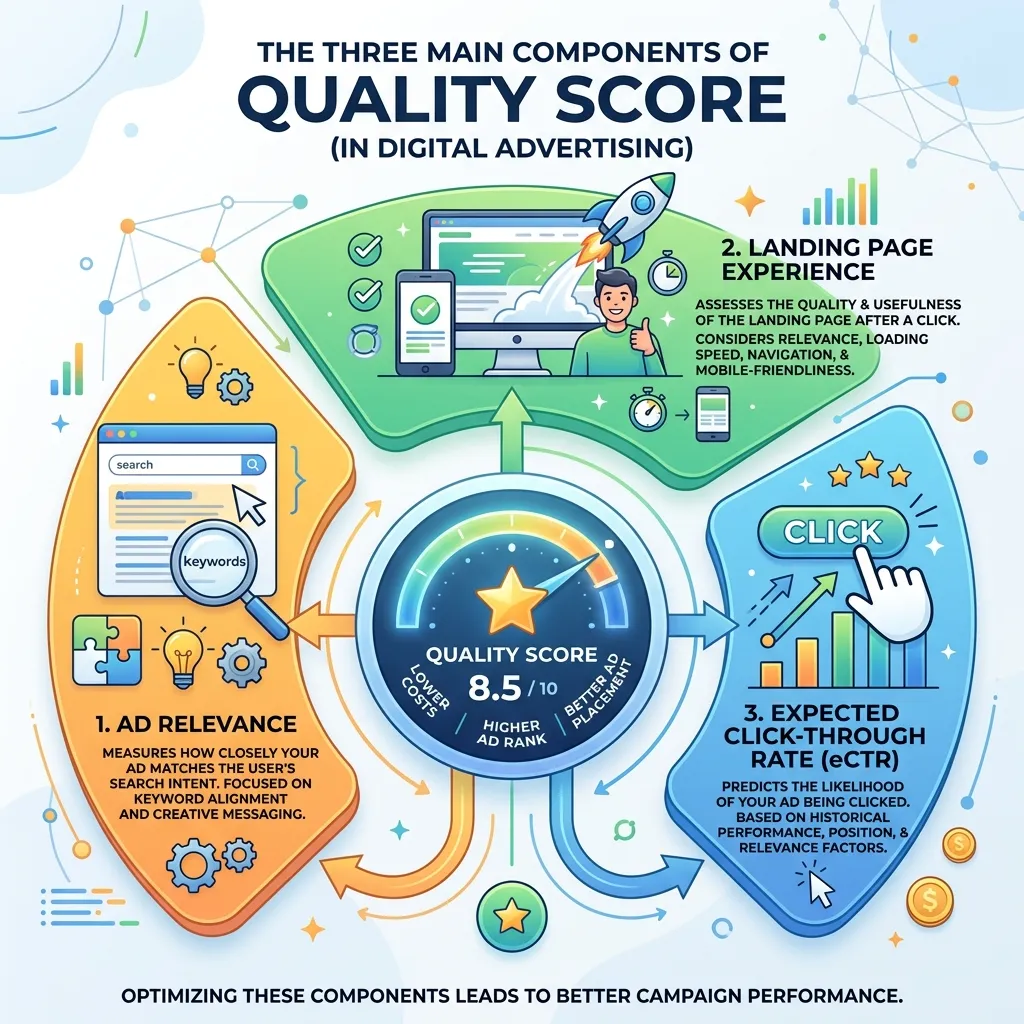
Google identifies three primary components that contribute to Quality Score:
- Expected Click-Through Rate (CTR)
- Ad Relevance
- Landing Page Experience
Each component can be classified as:
- Above average
- Average
- Below average
These evaluations compare your performance with other advertisers whose ads appeared for the same searches during the relevant historical period.
Let’s look at each component in detail.
1. Expected Click-Through Rate
Expected CTR estimates how likely your ad is to receive a click when it is shown.
CTR stands for Click-Through Rate.
The basic formula is:
CTR = Clicks ÷ Impressions × 100
For example, if your advertisement receives 50 clicks from 1,000 impressions:
50 ÷ 1,000 × 100 = 5% CTR
Expected CTR is not simply the same thing as your current reported CTR. Google evaluates expected click likelihood as part of its assessment of ad quality.
How to Improve Expected CTR
You can improve the likelihood of clicks by making your ads more relevant and compelling.
Consider:
- Writing clear headlines
- Matching the user’s search intent
- Highlighting a useful benefit
- Using relevant keywords naturally
- Creating specific calls to action
- Testing different ad messaging
- Making the offer easy to understand
For example, compare:
Ad A:
“Marketing Services Available”
with:
Ad B:
“SEO Services for Small Businesses – Get a Free Strategy Review”
The second example communicates a clearer service and potential benefit.
The goal is not to use clickbait. The goal is to make the advertisement genuinely useful to the person searching.
2. Ad Relevance
Ad relevance refers to how closely your advertisement matches the intent behind a user’s search.
If someone searches for:
“local SEO services”
and your advertisement talks specifically about local SEO services, the connection is clear.
But if the advertisement is extremely broad and promotes unrelated services, the user may be less likely to consider it relevant.
Google evaluates ad relevance as one of the three primary Quality Score components.
How to Improve Ad Relevance
Organize your campaigns and ad groups around closely related themes.
For example, instead of putting all marketing keywords into one large ad group:
Marketing
you could create more focused groups such as:
SEO Services
- SEO agency
- SEO services
- SEO consultant
Content Marketing
- content marketing agency
- content marketing services
- content strategy
- social media agency
- social media marketing
- social media management
This allows your advertisement to be more closely aligned with the keyword theme.
3. Landing Page Experience
The third major component is landing page experience.
A user clicks your advertisement expecting to find information that matches what the ad promised.
If the advertisement promotes:
“Professional SEO Services”
but the landing page is a generic homepage with no clear information about SEO services, the experience may be weaker.
Google evaluates how relevant and useful the landing page is to people who click the advertisement.
How to Improve Landing Page Experience
Your landing page should:
- Match the advertisement
- Match the search intent
- Provide useful information
- Be easy to navigate
- Work well on mobile devices
- Load efficiently
- Have a clear CTA
- Make important information easy to find
For example:
Search: “SEO audit service”
Ad: “Professional SEO Audit – Technical & On-Page Analysis”
Landing Page: A dedicated SEO audit service page
This creates a logical journey from search to advertisement to landing page.
Why Relevance Matters
Imagine searching for:
“Google Ads management service”
You click an advertisement that says:
“Google Ads Management for Growing Businesses.”
The landing page then immediately explains:
- Google Ads management
- Campaign optimization
- Keyword research
- Conversion tracking
- Reporting
- Pricing or consultation options
The entire journey is consistent.
This is much better than clicking an ad about Google Ads and arriving on a completely unrelated page.
How to Check Your Quality Score
You can check Quality Score directly inside your Google Ads account.
According to Google’s current instructions:
- Open your Google Ads account.
- Go to the Keywords section.
- Open the columns menu.
- Select the Quality Score section.
- Add Quality Score to your reporting table.
- You can also add:
- Landing Page Experience
- Expected CTR
- Ad Relevance
- Historical Quality Score metrics
Google also allows advertisers to view historical Quality Score information and segment it by day.
What Is a Good Quality Score?
There is no universal rule that every keyword must have a 10/10 score.
A higher score is generally a positive diagnostic signal, but Quality Score should be interpreted alongside other campaign metrics.
For example:
- 1–3: May indicate significant relevance or experience issues
- 4–6: May indicate opportunities for improvement
- 7–8: Generally a stronger diagnostic signal
- 9–10: Very strong diagnostic score
These ranges are useful as a practical interpretation, but advertisers should not treat them as Google’s official performance benchmarks.
More importantly, don’t optimize your account simply to turn every keyword into a 10.
Google itself recommends using Quality Score to diagnose areas that may need improvement rather than treating the score as a KPI.
Does a Higher Quality Score Reduce CPC?
Ad quality can influence advertising economics, but it is important to understand the distinction between Quality Score and the broader auction-time assessment of ad quality.
Google states that higher-quality ads can generally lead to better performance, including potentially better ad positions and lower costs per click.
However, Quality Score itself is not directly inserted into the auction formula.
Instead, advertisers should focus on improving the underlying factors that contribute to strong ad quality.
Quality Score vs. Ad Rank
These two concepts are often confused.
Quality Score
Quality Score is a diagnostic score from 1–10 available at the keyword level.
It helps advertisers understand areas such as:
- Expected CTR
- Ad relevance
- Landing page experience
Ad Rank
Ad Rank determines whether an eligible ad can show and where it may appear relative to competing ads.
Google says Ad Rank is influenced by factors including:
- Bid
- Ad and landing page quality
- Ad Rank thresholds
- Auction competitiveness
- Search context
- Expected impact of assets and other ad formats
Therefore:
Quality Score ≠ Ad Rank
Quality Score is a diagnostic indicator.
Ad Rank is part of the auction process.
Common Quality Score Problems
Low Quality Scores can come from several issues.
Poor Keyword-to-Ad Relevance
Your keywords may not closely match the advertisement.
Generic Ad Copy
The ad may be too broad to address the user’s specific search.
Weak Landing Page
The landing page may not provide the information promised by the advertisement.
Poor Search Intent Alignment
The keyword may attract users who are not actually looking for your product or service.
Unclear Value Proposition
The advertisement may not clearly explain why the user should click.
Poor User Experience
A difficult-to-use landing page can reduce the usefulness of the post-click experience.
How to Improve a Low Quality Score
If a keyword has a low Quality Score, don’t immediately delete it.
First, diagnose the three components.
Step 1: Check Expected CTR
If Expected CTR is below average, review your ad messaging.
Ask:
- Is the headline relevant?
- Is the offer clear?
- Does the ad match the search intent?
- Is the CTA useful?
Step 2: Check Ad Relevance
If Ad Relevance is below average, examine your ad group structure.
Ask:
- Are too many unrelated keywords grouped together?
- Does the ad address the keyword theme?
- Can the keywords be separated into tighter groups?
Step 3: Check Landing Page Experience
If Landing Page Experience is below average, review the destination page.
Ask:
- Does it match the ad?
- Does it answer the user’s query?
- Is the CTA clear?
- Is the page easy to navigate?
- Is the content useful?
Don’t Just Add Keywords Everywhere
A common mistake is trying to improve relevance by stuffing keywords into every part of an advertisement.
That is not the objective.
Your advertisement should sound natural and useful.
Instead of:
“SEO SEO SEO Services SEO Agency SEO Expert SEO Marketing”
create a natural message such as:
“Grow Organic Traffic With a Data-Driven SEO Strategy.”
Good advertising is about relevance and usefulness, not keyword repetition.
Improve Your Landing Pages
Your landing page should continue the conversation started by the advertisement.
For example:
Keyword: “Facebook advertising agency”
Ad: “Facebook Ads Management for Growing Brands”
Landing Page: “Facebook Ads Management”
This creates a clear connection.
The page can then explain:
- Campaign strategy
- Audience targeting
- Creative testing
- Conversion tracking
- Reporting
- Consultation options
The visitor should not have to search through the website to figure out what they clicked for.
Use Strong Calls to Action
A good CTA tells users what to do next.
Examples include:
- Get a Free Consultation
- Request a Quote
- Start Your Campaign
- Learn More
- Book a Strategy Call
- Get Your Audit
- View Pricing
The CTA should match the user’s stage in the buying journey.
A person conducting initial research may prefer:
“Learn More”
while someone ready to purchase may respond better to:
“Get Started.”
Quality Score and Conversion Rate
Quality Score and conversion rate are different metrics.
Quality Score helps diagnose ad quality.
Conversion rate measures how frequently users complete a desired action after interacting with your campaign.
A keyword can have a strong Quality Score but a poor conversion rate if:
- The offer is weak
- Pricing is uncompetitive
- The audience is wrong
- The landing page does not persuade
- The product does not match user expectations
This is why advertisers should never manage campaigns using Quality Score alone.
Quality Score and SEO
Google Ads and SEO are different channels, but there are areas where their strategies overlap.
Both benefit from:
- Search intent analysis
- Relevant content
- Clear messaging
- Useful landing pages
- Strong user experience
- Keyword research
However, a good SEO ranking does not automatically produce a high Google Ads Quality Score.
Paid search and organic search should be optimized according to their respective systems.
Quality Score and Mobile Experience
Many searchers use mobile devices, so advertisers should pay close attention to mobile landing-page experience.
A mobile landing page should:
- Display correctly on smaller screens
- Have readable text
- Use easy-to-tap buttons
- Avoid unnecessary pop-ups
- Load efficiently
- Make important information easy to access
A technically functional page is not enough. The page should also make it easy for users to complete the intended action.
Use Quality Score as a Diagnostic Tool
One of the biggest mistakes advertisers make is checking Quality Score every day and treating small changes as the primary measure of campaign success.
Google recommends using Quality Score as a diagnostic tool rather than a KPI.
Instead, use it to answer questions such as:
Why is this keyword underperforming?
Is my advertisement relevant enough?
Does my landing page match the user’s intent?
Which component needs improvement?
Then look at broader performance metrics such as:
- Clicks
- CTR
- CPC
- Conversions
- Conversion rate
- Cost per conversion
- Revenue
- Return on ad spend
A Simple Quality Score Optimization Checklist
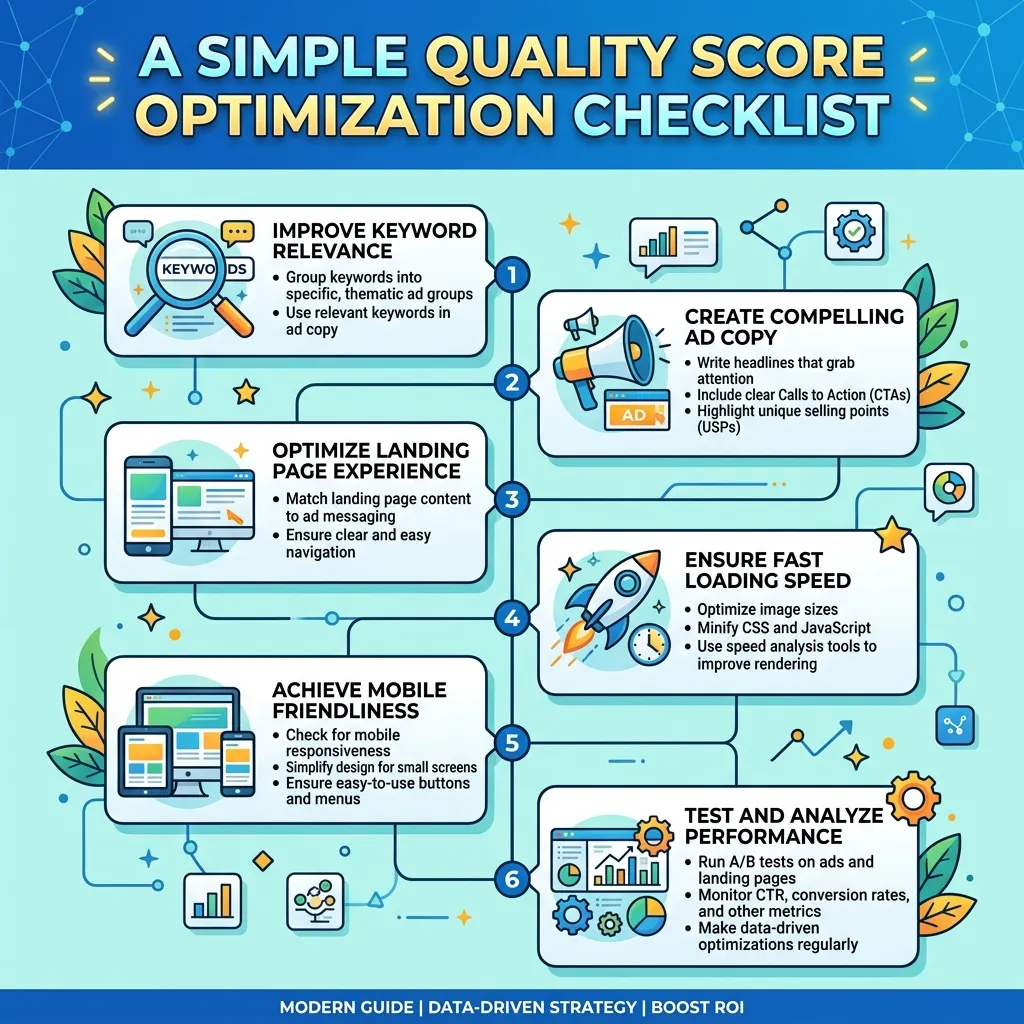
Before launching or optimizing a Search campaign, review the following:
Keyword Relevance
- Are keywords closely related?
- Does each keyword reflect actual search intent?
- Are unrelated terms separated?
Ad Relevance
- Does the ad match the keyword theme?
- Is the benefit clear?
- Is the CTA relevant?
- Does the ad accurately represent the offer?
Landing Page
- Does the page match the advertisement?
- Does it answer the user’s query?
- Is the content useful?
- Is the CTA easy to find?
- Is the page mobile-friendly?
Campaign Performance
- Are users clicking?
- Are users converting?
- Is the traffic relevant?
- Is the cost per conversion acceptable?
Final Thoughts
Google Ads Quality Score is a valuable diagnostic tool for advertisers who want to understand and improve the quality of their Search campaigns.
The score is measured from 1 to 10 and is based on three primary components:
Expected CTR + Ad Relevance + Landing Page Experience
But remember that Quality Score itself is not the auction.
The better approach is to use the score to identify weaknesses in your advertising strategy and then improve the underlying user experience.
Create ads that match search intent. Build focused ad groups. Write relevant and useful copy. Send users to dedicated landing pages. Make the landing experience clear and easy to use.
Most importantly, don’t chase a perfect Quality Score at the expense of actual business results.
The real objective is to build advertising campaigns that attract the right users, provide relevant information, generate conversions, and produce sustainable returns from your advertising budget.
Useful Google Ads Resources
For the most accurate and up-to-date information, advertisers can also explore:
- Google’s official guide to Quality Score
- Google’s guide to using Quality Score for optimization
- Google’s official guide to Ad Rank
- Google Ads guide to ad quality
Frequently Asked Questions
1. What is Google Ads Quality Score?
Google Ads Quality Score is a diagnostic score from 1 to 10 that helps advertisers understand how the quality of their ads and landing pages compares with other advertisers. It is available at the keyword level.
2. What are the three components of Quality Score?
The three primary components are Expected CTR, Ad Relevance, and Landing Page Experience. Google evaluates each component as Above average, Average, or Below average.
3. Does Quality Score directly determine ad position?
No. Quality Score itself is not an input in the ad auction. Ad Rank determines ad eligibility and position and considers several factors, including bid, ad and landing page quality, auction competition, search context, and assets.
4. How can I improve my Quality Score?
Focus on improving the underlying areas identified by the diagnostic: make your ads more relevant, improve expected CTR through useful messaging, and create landing pages that closely match the user’s search and advertisement.
5. Is a Quality Score of 10 always necessary?
No. A 10/10 score should not be treated as the main objective of campaign management. Google recommends using Quality Score as a diagnostic tool and focusing on meaningful improvements to ad quality and campaign performance.



Leave a Reply