


Content marketing is a digital marketing approach that involves creating and sharing valuable, relevant content to attract an audience, build trust, and encourage profitable customer actions. From developing an effective strategy to exploring content marketing tools and the latest trends, businesses can use content to improve visibility, engage potential customers, and achieve long-term growth.
Content Marketing Strategy
A successful content marketing strategy helps businesses attract the right audience and turn their interest into meaningful engagement. Instead of creating content without a clear purpose, companies should identify their target audience, understand their challenges, and develop content that answers their questions. This approach ensures that every blog post, video, email, or social media update supports a specific marketing goal.
Start by researching relevant keywords, analyzing competitors, and choosing the platforms where your audience spends time. Establish measurable objectives, such as increasing organic traffic, generating leads, or improving conversions. A well-planned strategy should also include a content calendar, distribution plan, and performance tracking process. Businesses looking to strengthen their overall approach can explore this social media marketing strategy guide to understand how social platforms can complement their content marketing efforts.
Content Marketing Tips
Effective content marketing requires consistency, relevance, and a clear understanding of customer needs. One of the most useful tips is to focus on solving problems rather than simply promoting products or services. Educational articles, practical tutorials, industry insights, and helpful videos can establish your brand as a reliable source of information.
Another important tip is to make content easy to read and understand. Use descriptive headings, short paragraphs, engaging introductions, and clear examples to improve the reader experience. Optimize content for search engines by naturally including relevant keywords in titles, headings, and body text. You should also repurpose existing material into different formats, such as turning a blog post into a video or an email newsletter. Regularly reviewing engagement and conversion data helps you understand which content resonates most with your audience.
Content Marketing for Beginners
For beginners, content marketing may seem complicated, but getting started does not require a large budget or an extensive team. The first step is to choose a specific audience and identify the information they are actively searching for. For example, a fitness business might publish beginner workout guides, while an online education company could create tutorials that help students choose suitable courses.
Next, select one or two content formats that match your skills and resources. Blogging is useful for answering search queries, while short videos can demonstrate products or explain concepts quickly. Publish consistently and focus on quality rather than producing a large volume of content without a clear purpose. Beginners should also learn basic search engine optimization, audience research, and performance measurement. As your experience grows, you can expand your content channels and refine your approach based on real results.
Content Marketing Benefits
Content marketing offers several long-term benefits for businesses of different sizes. One major advantage is improved search visibility. Publishing useful, well-optimized content can help your website appear for relevant search queries and attract visitors who are already interested in your products or services.
It also builds credibility by demonstrating your knowledge and understanding of customer problems. When people repeatedly find helpful information from your brand, they may become more comfortable considering your offerings. Content can support the entire customer journey, from initial awareness to purchase decisions and customer retention.
Another benefit is that valuable content can continue attracting traffic after publication, unlike some paid advertising campaigns that stop generating visits when spending ends. However, results depend on content quality, competition, distribution, and ongoing optimization. To make these benefits measurable, businesses should regularly review their marketing performance and identify opportunities for improvement through a structured marketing strategy analysis.
Content Marketing Examples
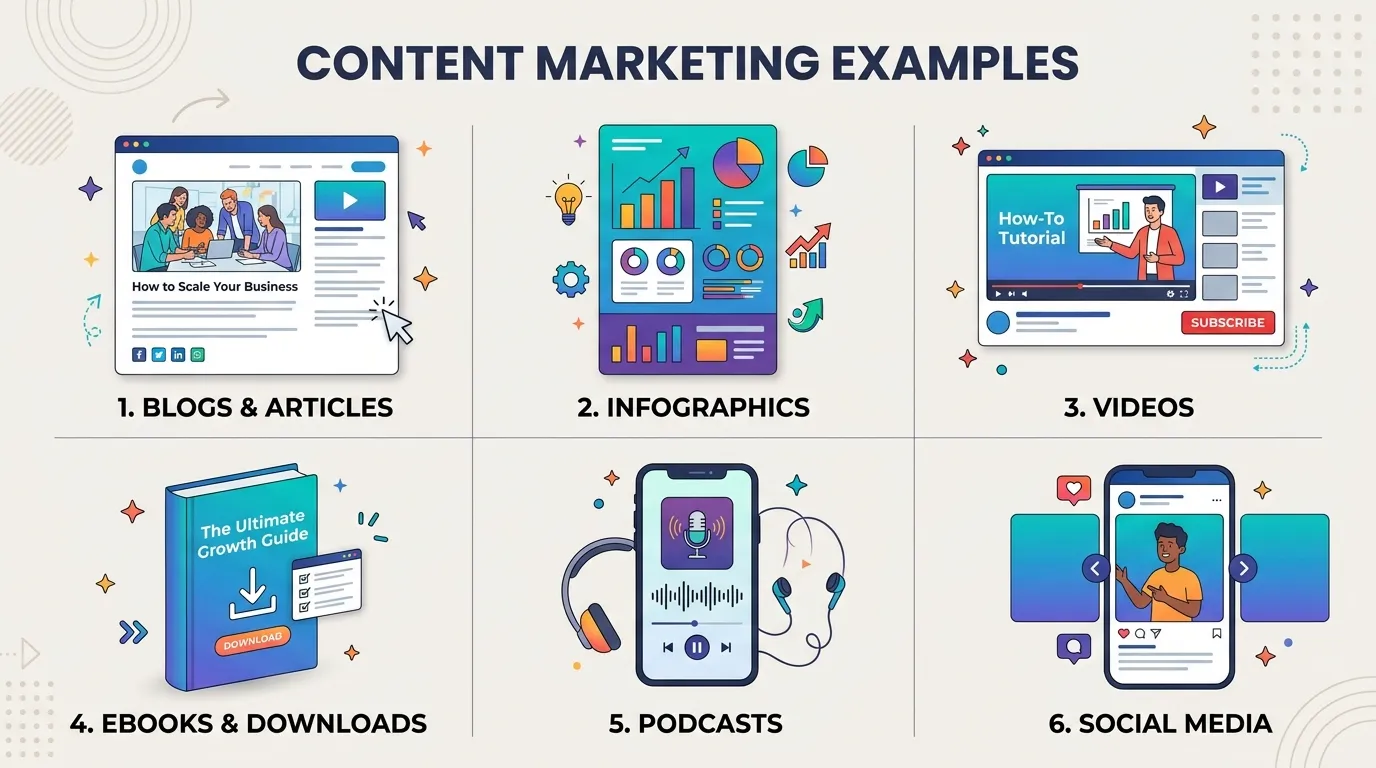 Content marketing can take many forms depending on a business’s goals and audience. Blog articles are a common example because they answer customer questions and help websites attract organic search traffic. A software company, for instance, might publish troubleshooting guides or comparisons that help potential customers understand its solutions.
Video tutorials are another effective format, particularly when a topic requires a visual demonstration. A beauty brand could create skincare tutorials, while a technology business might explain how to use a new feature. Case studies and customer success stories can demonstrate how a product solves real problems and help prospective buyers evaluate their options.
Email newsletters, downloadable guides, infographics, podcasts, and social media posts also support content marketing. For online educators, an especially useful example is sharing valuable lessons through email before introducing a paid course. A practical resource on email marketing for courses can help businesses understand how to nurture subscribers and guide interested learners toward enrollment.
Content Marketing Trends
Content marketing continues to evolve as audience preferences, search technology, and digital platforms change. One important trend is the growing use of artificial intelligence to support research, brainstorming, editing, and content planning. These tools can improve efficiency, but human review remains essential for accuracy, originality, and a distinctive brand voice.
Short-form video is another popular format because it delivers information quickly and encourages audience engagement. Interactive content, including quizzes, calculators, and assessments, can also help businesses provide more personalized experiences.
Authenticity is increasingly important as audiences encounter large amounts of online content. Original research, expert commentary, real customer experiences, and firsthand examples can help brands stand out. Businesses should also consider how people discover information through traditional search engines, social platforms, and AI-powered search experiences. Rather than following every trend, focus on formats and channels that genuinely support your audience’s needs and business objectives.
Digital Content Marketing
Digital content marketing involves creating and distributing valuable information through online channels. These include websites, search engines, social media platforms, email newsletters, podcasts, and video-sharing services. Its main purpose is to attract relevant audiences, build relationships, and encourage actions such as subscribing, requesting a consultation, or making a purchase.
A strong digital content marketing approach connects different channels instead of treating them as separate activities. For example, a business can publish an SEO-focused article, share its key insights on social media, and send a summary to its email subscribers. This allows the same core idea to reach people through different touchpoints.
To measure performance, monitor indicators such as website traffic, engagement, email sign-ups, qualified leads, and conversions. The most useful metrics depend on your goals. A campaign designed to build awareness may prioritize reach and engagement, while a lead-generation campaign should focus more on qualified inquiries and conversion rates.
Content Marketing Tools
Content marketing tools help businesses research topics, organize campaigns, produce material, and measure results. Keyword research and analytics platforms can reveal what audiences search for and how visitors interact with published pages. Content management systems make it easier to publish and update website articles, while project management tools help teams coordinate deadlines and responsibilities.
Writing and editing tools can improve readability, and graphic design applications can help create visual content for blogs, newsletters, and social media. Email marketing platforms support subscriber management, automated campaigns, and performance tracking. Social media scheduling tools can simplify publishing across multiple channels.
However, using more tools does not automatically lead to better results. Beginners should start with a manageable set of tools that addresses their immediate needs. Prioritize essential functions such as keyword research, content organization, analytics, and distribution before investing in advanced software. Review your tools periodically to ensure they save time, support your strategy, and provide useful insights.
Content Creation Strategy
A content creation strategy establishes how your business will plan, produce, review, and publish content consistently. It begins with audience research and topic selection, followed by choosing appropriate formats and assigning clear responsibilities. Each piece of content should have a defined purpose, whether it is educating readers, increasing awareness, generating leads, or supporting existing customers.
Create an editorial calendar that outlines topics, target keywords, publishing dates, and distribution channels. Before publishing, verify factual claims, review grammar, add relevant internal links, and ensure the content provides genuine value. Original examples and expert insights can make your material more useful than generic articles covering the same subject.
Content creation should not end when an article goes live. Update older posts when information changes, improve pages that receive impressions but few clicks, and expand successful topics with related content. Repurposing existing material can also help you reach different audiences without starting from scratch every time. A repeatable creation process improves consistency and makes it easier to maintain quality as your content library grows.
Content Marketing Best Practices
 Following content marketing best practices helps businesses build sustainable results rather than relying on occasional campaigns. Start by putting audience needs first and making sure every piece of content answers a relevant question or addresses a genuine challenge. Avoid keyword stuffing, misleading headlines, and unnecessary promotional language that reduces reader trust.
Use a clear heading structure, descriptive page titles, useful internal links, and relevant calls to action. Internal linking helps readers discover related resources and helps search engines understand how your pages connect. Keep content accurate, original, accessible, and easy to navigate on mobile devices.
Consistency is also essential. Publish at a realistic pace, distribute content through appropriate channels, and review performance regularly. Use analytics to identify which topics attract qualified visitors and which pages need improvement. Most importantly, measure success against business objectives rather than publishing volume alone. By combining useful information, thoughtful optimization, and ongoing evaluation, businesses can develop a content marketing program that supports long-term growth.
Conclusion
Content marketing is an effective way for businesses to attract the right audience, build trust, and achieve long-term growth. By developing a clear content marketing strategy, following proven best practices, and creating valuable content, businesses can improve their online visibility and strengthen relationships with potential customers. From blog posts and videos to email campaigns and social media content, every format offers an opportunity to educate audiences and encourage meaningful engagement.
FAQ
What is content marketing?
Content marketing is the practice of creating and sharing valuable, relevant content to attract an audience, build trust, and encourage profitable customer actions.
What are the main types of content marketing?
Common types include blog posts, videos, email newsletters, social media content, podcasts, infographics, case studies, and downloadable guides.
Why is content marketing important?
It helps businesses improve online visibility, educate potential customers, build credibility, generate leads, and maintain relationships with existing customers.
How do beginners start content marketing?
Beginners should identify their target audience, research relevant topics, select suitable content formats, publish consistently, and track performance.
What is a content marketing strategy?
A content marketing strategy is a plan that defines the target audience, marketing goals, content topics, distribution channels, publishing schedule, and success metrics.
How often should a business publish content?
The ideal publishing frequency depends on your resources, audience, and goals. A consistent schedule that maintains quality is more valuable than publishing frequently without a clear purpose.
Which content marketing channels are most effective?
The best channels depend on your audience. Search-optimized blog posts, social media, email marketing, and video can all be effective when aligned with your goals.
What tools are useful for content marketing?
Useful tools include keyword research platforms, website analytics, content management systems, writing tools, graphic design software, and email marketing platforms.
How can you measure content marketing success?
Measure results using relevant metrics such as organic traffic, engagement, subscriber growth, qualified leads, conversion rates, and customer retention.
How long does content marketing take to produce results?
Results vary depending on competition, content quality, distribution, and consistency. Some campaigns generate engagement quickly, while organic search growth often requires several months of sustained effort and optimization.



Leave a Reply