

The integration of generative AI into digital workflows is fundamentally changing how professionals operate. Using targeted chatgpt prompts for marketing allows teams to bypass the blank page and move directly into editing and strategic execution. From writing engaging social media captions and drafting SEO-optimized blog posts, to analyzing competitor strategies and defining audience personas, ChatGPT for Digital Marketing acts as a versatile extension of your team. The key to unlocking this potential lies in prompt engineering: assigning roles, defining clear tasks, providing context, and specifying formats.
Digital marketing strategies require constant innovation to capture audience attention and drive meaningful engagement. Marketers face increasing pressure to produce high-quality content, analyze complex data sets, and launch targeted campaigns faster than ever before. Meeting these demands manually drains resources and limits creative potential.
Generative artificial intelligence offers a powerful solution to this productivity challenge. ChatGPT, an advanced language model, enables professionals to automate routine tasks, brainstorm fresh ideas, and generate polished copy in seconds. However, the true value of this tool depends entirely on how you communicate with it.
Learning how to use chatgpt prompts for marketing can completely revolutionize your daily workflow. The right instructions turn a generic AI response into a highly specific, brand-aligned asset. By mastering prompt engineering, you unlock unprecedented efficiency and scale your creative output without sacrificing quality.
This comprehensive guide explains everything you need to know about chatgpt prompts for marketing. You will learn the fundamental rules of prompt engineering, discover highly effective prompt templates for various digital marketing channels, and explore how to leverage AI for complex strategy and SEO tasks.
Understanding the Basics: How ChatGPT Works for Marketers
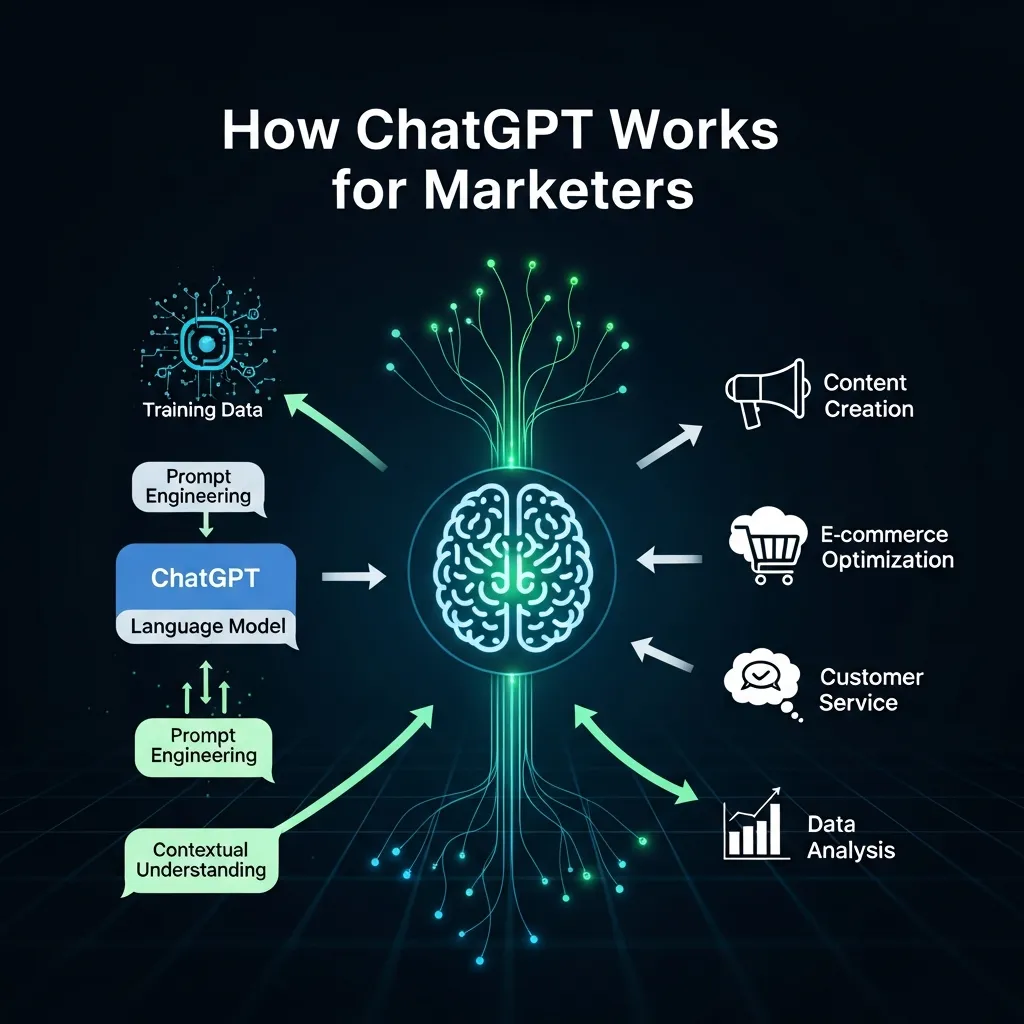
Artificial intelligence has quietly supported digital marketing efforts for years, primarily through programmatic advertising, predictive analytics, and basic chatbots. The release of advanced conversational models shifted this dynamic. AI is no longer just a backend analytical tool; it is a collaborative creative partner. Using ChatGPT for Marketing allows professionals to interact directly with the technology to produce tangible, forward-facing assets.
ChatGPT possesses remarkable capabilities tailored for digital marketing workflows. It excels at rapid content generation, taking a brief concept and expanding it into a full article, email sequence, or ad script. It also serves as a tireless brainstorming partner, offering dozens of angles for a single campaign. Furthermore, it can process raw text to extract key themes, summarize competitor data, or reformat information for different platforms.
The primary benefit of utilizing chatgpt prompts for marketing is a massive increase in efficiency. Tasks that traditionally required hours of drafting and editing can be completed in a fraction of the time. This efficiency naturally breeds enhanced creativity, as marketers spend less time staring at a blank page and more time refining AI-generated concepts. Scalability also improves drastically, allowing small teams to execute campaigns that would normally require a large department.
Crafting Effective ChatGPT Prompts for Marketing: The Fundamentals
The output you receive from artificial intelligence directly mirrors the quality of the instructions you provide. Precision matters immensely. A vague request yields a generic, often unusable response. Conversely, applying the principles of prompt engineering ensures the AI understands your specific goals, brand voice, and audience parameters. Crafting the best chatgpt prompts for marketing requires a structured approach.
Every highly effective prompt contains four distinct components:
- Role Assignment: Tell the AI exactly who it should be. Starting your chatgpt prompts for marketing with “Act as a senior digital marketing strategist” or “Adopt the persona of an expert copywriter” sets the baseline for the knowledge and tone the AI will apply.
- Clear Task Definition: State the exact action you want the AI to perform. Instead of saying “write about software,” use clear directives like “Generate 5 headline ideas for a new email marketing platform.”
- Context and Constraints: Provide the necessary background information. Good chatgpt prompts for marketing include details like “Our target audience is B2B SaaS founders,” “Focus heavily on the ROI of the product,” or “Do not use overly technical jargon.”
- Desired Output Format: Specify how you want the information presented. You might ask the AI to deliver the response “in a bulleted list,” “as a markdown table,” or “in a 300-word paragraph.”
Even with the perfect structure, your initial output might need adjustments. Iteration is a core part of using ChatGPT for Digital Marketing. If the tone is too formal, reply with “Make the tone more conversational and friendly.” If the ideas are too broad, ask it to “Focus specifically on local search strategies.” Refining your chatgpt prompts for marketing through ongoing dialogue always produces superior results.
ChatGPT Prompts for Content Creation
Content creation remains one of the most popular and effective applications for generative AI. By utilizing specific chatgpt prompts for marketing, you can accelerate your production schedule across every major channel.
Blog Post Ideas & Outlines
Generating fresh blog topics consistently challenges even the most experienced content teams. ChatGPT can instantly analyze your niche and suggest relevant, engaging ideas. Once you select a topic, it can map out the entire structure.
- Prompt example: “Act as an expert content marketer. Generate 10 blog post topics about sustainable fashion specifically tailored for Gen Z consumers. Ensure the topics address current environmental concerns.”
- Prompt example: “Create a detailed outline for a blog post titled ‘The Future of AI in Content Marketing’. Include an introduction, three main body sections with H2 and H3 subheadings, and a conclusion. Outline the key points to cover under each heading.”
Social Media Captions & Ideas
Social media demands high-volume, rapid-fire content. You can use chatgpt prompts for marketing to brainstorm visual concepts and write the accompanying captions in minutes.
- Prompt example: “Write 5 engaging Instagram captions for a new local coffee shop. Focus on creating a cozy, welcoming vibe. Include relevant hashtags and a call-to-action asking followers about their favorite morning beverage.”
- Prompt example: “Act as a social media strategist. Brainstorm 3 viral TikTok video ideas for a skincare brand targeting millennials. Describe the visual hook, the audio style, and the on-screen text for each video.”
Email Marketing Copy
Writing emails that drive high open and click-through rates requires persuasive copywriting. ChatGPT can help draft compelling subject lines and engaging body copy tailored to your specific audience segments.
- Prompt example: “Draft 10 highly clickable email subject lines for a 48-hour flash sale on winter apparel. Make half of them urgent and half of them curiosity-driven.”
- Prompt example: “Write the body copy for a welcome email going out to new newsletter subscribers of a fitness brand. The tone should be motivating and energetic. Include a brief introduction to the brand and a call-to-action to check out our workout guides.”
Website Copy & Landing Pages
Landing pages need to be concise, benefit-driven, and optimized for conversions. Effective chatgpt prompts for marketing can help you structure your page and write persuasive elements.
- Prompt example: “Act as a conversion rate optimization expert. Generate compelling hero text (headline and subheadline) for a landing page promoting a new project management software tool designed for remote teams.”
- Prompt example: “Write 3 distinct, action-oriented call-to-action buttons for an e-commerce product page selling ergonomic office chairs.”
ChatGPT Prompts for SEO and Keyword Research
Search engine optimization relies heavily on data and precise targeting. While AI cannot replace dedicated SEO software for live search volume metrics, it is an incredible tool for brainstorming, semantic grouping, and on-page optimization. Using chatgpt prompts for marketing specifically for SEO streamlines the research process.
Keyword Generation
Finding the right long-tail variations and semantic keywords is essential for building topical authority. ChatGPT can quickly expand a core concept into a comprehensive keyword list.
- Prompt example: “Act as an SEO specialist. List 20 long-tail keywords related to the core topic ‘vegan meal prep delivery service’. Group them by user intent (informational, navigational, transactional).”
- Prompt example: “Suggest 15 semantic keywords and LSI variations for a comprehensive blog post about ‘remote work productivity tips’. These should be naturally woven into the content.”
Meta Descriptions & Titles
Writing unique meta descriptions and titles for hundreds of pages is tedious. Automate this process using chatgpt prompts for marketing to ensure every page is optimized for click-through rates.
- Prompt example: “Write a compelling, SEO-friendly meta description under 155 characters for a product page selling handmade silver jewelry. Include the phrase ‘artisan silver rings’.”
- Prompt example: “Generate 5 SEO-friendly blog post titles for an article about ‘how to choose the best CRM software’. Make them catchy and keep them under 60 characters.”
Content Optimization Suggestions
You can feed existing drafts into the AI and ask it to evaluate the text against SEO best practices.
- Prompt example: “Act as an on-page SEO editor. Analyze the following text [insert text here] and suggest specific improvements. Focus on better keyword integration, improving header structure, and identifying areas to increase readability.”
ChatGPT Prompts for Marketing Strategy & Analysis
Beyond basic copywriting, ChatGPT serves as an analytical assistant. You can use complex chatgpt prompts for marketing to synthesize market research, evaluate competitors, and define audience personas.
Competitor Analysis
Understanding your competitive landscape requires sifting through massive amounts of text. You can paste competitor content, mission statements, or product descriptions into the prompt and ask for summaries.
- Prompt example: “Act as a market researcher. Summarize the core marketing strategies and unique value propositions of [Competitor A] and [Competitor B] based on the following text from their ‘About Us’ pages: [insert text].”
Audience Profiling
Creating accurate buyer personas ensures your messaging hits the mark. ChatGPT can help flesh out these profiles based on your product details.
- Prompt example: “Create a detailed buyer persona for a B2B financial software product targeting mid-sized logistics companies. Include their daily challenges, primary goals, preferred content channels, and common objections to purchasing new software.”
Ready to Transform Your Marketing Strategy?

Embracing generative AI is no longer an optional tactic for digital professionals; it is a vital step for staying competitive. By learning how to formulate precise, detailed chatgpt prompts for marketing, you empower yourself to work faster, think bigger, and execute campaigns with unmatched efficiency. Start by testing the prompt examples provided in this guide. Adapt them to your brand’s unique voice, experiment with different instructions, and watch your daily productivity soar. The future of digital marketing relies on human-AI collaboration, and your journey starts with a single, well-crafted prompt.
Frequently Asked Questions (FAQ)
1. What are chatgpt prompts for marketing?
They are specific text instructions given to the ChatGPT AI model designed to generate marketing-related content, strategies, or data analysis. Good prompts include role assignments, context, and clear deliverables.
2. How can I use ChatGPT for Marketing effectively?
You use it effectively by applying it to tasks like brainstorming content ideas, drafting email copy, outlining blog posts, and generating SEO meta tags. The secret is to use precise, highly detailed chatgpt prompts for marketing.
3. Does using chatgpt prompts for marketing replace human writers?
No. ChatGPT is a tool that enhances human productivity. It drafts and brainstorms quickly, but human marketers are still required to edit the output, ensure brand voice consistency, and verify factual accuracy.
4. How do I make my chatgpt prompts for marketing yield better results?
Improve your results by being more specific. Tell the AI the exact format you want, the target audience, the tone of voice, and the primary goal of the content. Iterating and refining your prompts is also essential.
5. Can chatgpt prompts for marketing help with SEO?
Yes. You can use prompts to generate long-tail keyword ideas, write SEO-friendly meta titles and descriptions, and structure article outlines to cover semantic search topics comprehensively.
6. Is it safe to use ChatGPT for Digital Marketing data analysis?
It is safe for analyzing public or anonymized data. However, you should never paste confidential company data, sensitive customer information, or proprietary financial numbers into a public AI tool.
7. How long should chatgpt prompts for marketing be?
There is no strict limit, but detailed prompts generally perform better. A prompt can be a single sentence or a few paragraphs long, provided it clearly outlines the role, task, context, and desired output format.
8. Can I use chatgpt prompts for marketing to write a full blog post?
You can, but the best approach is to generate the post in sections. Ask the AI for an outline first, then use specific chatgpt prompts for marketing to write each individual section. This gives you much more control over the final quality.
9. Why do my chatgpt prompts for marketing sound robotic?
If the output sounds robotic, your prompt likely lacks tone instructions. Always include directives like “write in a conversational tone,” “use humor,” or “write at an 8th-grade reading level” to make the text sound more human.
10. What is the most important part of chatgpt prompts for marketing?
Context is arguably the most important part. The AI needs to know who the target audience is and what the ultimate goal of the marketing asset is in order to generate relevant and persuasive copy.
11. Can chatgpt prompts for marketing assist with social media strategy?
Absolutely. You can use prompts to generate content calendars, brainstorm viral video ideas, write caption variations, and suggest relevant hashtags for specific social media platforms.
12. Do I need to buy a special version of ChatGPT for Marketing?
No, you can use the standard free or Plus versions. While enterprise versions offer more data security, the underlying model responds to effective chatgpt prompts for marketing exactly the same way.



Leave a Reply