

The digital marketing industry is constantly evolving as technology, consumer expectations, and online platforms continue to change. Businesses must understand the latest marketing trends to remain competitive, attract potential customers, and build long-term relationships with their audiences. From artificial intelligence and social media marketing to influencer partnerships, search engine optimization, and marketing automation, modern strategies are transforming how brands communicate with consumers. This article explores the most important developments, emerging opportunities, and practical strategies businesses can use to improve their marketing performance and achieve sustainable growth.
Latest Digital Marketing Trends
The digital marketing landscape is changing faster than ever. Businesses can no longer depend entirely on traditional promotional methods because consumers increasingly discover products, compare services, and make purchasing decisions through digital channels. Understanding the latest marketing trends helps companies adapt to these changes and develop more effective promotional campaigns. One major development is the growing importance of personalized marketing. Customers expect brands to understand their interests and provide relevant recommendations, advertisements, and experiences. Businesses are using customer data, browsing behavior, and purchase histories to create targeted campaigns that connect with specific audiences. Another important development is video marketing. Short-form videos, live streaming, product demonstrations, and educational content are becoming powerful ways to attract attention.
Platforms such as Instagram, TikTok, YouTube, and Facebook allow brands to communicate their messages through engaging visual content. Businesses are also combining multiple digital channels to create consistent customer experiences. For example, a potential customer might discover a brand through social media, visit its website through a search engine, and eventually make a purchase after receiving an email promotion. A coordinated strategy helps businesses reach customers at different stages of their buying journey. Companies that monitor these developments and continuously improve their campaigns can build stronger online visibility and maintain a competitive advantage.
Emerging Marketing Strategies
Emerging marketing strategies are helping businesses connect with customers in more meaningful and measurable ways. Instead of focusing only on increasing website traffic or generating immediate sales, modern businesses are prioritizing customer relationships, brand awareness, and long-term engagement. One effective approach is experience-based marketing. This strategy focuses on creating memorable interactions between customers and brands. Interactive advertisements, online events, product demonstrations, virtual experiences, and personalized recommendations can make a business more recognizable.
Another growing approach is community-based marketing. Brands are creating online communities where customers can discuss products, share experiences, ask questions, and interact with other consumers. These communities encourage trust and help businesses understand customer expectations. Companies are also exploring new ways to improve their advertising campaigns. A well-planned marketing campaign can combine social media promotions, search engine advertising, email marketing, and content creation to reach the right audience.
Sustainability and social responsibility are becoming important considerations as well. Consumers increasingly pay attention to how businesses treat employees, manage resources, and contribute to society. Authentic communication about these efforts can strengthen brand credibility. The most successful emerging marketing strategies are those that combine creativity, technology, and a genuine understanding of customer needs.
Future of Digital Marketing
The future of digital marketing will be shaped by technological innovation, changing consumer expectations, and the growing importance of data-driven decision-making. Businesses will need to become more flexible and responsive as new platforms and communication methods emerge. Artificial intelligence will play an increasingly important role in campaign planning, customer support, content development, and audience analysis. Businesses will be able to process large amounts of information more efficiently and identify patterns that help improve marketing decisions.
Voice search and conversational search are also expected to influence how people discover information online. Consumers are increasingly using natural language when asking questions through smartphones, voice assistants, and AI-powered search tools. Businesses should therefore create helpful content that directly answers relevant questions.
Privacy will also remain a major concern. Customers want personalized experiences, but they also expect companies to protect their personal information. Transparent data collection practices and responsible marketing will become essential for maintaining trust. Another important development is the integration of online and offline experiences. Businesses are connecting websites, mobile applications, physical stores, and customer service channels to create a smoother purchasing journey. Companies that invest in innovation while maintaining customer trust will be better positioned to benefit from future marketing trends.
Social Media Marketing Trends
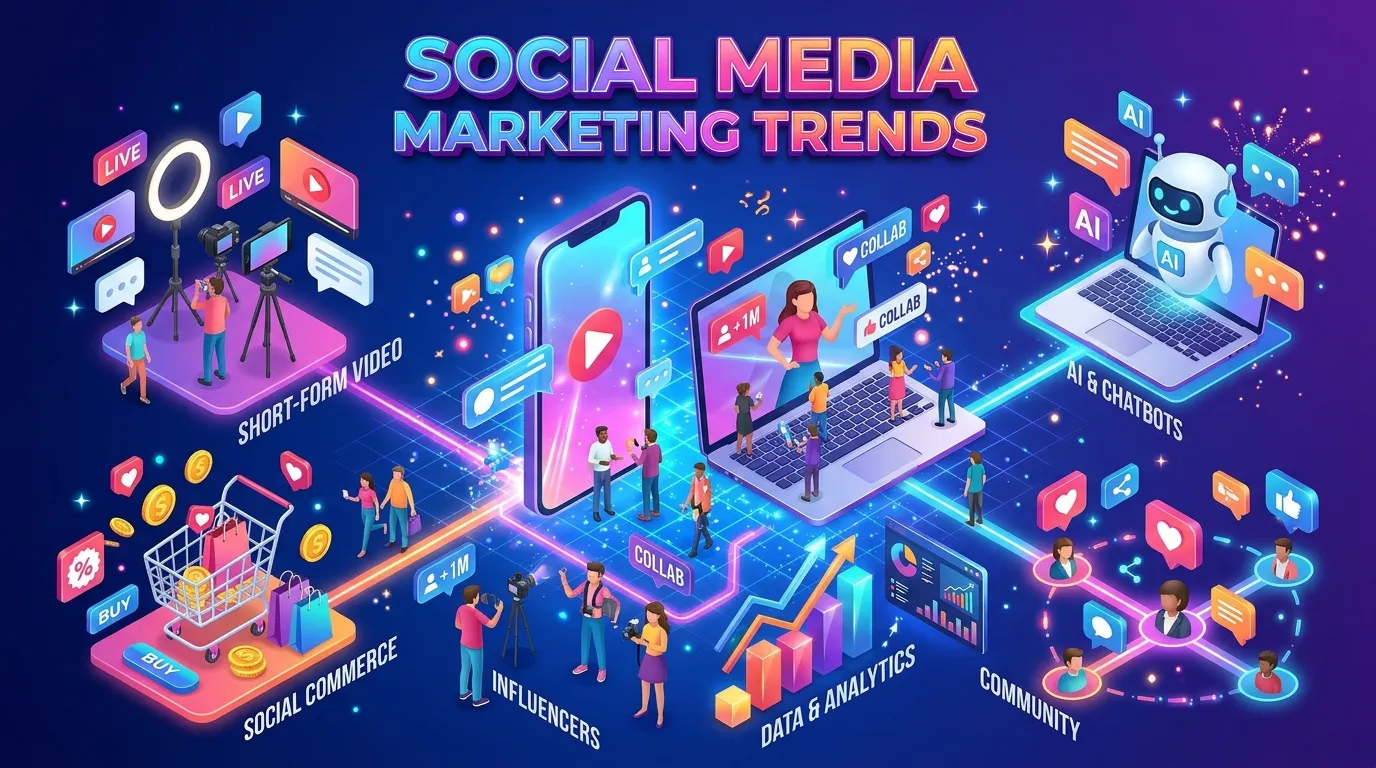 Social media has become one of the most influential channels for business promotion. Platforms such as Facebook, Instagram, TikTok, LinkedIn, and YouTube provide opportunities to reach specific audiences, communicate brand messages, and build lasting customer relationships. Short-form video content is one of the most noticeable developments. Consumers often prefer quick, entertaining, and informative videos rather than lengthy promotional messages. Businesses can use tutorials, behind-the-scenes content, customer testimonials, and product demonstrations to increase engagement.
Social commerce is another important development. Many platforms now provide shopping-related features that allow customers to discover products and move toward purchasing without leaving the social media environment. This creates a more convenient shopping experience. Paid advertising also remains valuable for businesses looking to reach targeted audiences. For example, companies operating online stores can explore Facebook ads for ecommerce to understand how targeted advertising can attract potential buyers and support online sales.
Authenticity is equally important. Consumers are more likely to engage with brands that communicate naturally rather than relying entirely on overly promotional messages. Responding to comments, answering questions, and sharing genuine customer experiences can improve brand relationships. Businesses should choose platforms based on their target audience instead of trying to maintain an active presence everywhere. Consistency, creativity, and meaningful interaction are essential for successful social media marketing.
Content Marketing Strategies
Content marketing remains an essential method for attracting, educating, and retaining customers. Instead of directly promoting products in every message, businesses provide useful information that helps audiences understand problems and discover possible solutions. High-quality blog articles are particularly valuable because they can attract organic search traffic and establish a business as a reliable source of information. Well-researched articles, practical guides, tutorials, and industry insights can answer customer questions while introducing relevant products or services.
Video content, infographics, podcasts, and downloadable resources also help businesses communicate information in different formats. Using multiple content formats allows brands to reach audiences with different preferences. Search intent should guide content creation. Before publishing an article, businesses should understand what their target audience wants to learn. Content that provides clear answers and practical value is more likely to attract attention and encourage visitors to explore additional pages.
Another effective strategy is content repurposing. A single detailed blog post can become several social media posts, a short video, an email newsletter, or an infographic. This approach helps businesses maintain consistency without creating completely new material every time. Modern marketing trends demonstrate that valuable content should prioritize usefulness, originality, accuracy, and readability. Businesses should also update older articles regularly to maintain relevance and provide accurate information.
AI in Digital Marketing
Artificial intelligence is transforming how companies plan, manage, and evaluate their marketing activities. AI-powered tools can analyze customer behavior, identify audience patterns, generate content ideas, automate repetitive tasks, and support faster decision-making. One major application is predictive analytics. Businesses can examine historical customer information to identify purchasing patterns and estimate which products or services may interest particular audiences. These insights can help marketers develop more relevant campaigns.
AI chatbots are also improving customer communication. They can answer frequently asked questions, provide product information, guide website visitors, and assist customers outside regular business hours. This can reduce response times and improve the overall customer experience. Content creation is another area experiencing significant change. AI tools can help marketers generate topic ideas, prepare outlines, summarize research, and improve existing content. However, human review remains essential to ensure originality, accuracy, brand consistency, and meaningful insights.
AI-powered advertising platforms can also support audience targeting and campaign optimization. By analyzing performance data, marketers can identify opportunities to improve advertising results and allocate budgets more effectively. Although artificial intelligence is one of the most influential marketing trends, businesses should not depend on automation alone. Human creativity, strategic thinking, ethical decision-making, and authentic communication remain important elements of successful marketing.
Search Engine Optimization Trends
 Search engine optimization continues to be a fundamental part of digital marketing. It helps businesses improve their visibility in search results, attract relevant website visitors, and establish credibility within their industries. Search engines are becoming increasingly sophisticated in understanding search intent and content quality. Therefore, businesses should focus on creating helpful, relevant, and original content instead of simply repeating keywords throughout their pages.
One important SEO approach is topic-based content development. Rather than publishing unrelated articles, businesses can create comprehensive content around specific subjects and connect related pages through internal links. This structure helps readers discover additional information and allows search engines to understand relationships between website topics. Technical SEO is equally important. Website speed, mobile responsiveness, secure browsing, clear navigation, and proper indexing all contribute to a better website experience. Businesses should regularly review technical performance to identify issues that may affect search visibility.
Another significant development is the growing influence of AI-powered search experiences. Search results may provide summarized answers and conversational responses, making it important for businesses to publish accurate, well-organized information that clearly addresses user questions. E-E-A-T, which stands for Experience, Expertise, Authoritativeness, and Trustworthiness, is also an important quality concept in Google’s search guidance. Businesses should monitor keyword performance, organic traffic, search rankings, and user engagement to understand which SEO activities are producing meaningful results. Following these marketing trends can help companies develop a sustainable search strategy rather than relying on short-term ranking techniques.
Influencer Marketing Trends
Influencer marketing has become an effective promotional strategy because consumers often value recommendations from people they follow and trust. Instead of communicating exclusively through traditional advertisements, brands collaborate with content creators who have established relationships with specific audiences. One important development is the growing popularity of micro-influencers. These creators generally have smaller audiences than major celebrities, but they may generate stronger engagement within specialized communities. Their content can feel more personal and relatable.
Authenticity is another major factor. Consumers are becoming more selective about promotional content, so businesses should collaborate with influencers whose values, interests, and audience demographics align with their brands. Long-term partnerships are also becoming more valuable than isolated promotional posts. Ongoing collaborations allow creators to introduce products naturally and provide audiences with consistent brand exposure.
Businesses should evaluate influencer campaigns using measurable indicators such as engagement, website visits, conversions, audience relevance, and return on investment. Follower counts alone do not necessarily indicate campaign success. Disclosure and transparency are essential. Sponsored relationships should be communicated clearly so audiences understand when content includes paid promotion. Among the important marketing trends, influencer marketing demonstrates how trust, community relationships, and authentic recommendations can influence consumer decisions.
Marketing Automation Strategies
Marketing automation allows businesses to manage repetitive marketing activities through software and predefined workflows. It helps companies communicate with customers efficiently while maintaining consistent engagement across different channels. Email automation is one of the most common applications. Businesses can send welcome messages, product recommendations, abandoned-cart reminders, follow-up emails, and special offers based on customer actions.
Customer segmentation makes these campaigns more effective. Instead of sending identical messages to everyone, businesses can organize audiences according to interests, purchase history, engagement levels, and other relevant information. Lead nurturing is another valuable application. When someone subscribes to a newsletter or downloads a resource, an automated sequence can provide helpful information and gradually introduce relevant products or services.
Automation can also support customer relationship management. By connecting marketing tools with CRM systems, businesses can maintain organized customer records and coordinate communication between marketing and sales teams. However, automation should not make communication feel impersonal. Businesses must regularly review their workflows, update messaging, and ensure customers receive relevant information at appropriate times. The most effective marketing trends in automation focus on improving efficiency without sacrificing the human connection that makes customer relationships valuable.
Consumer Behavior Trends
 Understanding consumer behavior is essential for developing successful marketing strategies. Customers’ expectations, purchasing habits, and decision-making processes continue to evolve as technology and online shopping experiences change. Today’s consumers often research products before making purchasing decisions. They compare prices, read customer reviews, watch product demonstrations, and explore social media discussions to evaluate different options.
Convenience is another major purchasing factor. Customers increasingly expect fast websites, simple checkout processes, flexible payment options, and responsive customer support. Businesses that remove unnecessary barriers from the buying journey can improve customer satisfaction. Personalization also influences purchasing decisions. Relevant product recommendations, customized offers, and useful communication can make customers feel understood. However, personalization must be balanced with privacy and responsible data management.
Brand reputation plays an important role as well. Positive reviews, transparent policies, reliable products, and responsive customer service can increase consumer confidence. Businesses should also pay attention to changing economic conditions, cultural preferences, and lifestyle developments. These factors influence what customers purchase, how much they spend, and which brands they prefer. Keeping track of consumer behavior is one of the most important marketing trends because effective marketing begins with understanding the people a business wants to serve.
Conclusion
Digital marketing continues to evolve as new technologies, platforms, and consumer expectations reshape the business environment. From artificial intelligence and search engine optimization to social media, influencer partnerships, and marketing automation, businesses have more opportunities than ever to connect with their audiences. However, adopting every new strategy is not necessary. Companies should identify the approaches that align with their objectives, target customers, and available resources. Consistent performance monitoring, valuable content, responsible technology use, and customer-focused communication are essential for sustainable results. By understanding these marketing trends and adapting to meaningful industry developments, businesses can strengthen their online presence, build customer trust, and create effective strategies for long-term growth.
FAQ
1. What are the latest marketing trends?
The latest marketing trends include artificial intelligence, short-form video content, personalized advertising, influencer partnerships, social commerce, marketing automation, and AI-powered search experiences. Businesses are adopting these approaches to improve customer engagement and marketing performance.
2. Why are marketing trends important for businesses?
Understanding industry developments helps businesses identify new opportunities, respond to changing customer expectations, and remain competitive. It also allows companies to improve their promotional strategies and use marketing budgets more effectively.
3. How is AI changing digital marketing?
AI is helping businesses analyze customer data, personalize recommendations, automate communication, optimize advertisements, and generate content ideas. It improves efficiency while allowing marketers to make more informed decisions.
4. What is the future of digital marketing?
The future will involve greater use of artificial intelligence, conversational search, personalized customer experiences, privacy-focused advertising, and integrated digital platforms. Businesses will increasingly combine technology with human creativity.
5. Which social media platform is best for marketing?
The best platform depends on the target audience and business objectives. Instagram and TikTok are useful for visual and short-form video content, Facebook supports community engagement and advertising, LinkedIn is valuable for B2B marketing, and YouTube is effective for long-form video content.
6. Is content marketing still effective?
Yes, content marketing remains an effective strategy for building brand awareness, attracting organic traffic, educating customers, and establishing industry credibility. High-quality, relevant, and original content can deliver long-term value.
7. How can small businesses follow new marketing trends?
Small businesses can start by monitoring industry developments, understanding customer needs, experimenting with affordable digital tools, publishing useful content, and measuring campaign performance. They should prioritize strategies that provide measurable value.
8. What role does SEO play in modern marketing?
SEO helps businesses improve their visibility in search engines and attract visitors who are actively looking for relevant information, products, or services. Strong SEO combines quality content, technical optimization, search intent, and a positive user experience.
9. How does marketing automation improve business performance?
Marketing automation reduces repetitive tasks, improves customer communication, supports lead nurturing, and helps businesses deliver personalized messages. It saves time and allows marketing teams to focus on strategy and creative work.
10. How often should businesses update their marketing strategies?
Businesses should review their marketing performance regularly, ideally every month or quarter, depending on their campaign activity. They should make adjustments when customer behavior, platform features, business objectives, or industry conditions change.



Leave a Reply