

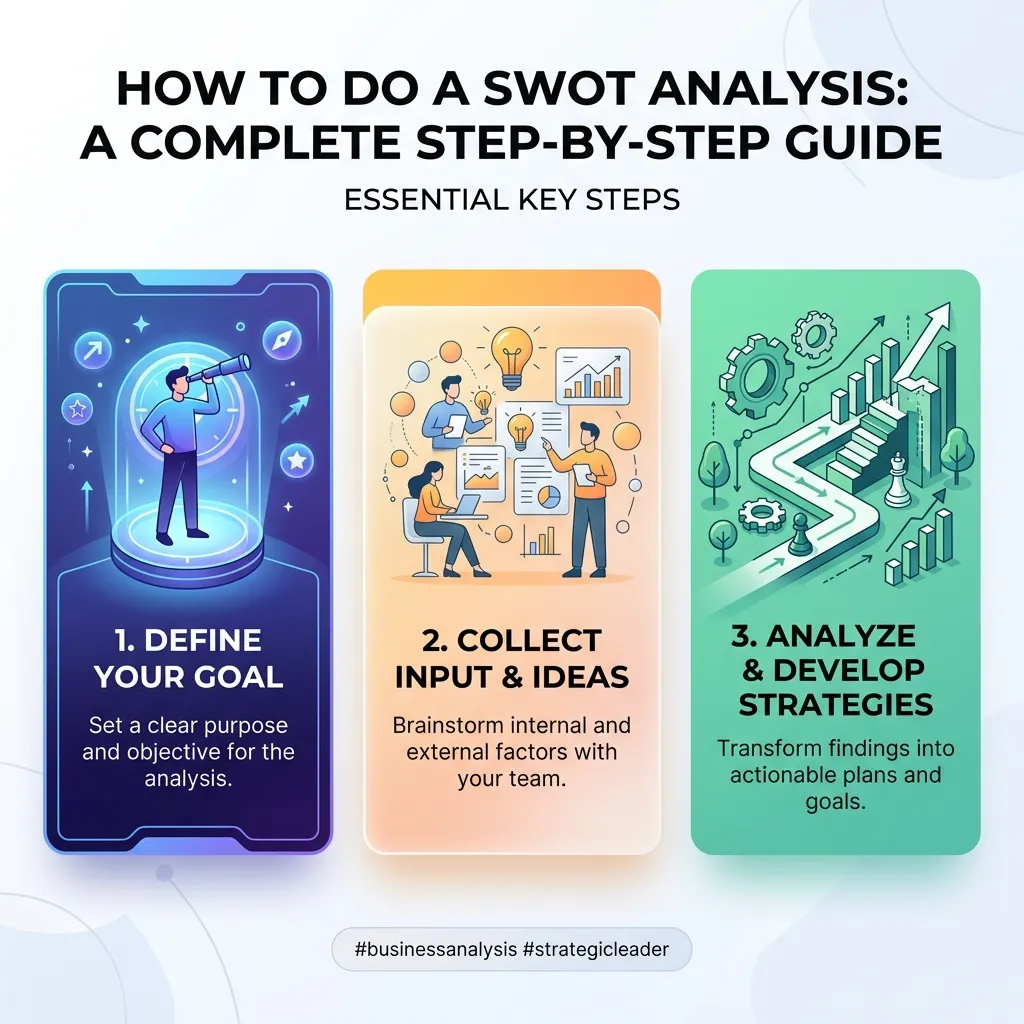
A SWOT analysis is one of the simplest yet most powerful strategic planning tools any business, marketer, or individual can use. It helps you evaluate four critical dimensions — Strengths, Weaknesses, Opportunities, and Threats — so you can make smarter decisions with the resources you already have. This guide walks you through exactly how to do a SWOT analysis step by step, why each quadrant matters, common mistakes to avoid, and how to turn your findings into an actionable strategy. Whether you’re launching a startup, planning a marketing campaign, or reviewing your career path, this guide gives you a practical, repeatable framework you can start using today.
If you’ve ever felt stuck trying to figure out where your business stands or where it should go next, a SWOT analysis is the tool you need. It’s been used by Fortune 500 companies, small business owners, students, and even individuals mapping out personal career decisions. The reason it has survived decades of changing business trends is simple — it works, and it’s easy to understand.
In this guide, we’ll break down exactly how to do a SWOT analysis from scratch, even if you’ve never done one before. We’ll also look at what is a SWOT analysis in more depth, cover each of the four components of a SWOT analysis, and show you how to convert your findings into a real strategy.
What Is a SWOT Analysis?
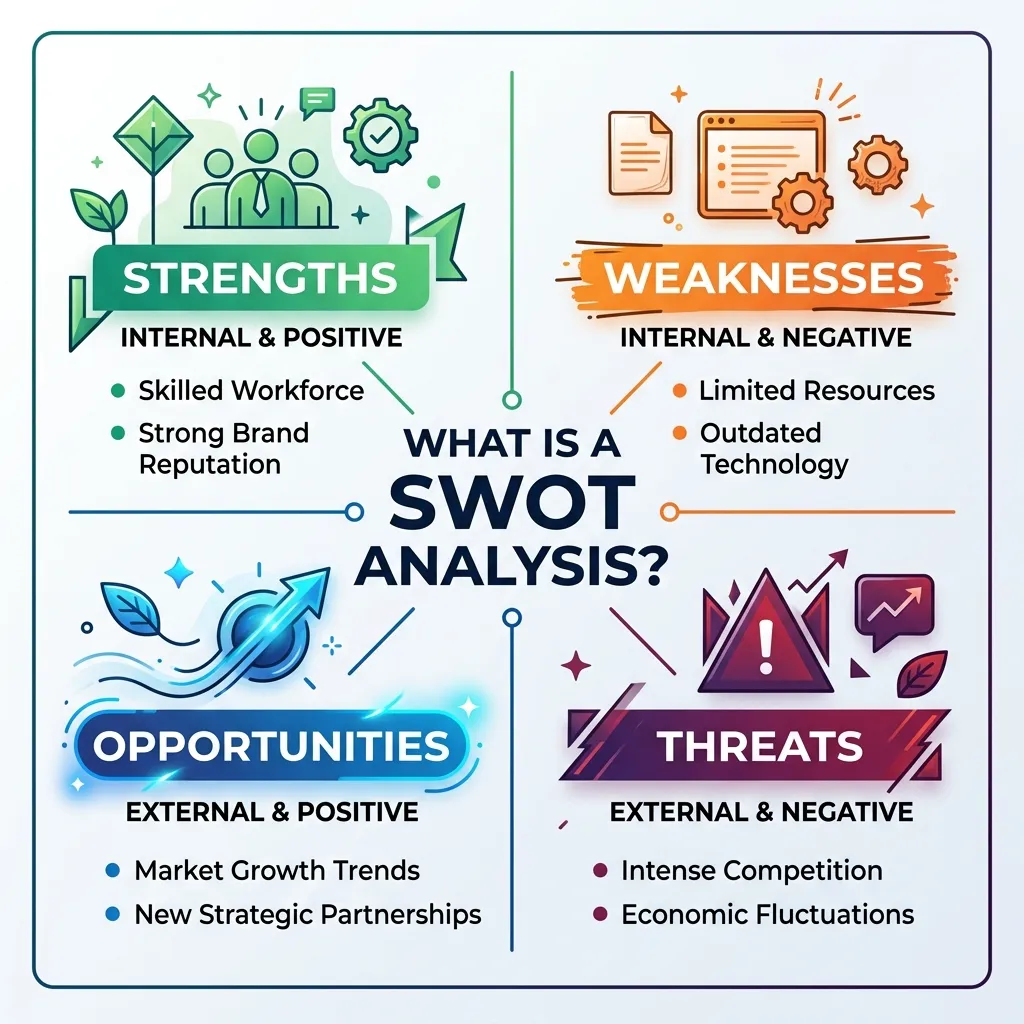
A SWOT analysis is a strategic planning framework used to evaluate the internal and external factors that affect a business, project, or individual. SWOT stands for Strengths, Weaknesses, Opportunities, and Threats. Strengths and Weaknesses are internal factors you can control, while Opportunities and Threats come from the external environment.
According to the general framework popularized in strategic management literature, a SWOT analysis is typically organized into a simple two-by-two grid, making it easy to visualize all four categories at once. If you want a deeper academic breakdown of the concept, the Wikipedia entry on SWOT analysis offers useful historical context on how the framework was developed and adopted across industries.
Why a SWOT Analysis Matters
Before diving into the process, it’s worth understanding why so many organizations still rely on a SWOT analysis:
- It forces honest, structured thinking about your business.
- It’s fast — a SWOT analysis session can be completed in a single meeting.
- It works at any level: company-wide, department-level, product-level, or even personal.
- It bridges the gap between internal capabilities and external market realities.
- It sets the foundation for deeper strategic planning tools like the TOWS matrix or a full digital marketing audit.
Step-by-Step: How to Do a SWOT Analysis
Step 1: Define Your Objective
Every effective SWOT analysis starts with a clear objective. Are you analyzing the entire company, a new product launch, a marketing campaign, or your career? Without a defined scope, your SWOT analysis will become too broad and lose its usefulness. Write down exactly what you’re evaluating and why, and keep that objective visible throughout the process.
Step 2: Gather the Right People
A SWOT analysis works best as a collaborative exercise. Bring together people from different departments or perspectives — sales, operations, finance, customer service — so you get a well-rounded view. If you’re doing a personal SWOT analysis, consider asking a mentor, colleague, or friend for honest external input, since we often struggle to see our own blind spots.
Step 3: Identify Your Strengths
Strengths are the internal advantages that set you apart. Ask questions like:
- What do we do better than our competitors?
- What unique resources, skills, or assets do we have?
- What do customers consistently praise us for?
- What internal processes run efficiently?
List everything, even if it seems minor. You’ll prioritize later.
Step 4: Identify Your Weaknesses
This is the hardest part of any SWOT analysis because it requires honesty. Weaknesses are internal limitations holding you back. Ask:
- Where do we consistently underperform?
- What resources are we lacking?
- What do competitors do better than us?
- Where do customers complain most often?
Being brutally honest here is what separates a useful SWOT analysis from a superficial one.
Step 5: Identify Your Opportunities
Opportunities are external factors you could take advantage of. These often come from market trends, new technology, changing customer behavior, or gaps left by competitors. Ask:
- Are there emerging trends we could capitalize on?
- Is there an underserved market segment?
- Could new technology or platforms help us grow?
- Are there partnership opportunities available?
A good market research process can surface opportunities you might otherwise miss.
Step 6: Identify Your Threats
Threats are external risks that could hurt your business. Ask:
- Who are our biggest competitors and what are they doing well?
- Are there regulatory or economic changes on the horizon?
- Is customer behavior shifting away from what we offer?
- Could new entrants disrupt our market?
Running a proper competitor analysis alongside this step will give your threats section much more depth and accuracy.
Step 7: Build the SWOT Matrix
Once you’ve gathered input for all four categories, organize everything into a simple two-by-two grid:
| Strengths | Weaknesses |
|---|---|
| Opportunities | Threats |
Keep each bullet point short and specific. Avoid vague statements like “good team” — instead write “experienced customer support team with a 95% satisfaction rating.”
Step 8: Prioritize Your Findings
Not every point carries equal weight. Rank each item within its quadrant by impact and urgency. Focus your energy on the strengths that create the biggest competitive edge, the weaknesses that pose the greatest risk, the opportunities with the highest potential return, and the threats that are most likely to materialize soon.
Step 9: Turn Insights Into Strategy (TOWS Matrix)
A SWOT analysis is only valuable if it leads to action. This is where the TOWS matrix comes in — it pairs your quadrants together to generate strategic options:
- Strengths + Opportunities (SO): How can you use your strengths to capture opportunities?
- Weaknesses + Opportunities (WO): How can you overcome weaknesses by leveraging opportunities?
- Strengths + Threats (ST): How can your strengths help defend against threats?
- Weaknesses + Threats (WT): How can you minimize weaknesses to avoid worst-case threats?
This step turns a static SWOT analysis into a living strategic roadmap. It pairs well with a broader digital marketing plan if your objective was marketing-focused.
Step 10: Review and Update Regularly
Markets change, competitors evolve, and internal capabilities shift over time. A SWOT analysis isn’t a one-time exercise — revisit it quarterly or whenever a major change occurs, such as a new competitor entering the market or a shift in customer demand.
SWOT Analysis in Digital Marketing
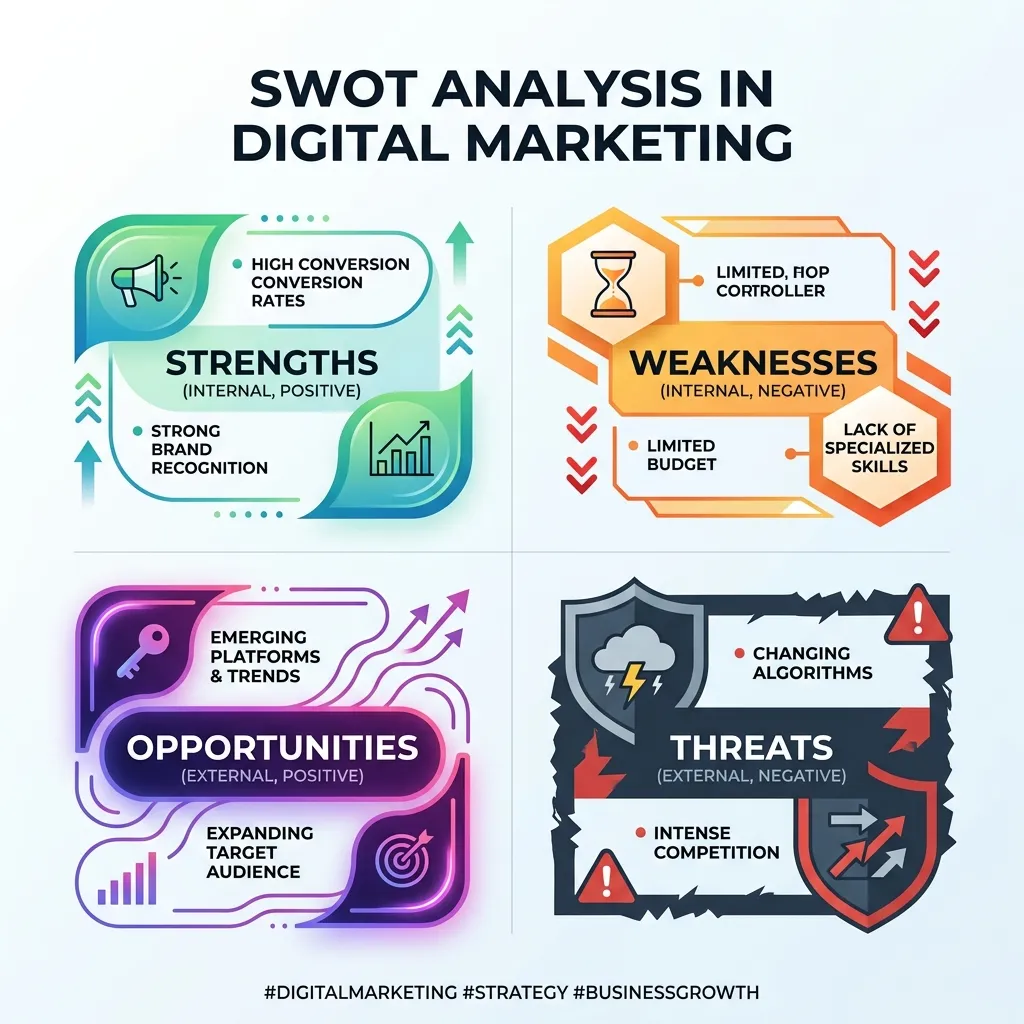
Marketers frequently use a SWOT analysis to evaluate campaigns, channels, or overall marketing strategy. It helps answer questions like which channels are underperforming, where competitors are gaining ground, and which emerging platforms represent untapped opportunity. For a deeper, marketing-specific breakdown, check out this guide on SWOT analysis in digital marketing, which applies the same four-quadrant framework directly to campaigns, SEO, and paid media performance.
Common Mistakes to Avoid
- Being too vague. “We have good customer service” tells you nothing actionable. Be specific and measurable wherever possible.
- Confusing internal and external factors. Strengths and weaknesses are internal; opportunities and threats are external. Mixing them up weakens the whole analysis.
- Doing it alone. A single perspective creates blind spots. Involve multiple stakeholders.
- Never following up. A SWOT analysis without an action plan is just a list — it needs to feed into real strategic decisions.
- Treating it as a one-time task. Business environments change constantly, so your SWOT analysis should evolve with them.
- Overloading each quadrant. Ten strong, specific points are far more useful than fifty generic ones.
Tools You Can Use for a SWOT Analysis
You don’t need expensive software to run a SWOT analysis. Some practical options include:
- Spreadsheets (Google Sheets or Excel) for a simple, shareable matrix.
- Whiteboard tools like Miro or a physical whiteboard for team brainstorming sessions.
- Slide templates in PowerPoint or Google Slides for presenting findings to leadership.
- Project management tools like Notion or Trello to track how findings turn into action items over time.
How to Do a Personal SWOT Analysis
The same framework that helps businesses plan strategy also works remarkably well for individuals. A personal SWOT analysis can help you decide on a career move, evaluate a job offer, or figure out what skills to develop next.
To do a personal SWOT analysis, ask yourself:
- Strengths: What skills, experience, or personal traits give me an edge? What do colleagues or mentors say I’m good at?
- Weaknesses: What skills am I missing? Where do I procrastinate, avoid feedback, or underperform compared to peers?
- Opportunities: What industry trends could benefit my career? Are there certifications, networking events, or emerging roles I could pursue?
- Threats: Is my industry being automated or disrupted? Are there more qualified candidates competing for the same roles?
The biggest difference between a personal and a business SWOT analysis is emotional distance — it’s harder to be objective about yourself. That’s why getting outside input from a mentor, manager, or trusted friend is especially valuable here. Once you’ve filled out your personal SWOT matrix, use it the same way a company would: lean into strengths that align with opportunities, and build a plan to close the weaknesses that expose you to the biggest threats.
How to Present a SWOT Analysis to Stakeholders
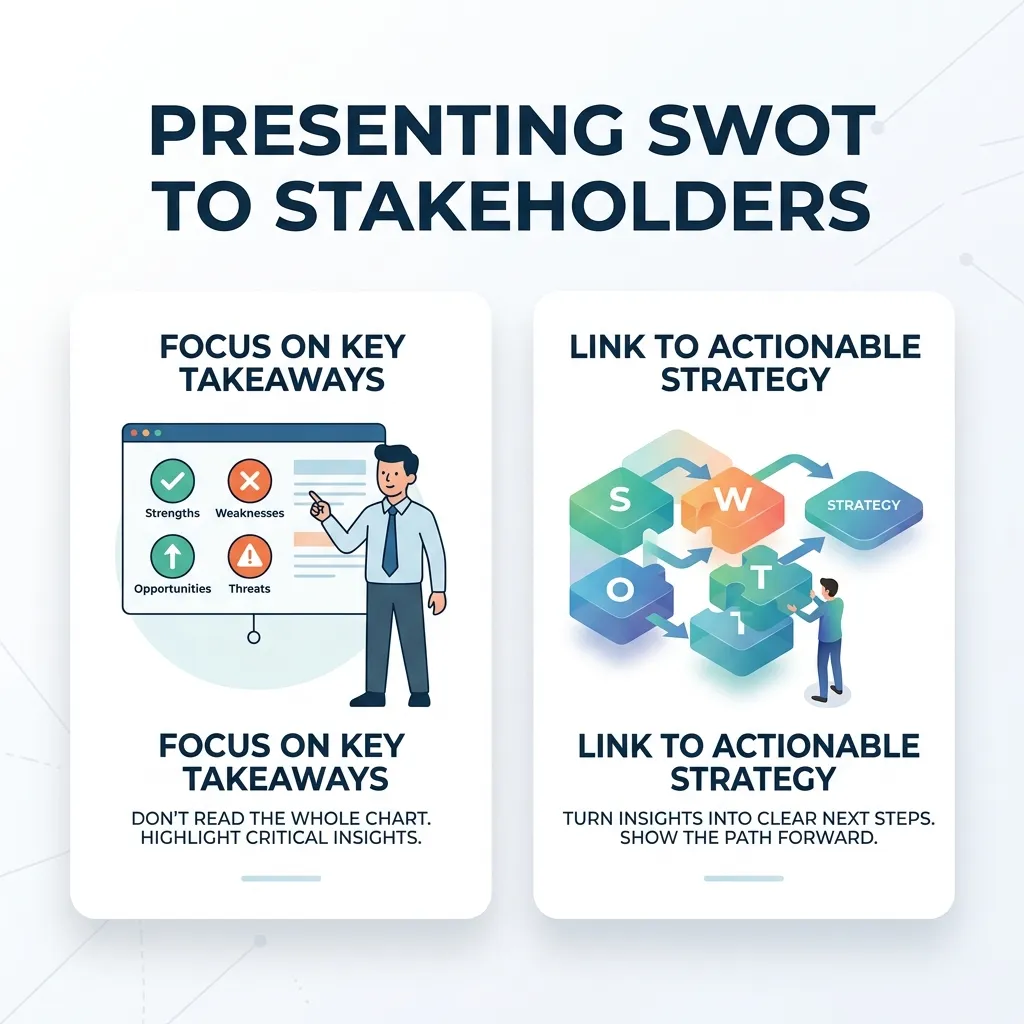
Doing the analysis is only half the job — communicating it clearly is what gets buy-in from leadership or clients. A few tips for presenting your SWOT analysis effectively:
- Lead with the objective. Remind the audience what you were evaluating and why before jumping into the findings.
- Use the matrix visually. A clean two-by-two grid is far easier to digest than a wall of bullet points in a slide.
- Highlight the top 3–5 items per quadrant. Stakeholders don’t need every single point — they need the ones that matter most.
- Connect findings to action. Always follow the SWOT matrix with a short “so what” section explaining what you recommend doing next.
- Anticipate pushback on weaknesses. Internal weaknesses can feel uncomfortable to hear. Frame them constructively, as areas of opportunity for improvement rather than criticism.
A well-presented SWOT analysis doesn’t just inform — it builds confidence that the team has a clear, honest picture of where things stand and where they’re headed.
A Simple Real-World Example
Imagine a small e-commerce store selling handmade candles. A quick SWOT analysis might look like this:
- Strengths: Unique, handcrafted products; loyal local customer base; strong Instagram engagement.
- Weaknesses: Limited production capacity; no wholesale distribution; high shipping costs.
- Opportunities: Growing demand for eco-friendly home products; potential partnerships with local boutiques; untapped TikTok audience.
- Threats: Large competitors with lower prices; rising raw material costs; seasonal demand fluctuations.
From here, the business owner can build a strategy: use their strong social media presence (strength) to reach the growing eco-conscious audience (opportunity), while exploring ways to reduce shipping costs (weakness) to stay competitive against larger players (threat).
Conclusion
Learning how to do a SWOT analysis is one of the most valuable skills you can develop, whether you’re running a business, managing a marketing campaign, or planning your next career move. The framework is simple on the surface, but its real power comes from honest self-assessment and a genuine commitment to turning insights into action. Start with a clear objective, involve the right people, be specific in each quadrant, and — most importantly — use your SWOT analysis to shape a real strategy rather than letting it sit in a forgotten document. Done consistently, a SWOT analysis becomes less of a one-time exercise and more of an ongoing habit that keeps your strategy sharp and your decisions grounded in reality.
Frequently Asked Questions (FAQs)
1. What does SWOT stand for?
SWOT stands for Strengths, Weaknesses, Opportunities, and Threats — the four categories analyzed in this strategic planning framework.
2. How long does a SWOT analysis take to complete?
A basic SWOT analysis can be completed in one to two hours with the right people in the room. More detailed versions involving research and data may take a few days.
3. Who should be involved in a SWOT analysis?
Ideally, people from different departments or perspectives — such as sales, marketing, operations, and finance — should contribute so the analysis reflects a well-rounded view of the business.
4. Is a SWOT analysis only for businesses?
No. Individuals use SWOT analysis for career planning, students use it for academic decisions, and nonprofits use it for program evaluation.
5. What’s the difference between SWOT and TOWS?
SWOT identifies the four categories, while TOWS takes those findings and pairs them together to generate specific strategic actions.
6. How often should I redo a SWOT analysis?
Most experts recommend reviewing it quarterly or whenever a significant internal or external change occurs, such as a new competitor or a shift in customer demand.
7. Can a SWOT analysis be done for a single product instead of a whole company?
Yes. SWOT analysis works well at the company, department, product, campaign, or even individual level, as long as the objective is clearly defined.
8. What are common examples of opportunities in a SWOT analysis?
Common opportunities include emerging market trends, new technology, underserved customer segments, and potential partnerships.
9. What are common examples of threats in a SWOT analysis?
Typical threats include new competitors, changing regulations, economic downturns, and shifting customer preferences.
10. Do I need special software to do a SWOT analysis?
No, a simple spreadsheet, whiteboard, or slide template is enough. The value comes from the thinking process, not the tool.
11. What’s the biggest mistake people make in a SWOT analysis?
Being too vague. Generic statements like “good team” or “strong brand” don’t provide actionable insight — specificity is key.
12. How do I turn my SWOT analysis into an actual strategy?
Use the TOWS matrix to pair strengths with opportunities, weaknesses with opportunities, strengths with threats, and weaknesses with threats to generate concrete strategic actions.
Want to go deeper? Read our complete breakdown of the components of a SWOT analysis or explore how a complete digital marketing strategy incorporates SWOT findings from day one.



Leave a Reply