

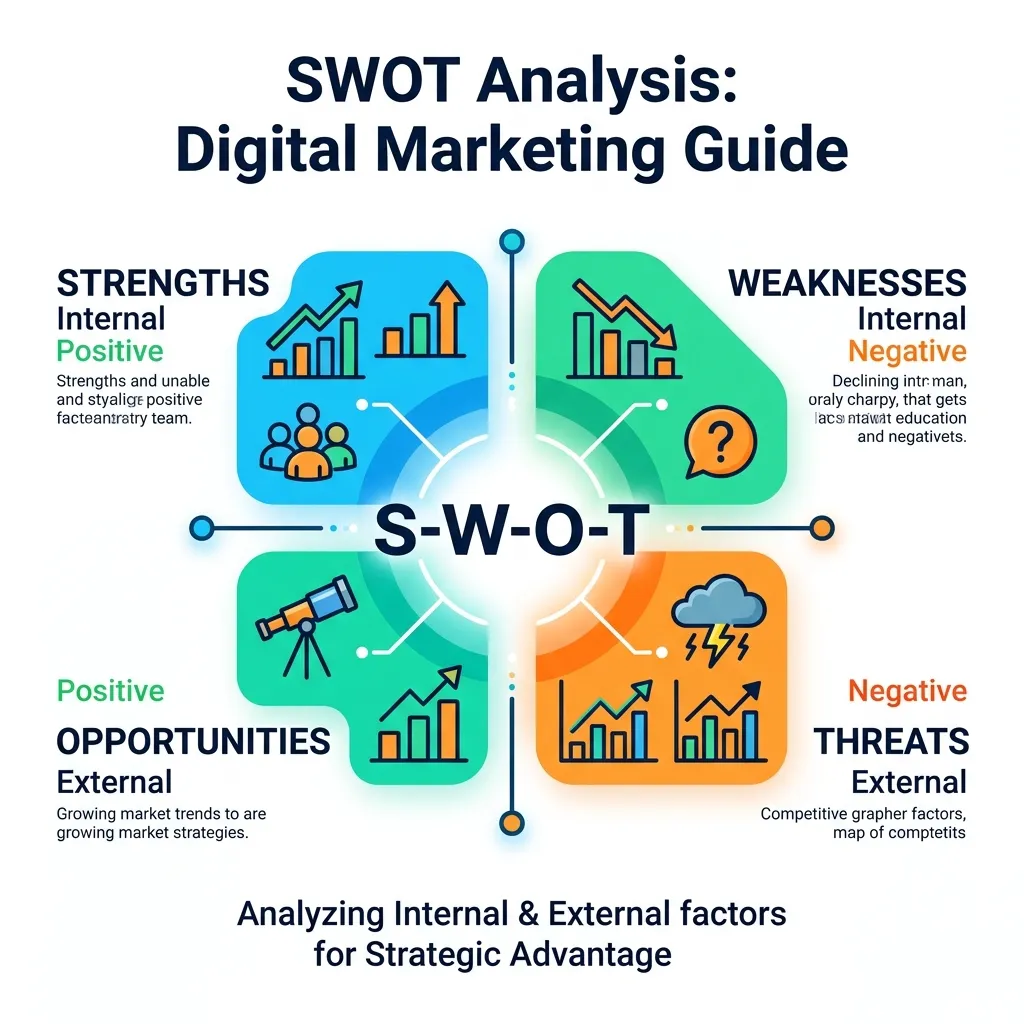
A SWOT Analysis in Digital Marketing helps businesses evaluate their marketing strengths, weaknesses, opportunities, and threats before making strategic decisions. By examining internal capabilities and external market conditions, marketers can identify competitive advantages, uncover gaps, prioritize opportunities, and reduce potential risks. This complete guide explains what SWOT analysis is, its four components, how to perform one, useful templates, practical digital marketing examples, and common mistakes to avoid.
What Is SWOT Analysis in Digital Marketing?
SWOT Analysis in Digital Marketing is a strategic framework used to evaluate the internal and external factors that can influence a company’s digital marketing performance. SWOT stands for Strengths, Weaknesses, Opportunities, and Threats.
The framework separates internal factors—strengths and weaknesses—from external factors—opportunities and threats. This makes it easier for marketers to understand what their business controls, where improvement is needed, and what changes in the market could affect future performance.
For example, a company may have strong brand recognition and a loyal audience as strengths but struggle with low organic traffic as a weakness. At the same time, growing demand for short-form video could represent an opportunity, while increasing advertising costs could become a threat.
A well-developed SWOT Analysis in Digital Marketing can support decisions related to:
- SEO and organic search
- Paid advertising
- Social media marketing
- Content marketing
- Email marketing
- Conversion optimization
- Brand positioning
- Customer acquisition
- Competitor analysis
- Marketing budget allocation
Before creating a SWOT framework, marketers should understand their current position. A detailed digital marketing audit can provide useful information about website performance, traffic, SEO, content, conversions, and other existing marketing activities.
SWOT should not be treated as the final strategy. Instead, it is a decision-making framework that helps turn observations into strategic priorities.
Components of SWOT Analysis
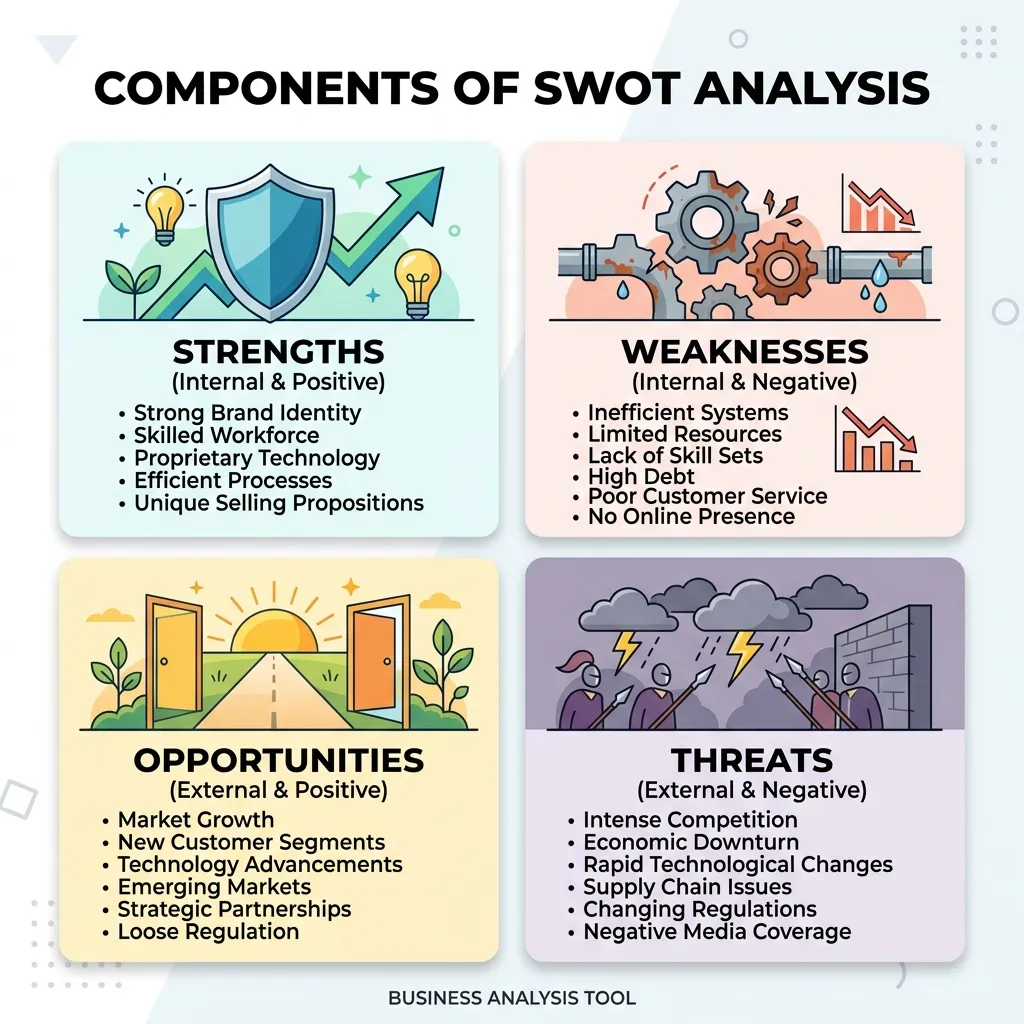
The four components of a SWOT Analysis in Digital Marketing are Strengths, Weaknesses, Opportunities, and Threats. Understanding the difference between these categories is essential for creating a useful analysis.
Strengths
Strengths are internal advantages that help a business compete effectively in digital channels.
Common digital marketing strengths include:
- Strong organic search visibility
- High-quality content
- Recognizable brand identity
- Large social media following
- Strong email subscriber base
- High customer retention
- Experienced marketing team
- Strong conversion rates
- Effective marketing automation
- Competitive product positioning
- High-quality first-party customer data
For example, a SaaS company that ranks for hundreds of valuable commercial keywords has an SEO advantage over a competitor with little organic visibility.
The goal is not simply to list everything the business does well. Marketers should identify strengths that directly contribute to measurable marketing outcomes.
Useful questions include:
- What digital channels perform best?
- Which campaigns generate the highest return?
- What makes our content different?
- Do we have a strong brand reputation?
- What marketing capabilities do competitors lack?
- Which assets can we scale?
Weaknesses
Weaknesses are internal limitations that reduce marketing effectiveness or create competitive disadvantages.
Examples include:
- Poor website performance
- Low organic traffic
- Weak content strategy
- Limited marketing budget
- Low conversion rates
- Inconsistent social media activity
- Poor email engagement
- Lack of marketing expertise
- Weak analytics implementation
- Limited customer data
- Poor mobile experience
For example, a business may generate significant website traffic but have a low conversion rate because its landing pages do not match user intent.
Weaknesses should be identified honestly. A SWOT Analysis in Digital Marketing becomes less useful when marketers avoid negative findings or describe every weakness as an opportunity.
Opportunities
Opportunities are external conditions that a business can potentially use to improve its digital marketing results.
Potential opportunities include:
- Emerging search trends
- New social platforms
- Changes in customer behavior
- Growing demand for specific products
- New content formats
- Untapped audience segments
- Competitor weaknesses
- New advertising technologies
- AI-assisted marketing workflows
- Expansion into new geographic markets
For example, if customers increasingly use video to research products and competitors have limited video content, creating educational videos may represent a strong opportunity.
Opportunities should be connected to business objectives rather than simply listed as trends.
Threats
Threats are external factors that could negatively affect digital marketing performance.
Examples include:
- Increasing competition
- Rising advertising costs
- Algorithm changes
- Economic uncertainty
- New competitors
- Privacy regulations
- Changing consumer behavior
- Platform dependency
- Negative online reviews
- Technological disruption
A threat does not necessarily mean something bad will happen. It means the factor has the potential to create risk.
For example, relying almost entirely on one advertising platform creates a strategic vulnerability if its costs increase or targeting capabilities change.
How to Do a SWOT Analysis
Creating a SWOT Analysis in Digital Marketing does not require complicated software. A spreadsheet, document, or simple four-quadrant matrix can be enough.
The key is to use reliable information instead of assumptions.
Step 1: Define Your Digital Marketing Objective
Start by determining exactly what you want to evaluate.
Your objective could be:
- Increase organic traffic
- Generate more qualified leads
- Improve conversion rates
- Reduce customer acquisition costs
- Launch a new product
- Improve social media performance
- Enter a new market
- Increase brand awareness
A specific objective makes the SWOT analysis more focused.
Step 2: Collect Internal Data
Gather information about current digital marketing performance.
Useful data sources include:
- Website analytics
- Search performance
- Conversion data
- Advertising reports
- Email metrics
- Social media analytics
- Customer feedback
- Sales data
- Content performance
- Marketing costs
Your digital marketing performance metrics and KPIs can help identify measurable strengths and weaknesses.
Step 3: Analyze Your Competitors
Competitor research is important because a strength only has strategic value when considered in relation to the market.
Compare factors such as:
- Keyword rankings
- Content quality
- Backlink profiles
- Social presence
- Advertising activity
- Website experience
- Offers and pricing
- Customer reviews
- Brand positioning
A dedicated competitor analysis in digital marketing can reveal gaps that should be incorporated into your SWOT framework.
Step 4: Identify Strengths
List the internal factors that provide an advantage.
Prioritize strengths that are:
- Relevant to your objective
- Difficult for competitors to replicate
- Supported by evidence
- Connected to measurable outcomes
For example, “good website” is too vague. “Website generates 35% of qualified leads through organic search” is more useful.
Step 5: Identify Weaknesses
Look for internal barriers.
Ask:
- Which channels underperform?
- Where are conversions being lost?
- Which skills are missing?
- What processes are inefficient?
- Which campaigns consistently fail to meet targets?
Be specific and data-driven.
Step 6: Identify Opportunities
Look outside the business for favorable changes.
Review:
- Search trends
- Customer needs
- Competitor gaps
- Emerging technologies
- New channels
- Market expansion
- Content opportunities
For example, a new audience segment searching for a problem that your product solves could become an important opportunity.
Step 7: Identify Threats
Consider external risks that may affect your strategy.
Think about:
- Competitor growth
- Platform changes
- Regulatory developments
- Economic conditions
- Consumer preferences
- Technology changes
- Increasing acquisition costs
The purpose is not to predict the future perfectly but to prepare for realistic possibilities.
Step 8: Prioritize the Findings
A long list of SWOT factors is not automatically useful.
Rank each factor according to:
- Impact
- Urgency
- Probability
- Business relevance
- Ease of action
Focus on the issues that can materially influence your marketing objectives.
Step 9: Turn SWOT Findings Into Actions
This is the most important step.
Do not stop after creating four boxes. Convert the findings into decisions.
For example:
Strength + Opportunity:
Use strong SEO expertise to target a growing search category.
Weakness + Opportunity:
Improve poor video capabilities by investing in short-form educational content.
Strength + Threat:
Use strong customer loyalty to reduce dependence on increasingly expensive paid acquisition.
Weakness + Threat:
Improve website conversion performance before increasing advertising spend.
This turns SWOT from a descriptive exercise into a practical strategic tool.
SWOT Analysis Template
A simple SWOT Analysis in Digital Marketing template can be organized into four sections:
| Internal Factors | External Factors |
|---|---|
| Strengths | Opportunities |
| Strong SEO performance | Growing search demand |
| Recognized brand | New audience segment |
| High conversion rate | Emerging content format |
| Skilled marketing team | Competitor content gaps |
| Weaknesses | Threats |
| Limited content production | Increasing competition |
| Low social engagement | Rising ad costs |
| Poor mobile UX | Algorithm changes |
| Limited marketing budget | Changing consumer behavior |
You can create a more actionable version by adding three additional columns:
| SWOT Factor | Evidence | Recommended Action |
|---|---|---|
| Strong organic traffic | High non-paid sessions | Expand high-performing topics |
| Low conversion rate | Landing-page data | Test new page designs |
| Growing video demand | Audience research | Create educational videos |
| Rising PPC costs | Advertising reports | Diversify acquisition channels |
This approach prevents the SWOT analysis from becoming a collection of unsupported opinions.
For broader planning, combine your findings with a structured digital marketing strategy so that each priority has a measurable objective, channel, timeline, and KPI.
SWOT Analysis Examples
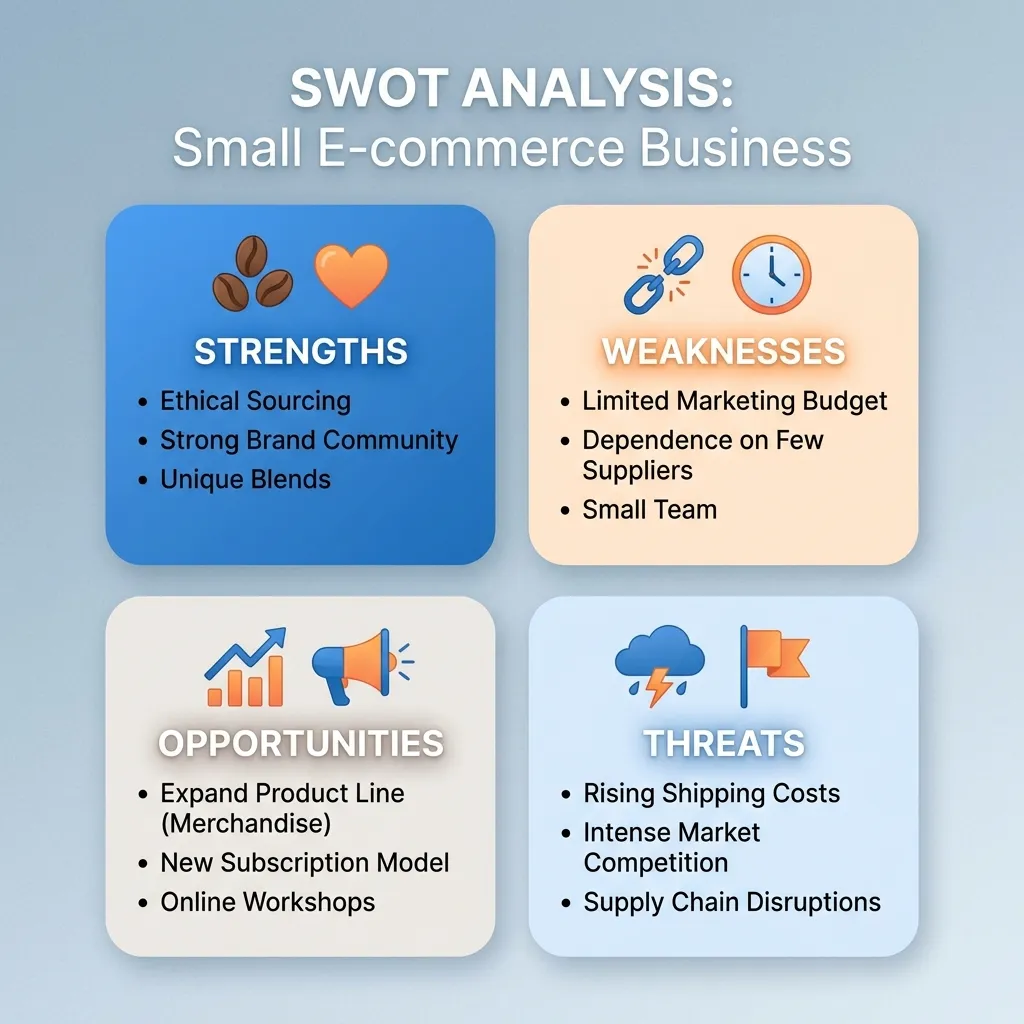
The best way to understand SWOT is to see how it can be applied to real digital marketing situations.
Example 1: E-Commerce Business
Imagine an online fashion store.
Strengths:
- Strong Instagram presence
- Repeat customers
- Attractive product photography
- High email engagement
Weaknesses:
- Limited organic visibility
- High cart abandonment
- Low blog activity
Opportunities:
- Growing interest in sustainable fashion
- Influencer partnerships
- Search demand for product comparisons
Threats:
- Large marketplace competitors
- Rising advertising costs
- Price competition
The company could use its strong social audience to promote educational content about sustainable fashion while improving SEO and abandoned-cart campaigns.
Example 2: SaaS Company
Consider a software company selling project-management tools.
Strengths:
- Strong product functionality
- Free trial
- Technical expertise
- Positive customer reviews
Weaknesses:
- Low brand awareness
- Limited video content
- Small marketing team
Opportunities:
- Growing demand for remote-work software
- Educational search queries
- Partnership opportunities
Threats:
- Established competitors
- Changing software preferences
- Increasing customer acquisition costs
The company could build authority through educational content, comparison pages, webinars, and targeted SEO.
Example 3: Local Business
A local restaurant can also use SWOT.
Strengths:
- Strong customer reviews
- Loyal local customers
- High-quality food images
Weaknesses:
- Poor website
- Inconsistent social posting
- Limited online ordering visibility
Opportunities:
- Local search demand
- Food delivery platforms
- User-generated content
Threats:
- New restaurants
- Negative reviews
- Economic pressure on consumers
The restaurant could prioritize local SEO, review management, better website conversion, and user-generated social content.
Why SWOT Analysis Matters in Digital Marketing
A SWOT Analysis in Digital Marketing helps marketers move beyond isolated metrics.
For example, a company may see that website traffic is increasing and assume everything is going well. SWOT can reveal that traffic is increasing primarily from low-intent searches while qualified leads remain unchanged.
It can also help marketers:
Improve Strategic Decision-Making
Instead of choosing channels based on popularity, businesses can evaluate which channels align with their strengths and opportunities.
Identify Competitive Advantages
SWOT makes it easier to recognize assets that competitors may struggle to replicate.
Reduce Marketing Risks
Threat analysis encourages marketers to consider external risks before they become serious problems.
Allocate Resources More Effectively
Businesses can prioritize campaigns based on potential impact rather than spreading budgets across every available channel.
Find New Growth Opportunities
Market changes, customer behavior, and competitor gaps can reveal new opportunities for content, SEO, advertising, and audience expansion.
SWOT Analysis Mistakes to Avoid
Even a simple SWOT framework can become ineffective when it is poorly constructed.
1. Being Too Generic
Statements such as “strong brand” or “weak marketing” are not actionable.
Use specific and measurable observations whenever possible.
2. Confusing Internal and External Factors
Strengths and weaknesses are internal. Opportunities and threats are external. Keeping this distinction clear is one of the foundations of SWOT analysis.
3. Relying on Opinions
A team’s assumptions may not reflect actual customer behavior.
Use analytics, customer research, competitor data, and campaign performance to support important findings.
4. Creating Too Many Factors
A matrix with dozens of items can become difficult to use.
Prioritize the factors with the greatest strategic impact.
5. Ignoring Competitors
Digital marketing does not operate in isolation.
A business may consider its SEO performance strong until it compares that performance with a direct competitor.
6. Treating SWOT as the Final Strategy
SWOT identifies conditions; it does not automatically create an execution plan.
The findings should be translated into goals, tactics, KPIs, budgets, and timelines.
7. Failing to Update the Analysis
Digital environments change quickly. Search behavior, platforms, competitors, technology, and customer expectations can all shift.
For that reason, SWOT should be reviewed periodically rather than treated as a permanent document.
8. Ignoring Data Quality
Bad data can produce bad strategic decisions.
Make sure your analytics, conversion tracking, customer information, and marketing reports are reliable before using them to support SWOT conclusions.
How to Make SWOT Analysis More Effective
A strong SWOT Analysis in Digital Marketing should be:
Specific: Focus on clearly defined marketing objectives.
Evidence-based: Support important findings with real data.
Competitive: Consider how your business compares with competitors.
Actionable: Connect each major finding to a possible response.
Prioritized: Focus on high-impact factors instead of listing everything.
Current: Review the analysis when market conditions change.
It is also useful to involve people from different areas of the business. SEO specialists, content marketers, paid media managers, sales teams, customer-support staff, and business leaders may see different strengths and risks.
The NIH Collaboration and Team Science Field Guide describes SWOT as a strategic exercise that can help teams identify strengths and weaknesses within a project and opportunities and threats in the wider environment.
SWOT Analysis vs. Other Marketing Analysis Methods
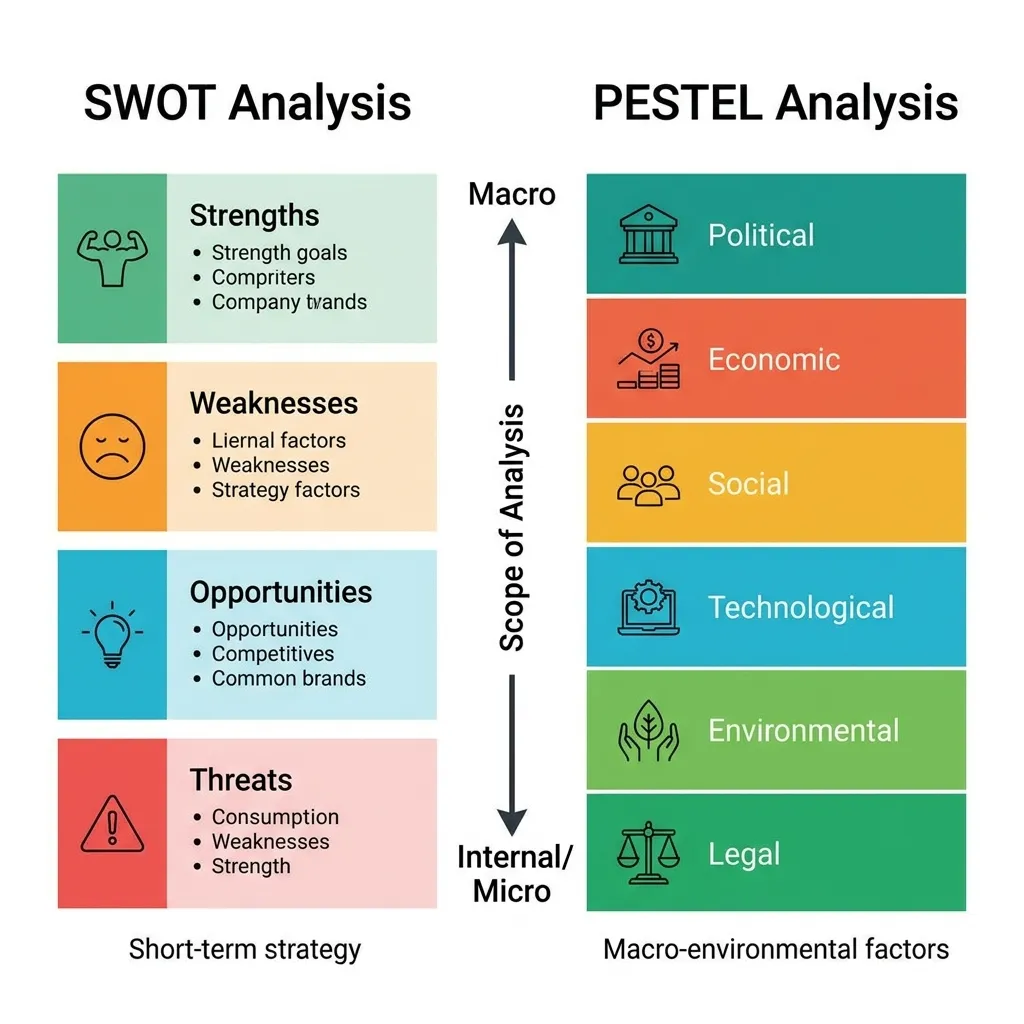
SWOT is useful, but it should not be the only analytical framework used by a digital marketing team.
For example:
- SWOT: Evaluates strengths, weaknesses, opportunities, and threats.
- Competitor analysis: Examines competing businesses and their strategies.
- Market research: Investigates customers, markets, demand, and industry conditions.
- Digital marketing audit: Evaluates current marketing performance and implementation.
- PESTLE analysis: Examines broader political, economic, social, technological, legal, and environmental factors.
Combining these methods can produce a more complete strategic picture.
For example, market research can reveal customer demand, competitor analysis can identify gaps, and SWOT can organize the most important findings into a strategic framework.
Conclusion
SWOT Analysis in Digital Marketing is a practical framework for understanding where a business stands and what it should consider before making important marketing decisions. By examining strengths, weaknesses, opportunities, and threats, marketers can identify competitive advantages, uncover internal problems, recognize market opportunities, and prepare for external risks.
The real value of SWOT does not come from filling four boxes. It comes from using those findings to make better decisions. A strong analysis should be supported by data, competitor research, customer insights, and measurable marketing objectives.
Whether you are planning an SEO campaign, launching a new product, improving paid advertising, expanding into a new market, or developing an overall digital marketing strategy, a well-structured SWOT Analysis in Digital Marketing can provide a clear starting point for strategic planning.
Frequently Asked Questions
1. What is SWOT Analysis in Digital Marketing?
SWOT Analysis in Digital Marketing is a framework for evaluating the strengths, weaknesses, opportunities, and threats affecting a company’s digital marketing performance.
2. What does SWOT stand for?
SWOT stands for Strengths, Weaknesses, Opportunities, and Threats. Strengths and weaknesses are internal factors, while opportunities and threats are external factors.
3. Why is SWOT Analysis important in digital marketing?
It helps marketers understand their current position, identify competitive advantages, discover growth opportunities, recognize weaknesses, and prepare for external threats.
4. What are examples of digital marketing strengths?
Examples include strong SEO rankings, high-quality content, a loyal audience, strong brand recognition, skilled marketing employees, high conversion rates, and effective email campaigns.
5. What are weaknesses in a digital marketing SWOT analysis?
Weaknesses can include poor website performance, low organic traffic, weak conversion rates, limited budgets, poor content production, low social engagement, or a lack of marketing expertise.
6. What are opportunities in digital marketing?
Opportunities can include emerging search trends, new audience segments, new content formats, competitor gaps, technological developments, and growing demand in a specific market.
7. What are threats in digital marketing?
Common threats include increasing competition, rising advertising costs, algorithm changes, changing customer behavior, platform dependency, negative reviews, and technological disruption.
8. How often should a digital marketing SWOT analysis be done?
There is no universal schedule. Businesses should review SWOT periodically and whenever major changes occur in their market, competitors, technology, customer behavior, or marketing performance.
9. Can small businesses use SWOT Analysis?
Yes. SWOT is suitable for businesses of different sizes because it can be created with simple tools such as spreadsheets or documents and adapted to the company’s objectives.
10. Is SWOT Analysis better than competitor analysis?
They serve different purposes. SWOT evaluates internal and external strategic factors, while competitor analysis focuses specifically on competing businesses. Using both can provide better strategic insight.
11. Can SWOT Analysis help with SEO strategy?
Yes. It can identify SEO strengths, technical or content weaknesses, new search opportunities, and threats such as increasing competition or changes in search behavior.
12. What should I do after completing a SWOT Analysis?
Convert the findings into specific actions. Prioritize the most important factors, assign responsibilities, establish KPIs, create timelines, and incorporate the actions into your broader digital marketing strategy.



Leave a Reply