

True digital marketing experts deliver measurable results, focus on strategy over flashy branding, and prioritize client success over social media popularity.
You’ve seen them everywhere—self-proclaimed digital marketing gurus promising to 10x your business overnight. LinkedIn feeds overflow with success stories, Instagram showcases luxury lifestyles funded by “marketing mastery,” and YouTube ads pitch courses that guarantee financial freedom through digital marketing expertise.
But here’s the uncomfortable truth: most digital marketing experts are selling dreams, not delivering results.
After working with hundreds of businesses and witnessing countless marketing disasters, I’ve noticed a pattern. The loudest voices in digital marketing often produce the quietest results. Meanwhile, the professionals who consistently deliver measurable growth rarely have time for flashy social media campaigns about themselves.
This post examines why the digital marketing expert landscape has become so diluted, how to spot genuine expertise, and what businesses should look for when investing in marketing talent.
The Digital Marketing Expert Gold Rush
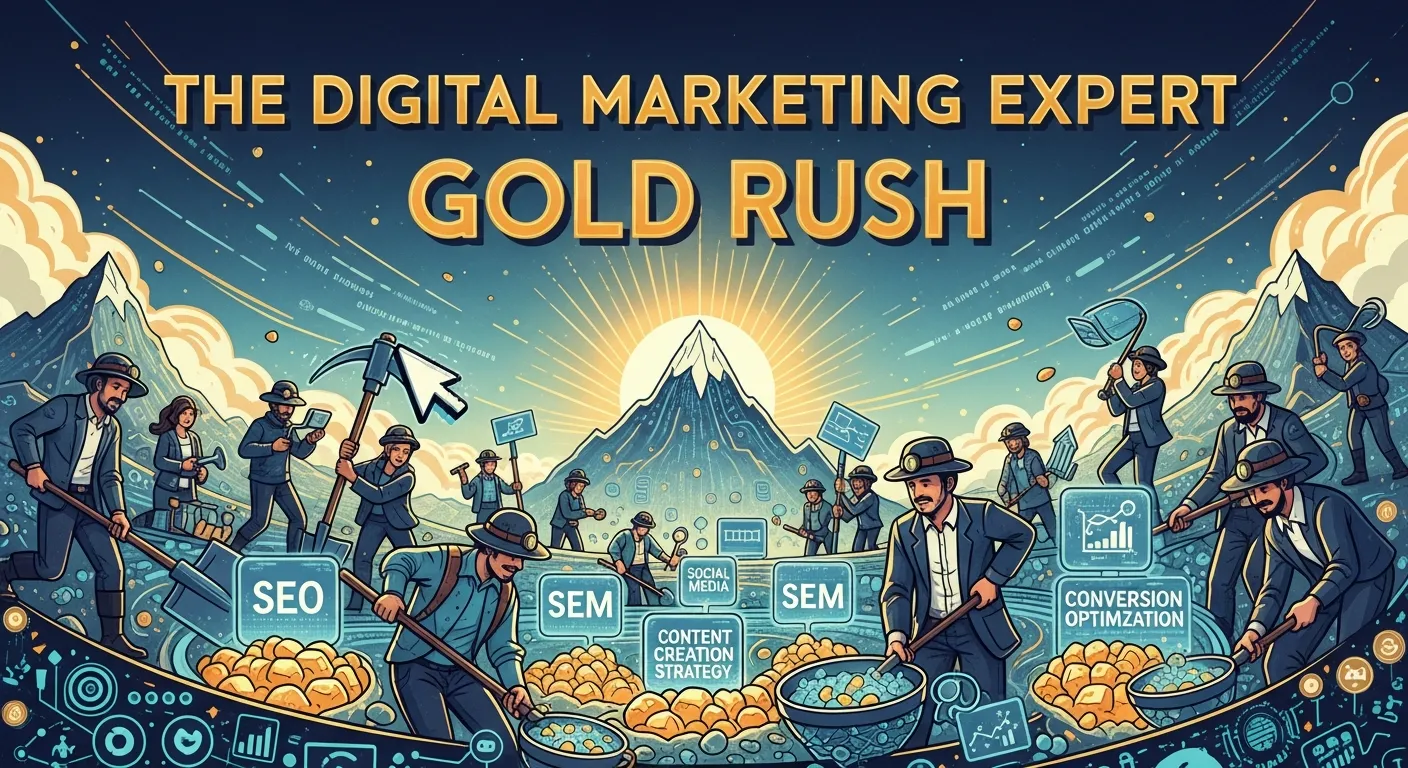
Digital marketing has become the modern equivalent of the California Gold Rush. Everyone wants in, and the barriers to entry seem refreshingly low. Create a website, post some case studies, and suddenly you’re an “expert” ready to transform businesses.
The explosion of online courses, certifications, and social media platforms has democratized marketing knowledge. While this accessibility has its benefits, it has also created an oversaturated market where credentials matter less than self-promotion skills.
Consider these red flags that plague the industry:
Overnight Expertise: Real marketing expertise develops through years of testing, failing, learning, and refining. Yet many “experts” claim mastery after completing a six-week course.
One-Size-Fits-All Solutions: Genuine experts understand that effective marketing strategies vary dramatically between industries, audiences, and business models. Cookie-cutter approaches rarely deliver sustainable results.
Guarantee-Heavy Marketing: Legitimate marketing professionals know that while they can influence outcomes, they cannot guarantee specific results. Market conditions, competition, and countless variables affect campaign performance.
The Experience vs. Education Divide
The digital marketing field suffers from a fundamental disconnect between theoretical knowledge and practical application. Many experts can recite marketing principles but struggle to adapt strategies when real-world challenges arise.
Academic marketing education often focuses on established frameworks and case studies from large corporations. While valuable, this knowledge doesn’t always translate to the messy reality of small business marketing, where budgets are tight and every dollar must produce measurable returns.
Conversely, experienced practitioners understand the nuances that textbooks can’t teach. They know when to break conventional rules, how to pivot quickly when campaigns underperform, and which metrics actually matter for long-term growth.
Conversely, experienced practitioners understand the nuances that textbooks can’t teach. They know when to break conventional rules, how to pivot quickly when campaigns underperform, and which metrics actually matter for long-term growth. Read our start digital marketing: a beginner guide to learn foundational skills and practical approaches.
The Social Proof Paradox
Social media has created a paradox where marketing experts spend more time marketing themselves than delivering results for clients. The most visible experts often prioritize personal brand building over client success.
This creates a dangerous cycle. Businesses see flashy social media presence and assume it indicates marketing competence. They hire these visible experts, often receiving mediocre results while the expert continues building their personal brand using the client relationship as content fodder.
Meanwhile, skilled marketing professionals focused on client results may have minimal social media presence. They’re too busy analyzing data, optimizing campaigns, and delivering measurable growth to create viral LinkedIn posts about their latest “breakthrough strategy.”
For insights on balancing digital marketing analytics with strategy, this guide is highly recommended.
The Metrics That Actually Matter
Genuine digital marketing expertise reveals itself through specific, measurable outcomes. Real experts focus on metrics that directly impact business growth, not vanity measurements that look impressive but lack substance.
Revenue Attribution: Skilled marketers can trace marketing activities to actual revenue generation. They understand customer journey complexity and can demonstrate how their efforts contribute to bottom-line results.
Customer Lifetime Value: Beyond acquisition, expert marketers optimize for long-term customer value. They develop strategies that attract profitable customers who remain engaged over time.
Cost Efficiency: True expertise manifests in achieving desired outcomes while minimizing costs. This requires a deep understanding of channel performance, audience behavior, and optimization techniques.
Adaptation Speed: Markets change rapidly, and skilled marketers adjust strategies accordingly. They monitor performance continuously and pivot quickly when data indicates strategy changes are necessary.
For actionable examples of strategies that work, see e-commerce marketing examples that actually work.
Industry-Specific Knowledge Gaps

Many digital marketing experts lack deep understanding of specific industries, leading to generic strategies that fail to address unique business challenges. B2B software marketing differs dramatically from e-commerce retail, yet many experts apply identical approaches across vastly different sectors.
Effective marketing requires understanding customer psychology, industry regulations, seasonal patterns, competitive landscapes, and countless other variables that vary by sector. Generalist experts often miss these critical details, resulting in campaigns that technically execute correctly but fail to connect with target audiences.
Effective marketing requires understanding customer psychology, industry regulations, seasonal patterns, competitive landscapes, and countless other variables. For those in financial sectors, financial services digital marketing strategies offer tailored guidance.
The Technology Tool Trap
The digital marketing landscape overflows with tools, platforms, and software solutions. Many experts become fixated on specific technologies, losing sight of strategic objectives in favor of tool mastery.
While technical proficiency matters, it shouldn’t overshadow strategic thinking. The best tools mean nothing without proper strategy, audience understanding, and execution quality. Yet many experts lead with technology discussions rather than business objective conversations.
Real expertise involves selecting appropriate tools for specific situations, not forcing clients into predetermined technology stacks. Different businesses require different solutions, and skilled marketers adapt their tool recommendations accordingly.
While technical proficiency matters, it shouldn’t overshadow strategic thinking. The best tools mean nothing without proper strategy, audience understanding, and execution quality. For a clear understanding of how SEO fits into a marketing strategy,
Building In-House vs. Outsourcing
Smart businesses increasingly question whether hiring external digital marketing experts makes sense compared to developing internal capabilities. While outsourcing can provide specialized knowledge and fresh perspectives, it also creates dependency relationships that may not serve long-term interests.
In-house marketing teams understand company culture, customer relationships, and business objectives more deeply than external experts ever could. They also remain with the company long-term, building institutional knowledge rather than moving to the next client.
Smart businesses increasingly question whether hiring external digital marketing experts makes sense compared to developing internal capabilities. In-house marketing teams understand company culture, customer relationships, and business objectives more deeply than external experts ever could. However, internal teams may lack specialized skills or industry-wide perspective that external experts provide.
Our guide on mastering your digital marketing strategy offers advice on balancing internal and external expertise.
What Genuine Expertise Looks Like
Authentic digital marketing experts share several characteristics that distinguish them from the crowd:
Question-Heavy Approach: Before proposing solutions, they ask detailed questions about business objectives, target audiences, competitive landscapes, and success metrics.
Realistic Timelines: They set appropriate expectations about when results will appear and explain why certain strategies require time to generate meaningful outcomes.
Transparent Reporting: They provide clear, regular reports that connect marketing activities to business results using relevant metrics.
Continuous Learning: They stay current with platform changes, industry trends, and emerging strategies while maintaining focus on fundamental marketing principles.
Client Success Focus: Their primary concern involves client results, not personal brand building or social media presence.
The Role of Data in Separating Experts from Pretenders
One of the clearest indicators of genuine digital marketing expertise is a data-driven approach. True experts understand that intuition alone cannot replace structured measurement and analysis. They continuously track key performance indicators (KPIs) to optimize campaigns and prove ROI.
These marketers leverage analytics to make informed decisions about audience segmentation, content performance, and channel allocation. They don’t just run campaigns—they run experiments, test hypotheses, and iterate rapidly based on results. Businesses that hire experts should expect detailed reporting on metrics that matter, such as Conversion rate analysis, customer acquisition costs, and engagement trends.
Furthermore, skilled professionals integrate data insights across channels. For example, they might align social media campaigns with email marketing performance or correlate paid ad results with organic search trends. This holistic approach ensures that every marketing activity contributes to measurable business outcomes rather than isolated vanity metrics.
Case Study Analysis: A Reality Check

Real digital marketing experts use case studies not as marketing tools but as proof of concept. They can break down complex campaigns to explain what strategies worked, why they worked, and how similar results might be replicated in different contexts.
When evaluating a potential marketing partner, pay attention to how they present case studies. Genuine experts provide transparency about both successes and challenges. They explain how adjustments were made mid-campaign to improve results. This level of insight demonstrates an ability to adapt strategy in real time and apply lessons learned to future initiatives.
Case studies also reveal whether an expert can handle various business sizes, industries, and goals. For instance, achieving measurable growth for a small e-commerce store may require different tactics than driving brand awareness for a B2B SaaS company. Experts know the nuances and can tailor strategies accordingly.
Continuous Learning: Staying Ahead in a Fast-Paced Industry
The digital marketing landscape evolves rapidly. Platforms, algorithms, and consumer behavior change constantly, meaning yesterday’s strategies may underperform tomorrow. True experts invest in continuous learning—not only for certifications but also through testing new approaches, attending industry conferences, and following credible research.
This dedication to staying ahead ensures that strategies are proactive rather than reactive. Businesses benefit from experts who anticipate changes in search engine algorithms, social media trends, or emerging ad technologies. Those who rest on past successes risk stagnation, delivering campaigns that look competent but fail to drive growth in a competitive marketplace.
Collaboration and Communication: The Unsung Skills
While technical skill is vital, communication and collaboration separate good marketers from great ones. Experts know how to translate complex data into actionable insights for business owners and stakeholders. They present recommendations clearly, set realistic expectations, and maintain open channels for feedback.
Moreover, strong collaboration extends beyond internal teams. Experienced marketers build productive relationships with designers, developers, and copywriters to ensure campaigns are cohesive and effective. They treat marketing as a cross-functional effort, recognizing that even brilliant strategy fails without execution excellence.
Technology Mastery With Strategic Purpose
Many digital marketers highlight their tool knowledge as a sign of expertise. However, the true value lies in using tools strategically rather than mastering software for its own sake. Genuine experts select platforms and technologies based on business goals, not personal preference.
For example, they might integrate marketing automation to nurture leads effectively or implement analytics dashboards to track multi-channel performance. Tools become an extension of strategy rather than a substitute for it. This mindset ensures that technology investments deliver real business value, not just flashy reports.
Future-Proof Marketing: Preparing for Change
The best digital marketing experts think ahead. They anticipate changes in consumer behavior, regulatory environments, and technology shifts. Future-proof marketers build flexible campaigns capable of pivoting as conditions evolve.
For instance, they may optimize for emerging channels like AI-driven advertising or voice search while maintaining a strong foundation in proven channels like email marketing and search engine optimization. Businesses partnering with such experts are better positioned to adapt and thrive in an unpredictable digital landscape.
Moving Forward: A Smarter Approach
The digital marketing expert landscape will likely remain crowded with questionable practitioners. However, businesses can protect themselves by adopting more sophisticated evaluation criteria.
Focus on demonstrated results rather than promised outcomes. Ask for specific case studies with measurable results. Request references from long-term clients. Evaluate their understanding of your specific industry and customer base.
Consider developing internal marketing capabilities alongside external expert relationships. This approach reduces dependency while building institutional knowledge that benefits long-term growth.
Most importantly, remember that effective digital marketing requires time, patience, and continuous optimization. Experts who promise quick fixes rarely deliver sustainable results.
The goal isn’t finding perfect marketing experts—they don’t exist. Instead, seek professionals who combine strategic thinking with practical experience, maintain realistic expectations, and prioritize your success over their personal brand.
Conclusion
The true mark of a digital marketing expert lies in measurable results, strategic thinking, and client-focused execution—not flashy social media personas or quick-fix promises. Genuine experts combine experience with continuous learning, adapt strategies to specific industries, leverage data effectively, and communicate clearly. By focusing on outcomes over appearances, businesses can partner with professionals who deliver sustainable growth, optimize resources, and future-proof marketing efforts in an ever-evolving digital landscape.
FAQs – Digital Marketing Experts
1. What defines a real digital marketing expert?
A real expert delivers measurable results, applies strategic thinking, adapts to industry-specific needs, and prioritizes client success over self-promotion.
2. How can I spot a fake marketing expert?
Red flags include promises of overnight results, cookie-cutter strategies, excessive focus on personal branding, and guaranteed outcomes without considering variables.
3. Why is experience more important than certifications?
Practical experience shows the ability to adapt to real-world challenges, optimize campaigns, and produce measurable outcomes, beyond theoretical knowledge.
4. What metrics truly matter in digital marketing?
Revenue attribution, customer lifetime value, cost efficiency, conversion rates, and engagement trends are key indicators of effective marketing.
5. Should I hire an external expert or build an in-house team?
Both have value. In-house teams understand company culture and long-term goals, while external experts bring specialized skills and fresh perspectives.
6. How important is industry-specific knowledge?
Critical. Understanding customer psychology, competitive landscapes, and regulations ensures campaigns are relevant, effective, and compliant.
7. Do marketing tools define expertise?
No. Tools are only as valuable as the strategy behind them. True experts use technology purposefully to support business goals.
8. How can I evaluate a digital marketing expert before hiring?
Review case studies with measurable results, check client references, assess industry knowledge, and ensure they prioritize strategy over personal branding.



Leave a Reply