

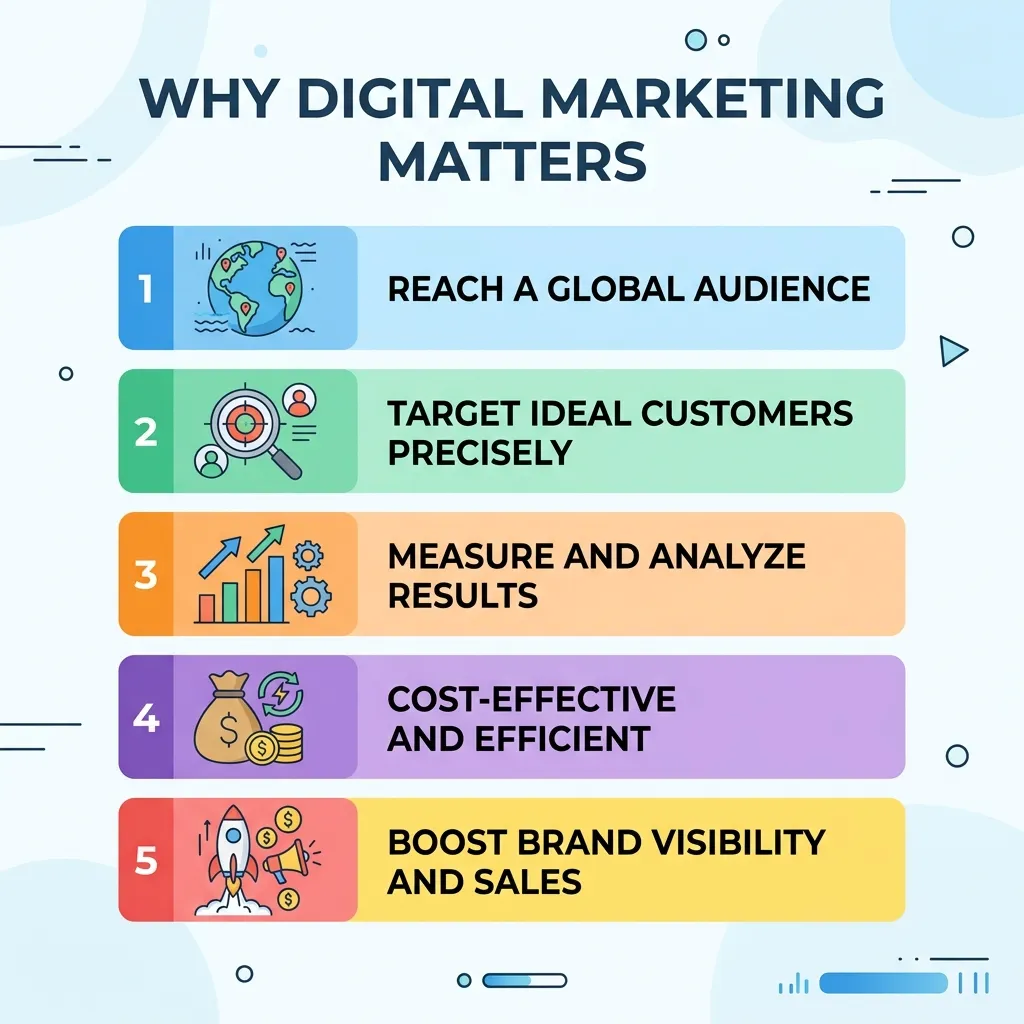
Digital marketing has become an essential part of how businesses attract customers, build brand awareness, generate leads, and increase sales. As consumers spend more time online, businesses need to meet them where they search for information, compare products, communicate with brands, and make purchasing decisions.
Unlike traditional marketing, digital marketing allows businesses to reach specific audiences, track campaign performance, communicate directly with customers, and adjust strategies based on real-time data. From search engines and social media to email marketing and online advertising, digital channels give businesses multiple ways to connect with potential customers.
Understanding why digital marketing matters for businesses in the modern era is therefore important for organizations of every size. Whether you operate a small local business, an e-commerce store, or a growing enterprise, a strong digital presence can support long-term visibility and growth.
What Is Digital Marketing?
Digital marketing refers to the promotion of products, services, brands, or businesses through digital channels and technologies. These channels may include search engines, websites, social media platforms, email, online advertising, content platforms, and other internet-based communication channels.
The goal is not simply to establish an online presence. Effective digital marketing helps businesses attract relevant audiences, build relationships, generate qualified leads, and encourage conversions.
Digital marketing can include:
- Search engine optimization (SEO)
- Content marketing
- Social media marketing
- Email marketing
- Pay-per-click advertising
- Display advertising
- Video marketing
- Influencer marketing
- Online reputation management
- Conversion rate optimization
Businesses can combine several of these channels depending on their goals, target audience, budget, and industry.
Why Digital Marketing Matters for Businesses
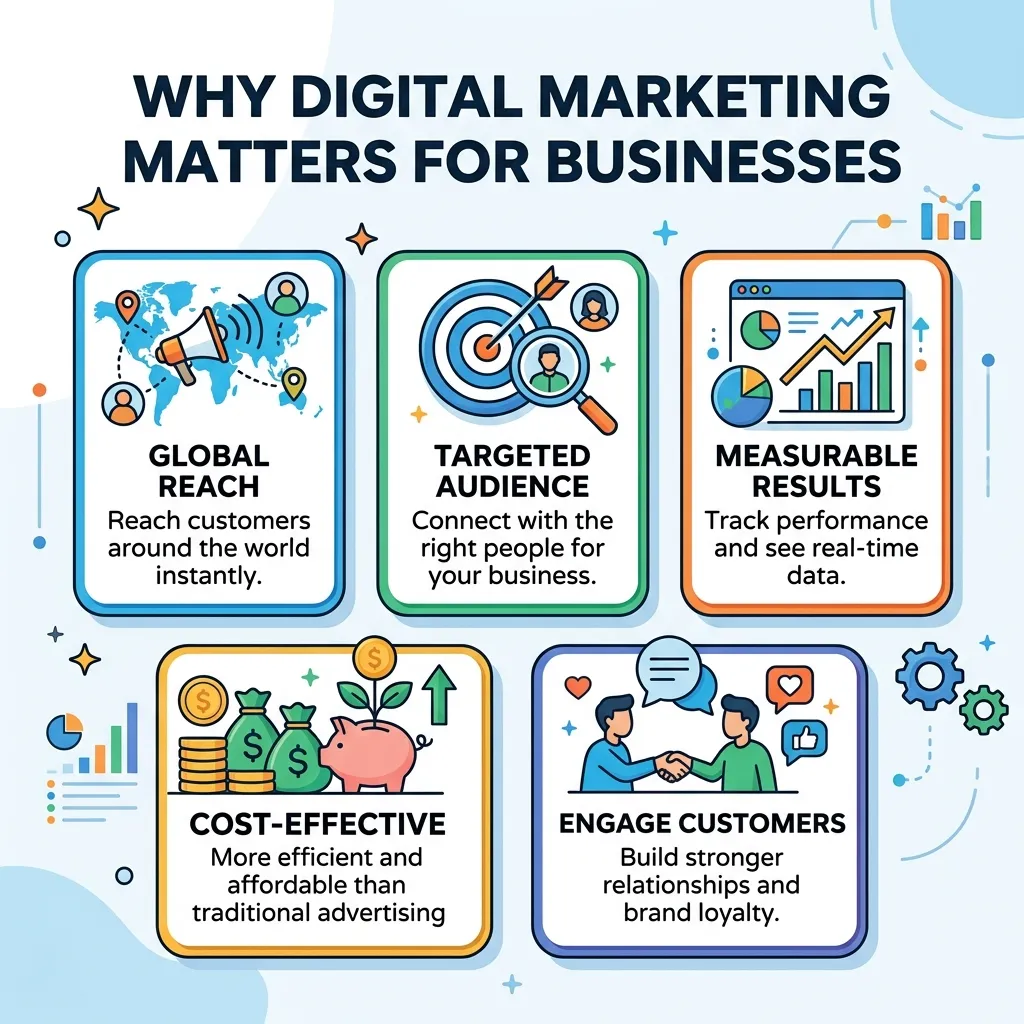
The importance of digital marketing comes from the way modern consumers discover and evaluate businesses. People often search online before visiting a store, contacting a service provider, or purchasing a product.
A business without a strong digital presence can therefore miss opportunities to reach potential customers.
Here are some of the major reasons digital marketing matters today.
1. Customers Are Spending More Time Online
Consumers use digital platforms throughout the buying journey. They search for information, read reviews, compare alternatives, watch videos, visit websites, and interact with brands online.
This makes digital channels an important place for businesses to communicate with potential customers.
A strong online presence allows a company to provide useful information at different stages of the customer journey. Instead of waiting for customers to discover a business through traditional channels, brands can actively appear where their audiences are already looking.
2. Digital Marketing Expands Business Reach
Traditional marketing methods often depend on physical locations, broadcast areas, publications, or other offline limitations. Digital marketing can help businesses reach audiences beyond their immediate geographic area.
For example, a local company can use digital campaigns to target customers in specific cities or neighborhoods, while an e-commerce company can reach potential buyers across different regions.
This flexibility is especially valuable for businesses that want to expand their customer base without opening physical locations in every market.
Businesses interested in understanding the broader role of traditional and digital approaches can also explore Digital Marketing vs. Traditional Marketing.
3. It Helps Businesses Reach Specific Audiences
One of the biggest advantages of digital marketing is audience targeting.
Businesses can create campaigns based on factors such as:
- Location
- Age group
- Interests
- Online behavior
- Search intent
- Previous interactions
- Device usage
- Customer characteristics
This allows marketers to focus resources on audiences that are more likely to be interested in their products or services.
For example, a local restaurant may target people within a specific geographic area, while an online software company may target professionals interested in a particular business solution.
More precise targeting can reduce wasted advertising spend and improve the relevance of marketing messages.
4. Digital Marketing Can Be More Measurable
Traditional marketing can sometimes make it difficult to determine exactly how many people interacted with an advertisement or what action they took afterward.
Digital marketing provides access to a wide range of measurable data.
Businesses can track metrics such as:
- Website traffic
- Click-through rate
- Conversion rate
- Cost per click
- Cost per acquisition
- Engagement rate
- Email open rate
- Leads generated
- Sales
- Return on advertising spend
These measurements help marketers understand what is working and where improvements are needed.
Businesses can use this information to adjust campaigns rather than relying entirely on assumptions.
5. It Supports Data-Driven Decision-Making
Data is one of the most valuable resources available to modern marketers.
Digital platforms generate information about how users interact with content, advertisements, websites, and offers. Marketers can analyze this information to identify patterns and make better decisions.
For example, if a particular landing page generates more conversions than another, the business can investigate what makes it more effective. Similarly, if one advertising audience produces better results, marketing resources can be shifted toward that audience.
This creates a continuous process of testing, measuring, learning, and improving.
6. Digital Marketing Builds Brand Awareness
Brand awareness is important because customers are more likely to consider businesses they recognize and remember.
Digital marketing provides multiple opportunities for repeated brand exposure through:
- Search results
- Social media posts
- Video content
- Display advertisements
- Blog articles
- Email campaigns
- Online communities
Consistent messaging across these channels can help businesses establish a recognizable identity.
Digital marketing can also complement offline efforts. Businesses interested in combining both approaches can learn more from Integrating Traditional and Digital Marketing.
7. It Creates Direct Customer Communication
Traditional advertising is often based on one-way communication. A business delivers a message, and the audience receives it.
Digital marketing makes two-way communication easier.
Customers can:
- Comment on social media posts
- Send direct messages
- Respond to emails
- Submit website forms
- Leave reviews
- Ask questions
- Participate in online discussions
This interaction can help businesses understand customer needs and respond to concerns more quickly.
Direct communication also gives companies opportunities to build stronger relationships with their audiences.
8. Digital Marketing Supports Customer Relationships
Marketing is not only about acquiring new customers. Retaining existing customers is also important.
Digital channels allow businesses to remain connected with customers after a purchase.
For example, businesses can use email campaigns to share:
- Product updates
- Special offers
- Educational content
- Helpful resources
- New product announcements
- Loyalty rewards
Social media and online communities can also help businesses maintain ongoing relationships with their audiences.
A consistent communication strategy can turn one-time buyers into repeat customers.
9. It Helps Small Businesses Compete
Digital marketing is particularly valuable for small businesses because it provides access to marketing channels that do not necessarily require the same resources as large-scale traditional advertising.
A small company can build visibility through SEO, content marketing, social media, email marketing, and targeted advertising.
This does not mean every small business will automatically compete with a major corporation. However, digital platforms can create opportunities for smaller companies to reach highly relevant audiences and establish a strong niche presence.
Businesses looking for broader traditional approaches can also review Traditional Marketing for Small Businesses.
10. It Supports Local Business Growth
Digital marketing is not limited to global companies.
Local businesses can use digital channels to reach people in nearby areas. Local search visibility, online reviews, social media, location-based advertising, and business listings can all support local customer acquisition.
For example, a local service provider can create content that answers questions commonly searched by customers in its service area.
A restaurant can promote special offers to nearby customers, while a retail store can use digital campaigns to encourage people to visit its physical location.
11. Digital Marketing Helps Businesses Understand Customers
Digital marketing creates opportunities to learn more about customer behavior.
Businesses can analyze:
- Which pages visitors view
- What content attracts attention
- Which products receive the most interest
- Which advertisements generate clicks
- Where visitors leave a website
- Which offers generate conversions
These insights can help businesses improve products, services, websites, content, and marketing campaigns.
Instead of treating customers as a broad audience, businesses can use data to understand different customer segments and their needs.
12. It Supports Multiple Stages of the Buying Journey
Customers rarely move directly from discovering a brand to making a purchase.
The buying journey may include several stages:
- Awareness
- Interest
- Research
- Evaluation
- Purchase
- Retention
- Advocacy
Digital marketing can support each stage.
For example, blog content can introduce a problem, search optimization can help customers discover the business, social media can build engagement, email can nurture prospects, and online advertising can encourage conversions.
This makes digital marketing a flexible part of the complete customer journey.
13. Content Marketing Provides Long-Term Value
Content is another reason digital marketing matters.
Businesses can create useful resources such as:
- Blog posts
- Guides
- Tutorials
- Case studies
- Videos
- Infographics
- FAQs
- Industry reports
High-quality content can attract visitors through search engines and social platforms while demonstrating a company’s knowledge.
Unlike some short-term promotional activities, useful content can continue attracting visitors after publication.
14. Digital Advertising Can Be Flexible
Online advertising allows businesses to create campaigns based on different objectives.
For example, a company may run campaigns designed to:
- Increase website traffic
- Generate leads
- Promote products
- Increase app installations
- Build brand awareness
- Drive online purchases
Campaigns can also be tested and adjusted based on performance.
This flexibility allows marketers to experiment with different audiences, messages, creatives, and offers.
15. It Can Support Faster Marketing Optimization
One important characteristic of digital marketing is the ability to make changes relatively quickly.
If an advertisement is underperforming, marketers can modify its audience, creative, message, or landing page.
If a blog article is receiving traffic but generating few conversions, the business can improve its calls to action or supporting content.
This creates an iterative marketing process in which campaigns can continuously improve based on available performance data.
Digital Marketing vs. Traditional Marketing
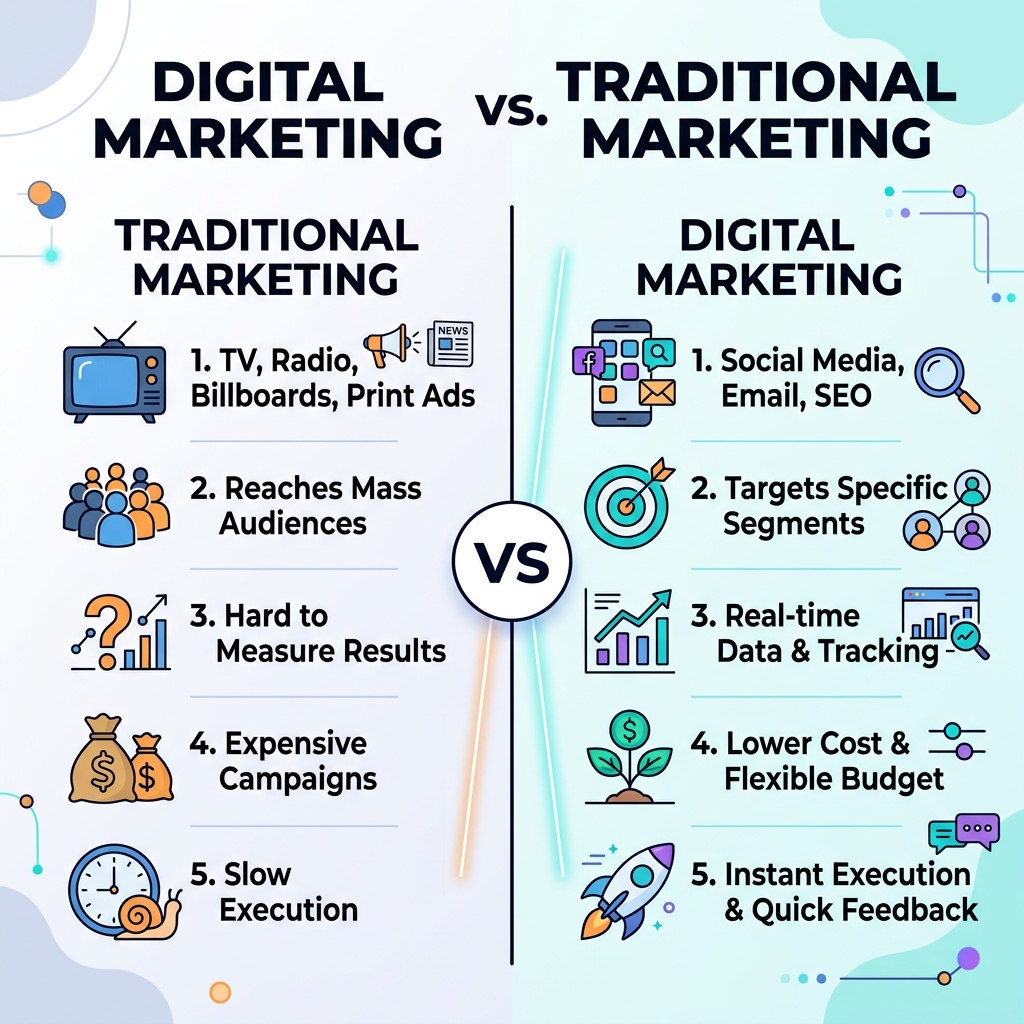
Digital and traditional marketing are not necessarily competing concepts. Both can play useful roles depending on a company’s objectives and target audience.
Traditional marketing can include:
- Television advertising
- Radio advertising
- Print advertising
- Direct mail
- Billboards
- Outdoor advertising
Digital marketing commonly includes:
- SEO
- Social media
- Search advertising
- Content marketing
- Online video
- Display advertising
The main difference is the environment in which communication takes place and the way marketers can interact with and measure audiences.
For a deeper comparison, businesses can explore How Is Digital Marketing Different From Traditional Marketing?.
How Businesses Can Build an Effective Digital Marketing Strategy
Understanding the importance of digital marketing is only the first step. Businesses also need a structured strategy.
Step 1: Define Business Goals
Start by identifying what the business wants to achieve.
Possible goals include:
- Increasing sales
- Generating leads
- Increasing website traffic
- Improving brand awareness
- Growing an email list
- Increasing customer retention
Clear objectives make it easier to select appropriate channels and measure performance.
Step 2: Identify the Target Audience
Businesses should understand who they want to reach.
Research customer needs, interests, problems, purchasing behavior, and online habits.
The more clearly an audience is defined, the easier it becomes to create relevant marketing messages.
Step 3: Choose the Right Digital Channels
Not every business needs to use every digital platform.
A company should prioritize channels that align with its audience and goals.
For example:
- SEO can support long-term search visibility.
- Social media can support engagement and community building.
- Email marketing can support customer retention.
- Paid advertising can generate targeted traffic.
- Content marketing can establish authority.
Step 4: Create Valuable Content
Content should provide a reason for people to engage.
Instead of producing content only to promote products, businesses should answer questions, solve problems, educate customers, and demonstrate expertise.
Step 5: Measure Performance
Track relevant metrics regularly.
The right KPIs depend on the campaign objective. A brand awareness campaign may focus on reach and impressions, while a lead generation campaign may focus on leads and cost per acquisition.
Step 6: Test and Improve
Digital marketing should not be treated as a one-time activity.
Businesses should continually test different:
- Headlines
- Images
- Videos
- Offers
- Landing pages
- Audiences
- Calls to action
Performance data can then guide future decisions.
Common Digital Marketing Challenges
Although digital marketing offers many advantages, businesses can also face challenges.
High Competition
Many companies compete for the same audiences and search terms. Businesses therefore need useful content, strong positioning, and consistent execution.
Constant Platform Changes
Search engines, social media platforms, advertising systems, and consumer behavior continue to change. Marketers need to monitor these developments and adjust strategies.
Content Saturation
Publishing content is not enough. Businesses need to create content that provides genuine value and differentiates the brand.
Measurement Complexity
Having access to large amounts of data does not automatically mean businesses will make better decisions. Marketers need to identify the metrics that actually connect to business objectives.
The Role of Traditional and Digital Marketing Together
Businesses do not always need to choose between traditional and digital marketing.
A hybrid approach can combine the broad visibility of traditional channels with the targeting, interaction, and measurement capabilities of digital platforms.
For example, a company may use television advertising to create broad awareness while using search advertising and social media to capture interested customers.
This approach can help businesses create a more connected customer experience.
Companies interested in this model can explore Traditional Marketing Strategies for the Digital Age.
Why Digital Marketing Will Remain Important
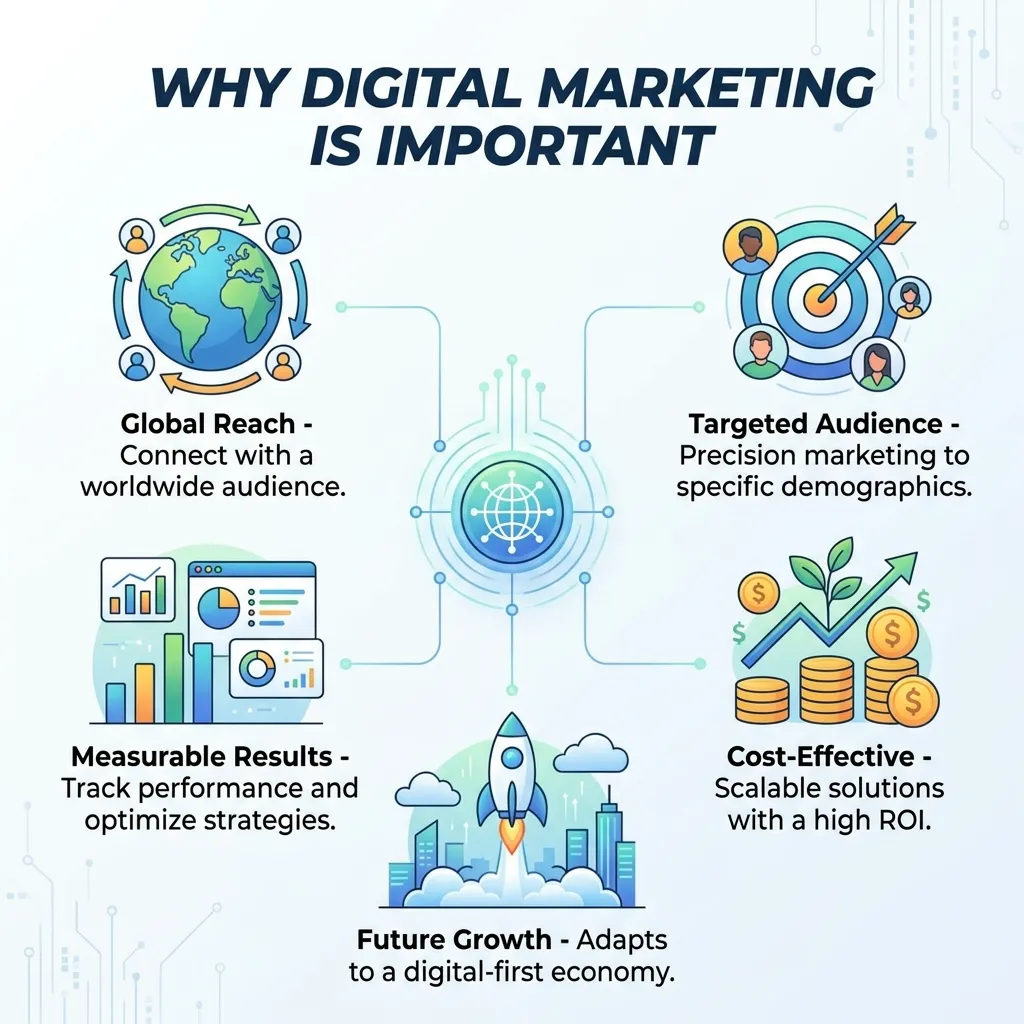
Consumer behavior continues to evolve alongside technology. People increasingly use digital devices to search, communicate, research products, consume content, and interact with businesses.
As a result, digital marketing is likely to remain an important component of modern business strategy.
However, successful digital marketing is not simply about being present on every platform. Businesses need to understand their customers, create useful experiences, select appropriate channels, and use data to improve performance.
Final Thoughts
Digital marketing matters for businesses in the modern era because it provides powerful ways to reach audiences, build awareness, communicate with customers, generate leads, and measure marketing performance.
Its value comes from more than simply having a website or social media account. A successful digital marketing strategy connects business goals with customer needs and uses the right channels to deliver relevant messages at the right time.
For modern businesses, the strongest approach may be neither purely digital nor purely traditional. Combining digital strategies with appropriate traditional marketing channels can create a broader and more connected marketing system.
As customer behavior continues to change, businesses that understand and adapt to digital marketing can create stronger opportunities for visibility, engagement, and sustainable growth.
Frequently Asked Questions
What is digital marketing?
Digital marketing is the promotion of products, services, or brands through digital channels such as search engines, websites, social media, email, online advertising, and digital content.
Why is digital marketing important for businesses?
Digital marketing helps businesses reach targeted audiences, increase online visibility, generate leads, communicate with customers, and measure marketing performance.
Is digital marketing useful for small businesses?
Yes. Small businesses can use SEO, content marketing, social media, email, and targeted advertising to reach relevant audiences and compete within specific markets.
What are the main benefits of digital marketing?
Major benefits include wider reach, audience targeting, measurable performance, customer engagement, flexible campaigns, brand awareness, and data-driven decision-making.
How does digital marketing differ from traditional marketing?
Digital marketing uses internet-based channels, while traditional marketing generally uses offline channels such as television, radio, print, direct mail, and billboards.
Can businesses use traditional and digital marketing together?
Yes. Businesses can combine traditional and digital channels to increase reach, reinforce messaging, and connect with customers across different stages of the buying journey.
What digital marketing channel should a business use?
The right channel depends on the business’s goals, audience, industry, resources, and customer behavior. Businesses should prioritize channels that are most relevant to their target customers.
How can businesses measure digital marketing success?
Businesses can measure results using metrics such as website traffic, leads, conversions, engagement, click-through rates, customer acquisition costs, and revenue.
Does digital marketing work for local businesses?
Yes. Local businesses can use search visibility, social media, online reviews, location-based campaigns, and content to reach customers in specific geographic areas.
Is digital marketing expensive?
The cost varies depending on the channels, campaign objectives, audience, competition, and resources involved. Businesses can use both organic and paid strategies based on their budgets.
Why is data important in digital marketing?
Data helps businesses understand customer behavior, evaluate campaign performance, identify opportunities, and make more informed marketing decisions.
Will digital marketing replace traditional marketing?
Not necessarily. Digital and traditional marketing can serve different purposes, and many businesses can benefit from combining both approaches.



Leave a Reply