

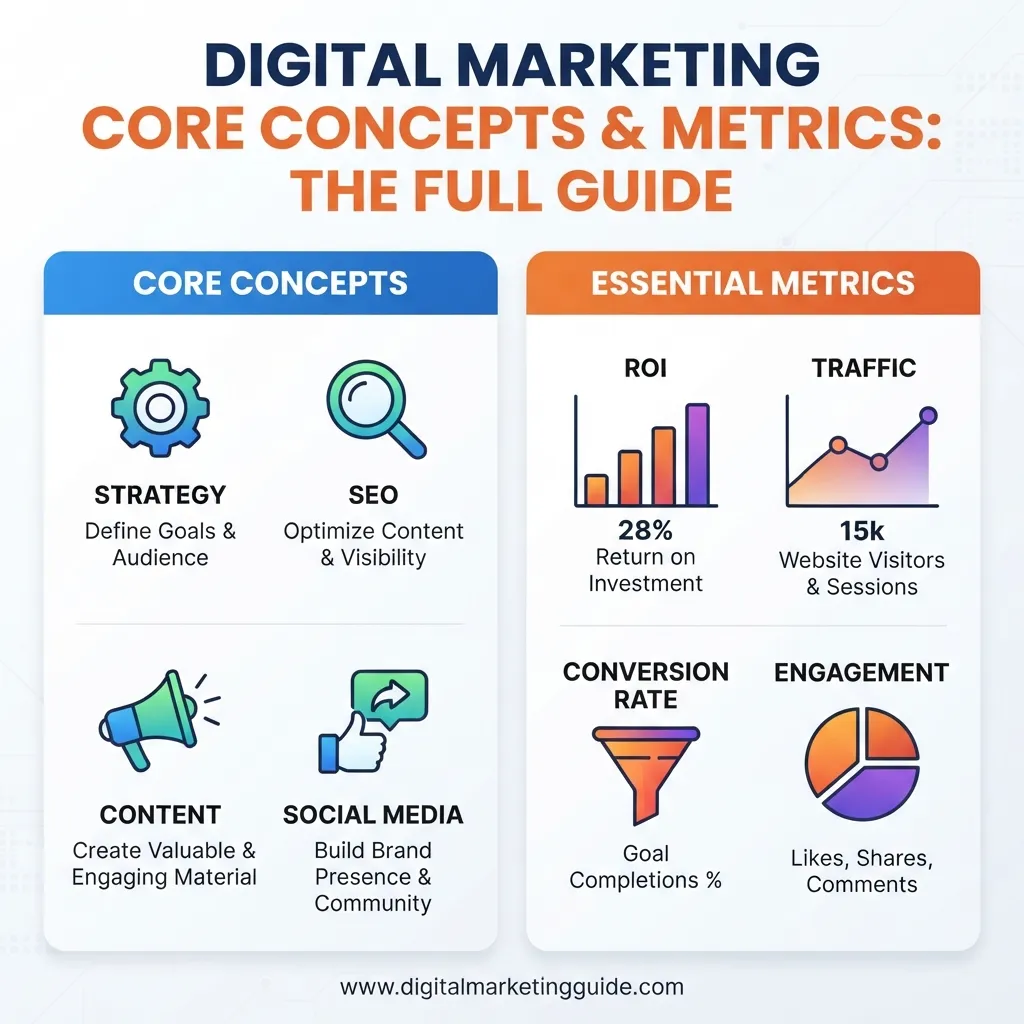
This pillar guide to digital marketing core concepts and metrics brings together the eight foundational ideas every marketer needs to understand: inbound versus outbound marketing, remarketing, lead qualification, LTV:CAC, attribution modeling, bounce rate versus engagement rate, growth hacking, and marketing mix modeling. Each section explains the concept clearly and links to a dedicated deep-dive for readers who want to go further.
Digital marketing has accumulated a dense vocabulary of terms, acronyms, and metrics over the past two decades — the digital marketing core concepts and metrics every practitioner eventually needs to know — and it’s easy for even experienced marketers to use some of them loosely without a precise working definition. That looseness has real costs — a team that can’t clearly distinguish an MQL from an SQL will argue past each other in a pipeline review, and a team that doesn’t understand LTV:CAC will make budget decisions on gut feeling rather than evidence.
This pillar guide brings together eight of the digital marketing core concepts and metrics that come up most often in strategy discussions, reporting meetings, and hiring interviews. Each section gives a clear, practical explanation and links out to a more detailed breakdown for anyone who wants to go deeper on a specific topic. Think of this page as the map for these digital marketing core concepts and metrics — the linked articles are the territory.
Inbound Marketing vs Outbound Marketing
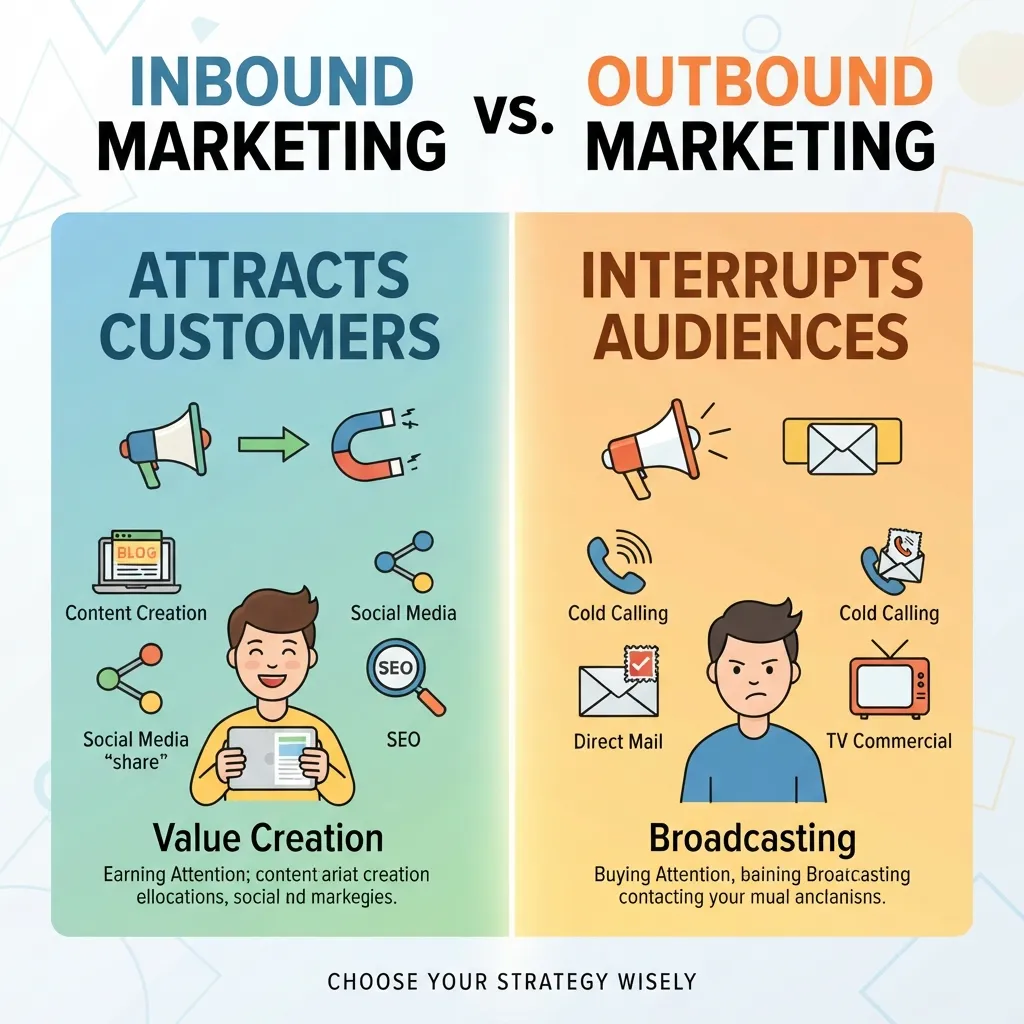
Inbound and outbound marketing represent two fundamentally different philosophies for reaching an audience, and understanding the distinction shapes almost every other decision a marketing team makes.
Outbound marketing pushes a message out to a broad audience regardless of whether they’ve expressed interest — traditional advertising, cold calling, direct mail, and unsolicited email all fall into this category. It interrupts attention rather than earning it, and its reach can be purchased at scale, which makes it useful for building broad awareness quickly.
Inbound marketing works in the opposite direction, creating content and experiences designed to attract people who are already searching for a solution. Blog content, SEO, gated resources, and organic social all fall under inbound. It tends to build trust more gradually but often converts better, since the audience arrives with existing intent rather than being interrupted mid-task.
Most mature marketing strategies use both rather than choosing one exclusively — outbound for speed and reach, inbound for efficiency and long-term compounding value. Our dedicated breakdown of inbound marketing vs outbound marketing covers how to decide the right mix for a given budget and sales cycle.
What Is Remarketing/Retargeting
Remarketing, also called retargeting, is the practice of showing ads specifically to people who have already interacted with a brand — visited a website, added a product to cart, or engaged with an app — without completing a desired action.
The logic behind remarketing is straightforward: someone who has already shown interest is a warmer prospect than a completely cold audience, and a well-timed reminder can recover a meaningful share of visitors who would otherwise never return. Common remarketing formats include display ads that follow a visitor across other websites, email sequences triggered by cart abandonment, and dynamic product ads that show the exact items a visitor previously viewed.
Remarketing tends to have a lower cost per conversion than cold prospecting, since the audience is already familiar with the brand, but it also has a ceiling — it can only recover interest that already existed, not create new demand from scratch. Our full guide on remarketing and retargeting covers setup, frequency capping, and how to avoid the fatigue that comes from over-targeting the same audience.
What Is a Marketing Qualified Lead (MQL) vs SQL
Lead qualification is one of the most common sources of friction between marketing and sales teams, largely because the terms MQL and SQL get used inconsistently across organizations.
A Marketing Qualified Lead (MQL) is a lead that has shown enough engagement — downloading a resource, attending a webinar, visiting high-intent pages repeatedly — to suggest genuine interest, but hasn’t yet been vetted for fit or immediate buying intent. MQLs are typically identified through lead scoring models built on behavioral and demographic signals.
A Sales Qualified Lead (SQL) is a lead that has been reviewed, usually by a sales development rep, and confirmed to match the target customer profile with genuine near-term buying intent. The transition from MQL to SQL is where marketing hands off responsibility to sales, and misalignment on what qualifies a lead at each stage is one of the most common causes of pipeline disputes.
Clear, jointly agreed definitions for both stages — documented and revisited regularly — tend to resolve most of the friction that otherwise builds up between the two teams. Our detailed comparison of MQL vs SQL walks through how to build a lead scoring model that both teams actually trust.
LTV to CAC Ratio Explained
The LTV:CAC ratio compares customer lifetime value against customer acquisition cost, and it’s one of the clearest single indicators of whether a business’s growth engine is fundamentally healthy.
Customer lifetime value (LTV) estimates the total revenue or profit a business can expect from a customer over the full relationship, not just the first purchase. Customer acquisition cost (CAC) is the total sales and marketing spend divided by the number of new customers acquired in a given period. Dividing LTV by CAC produces a ratio that indicates whether acquisition spend is being recovered with enough margin to justify continued investment.
A commonly cited benchmark suggests a ratio of 3:1 or higher as healthy for many business models, though the right target varies significantly by industry, margin structure, and how quickly a business needs to recoup acquisition costs. A ratio too close to 1:1 suggests a business is barely breaking even on new customers, while an unusually high ratio can sometimes indicate underinvestment in growth rather than genuine efficiency. The concept of customer lifetime value itself has a long history in marketing measurement, predating most of the digital-specific metrics covered elsewhere in this guide. Our dedicated piece on the LTV to CAC ratio walks through the calculation in detail, along with common mistakes that distort the number.
Attribution Modeling in Digital Marketing
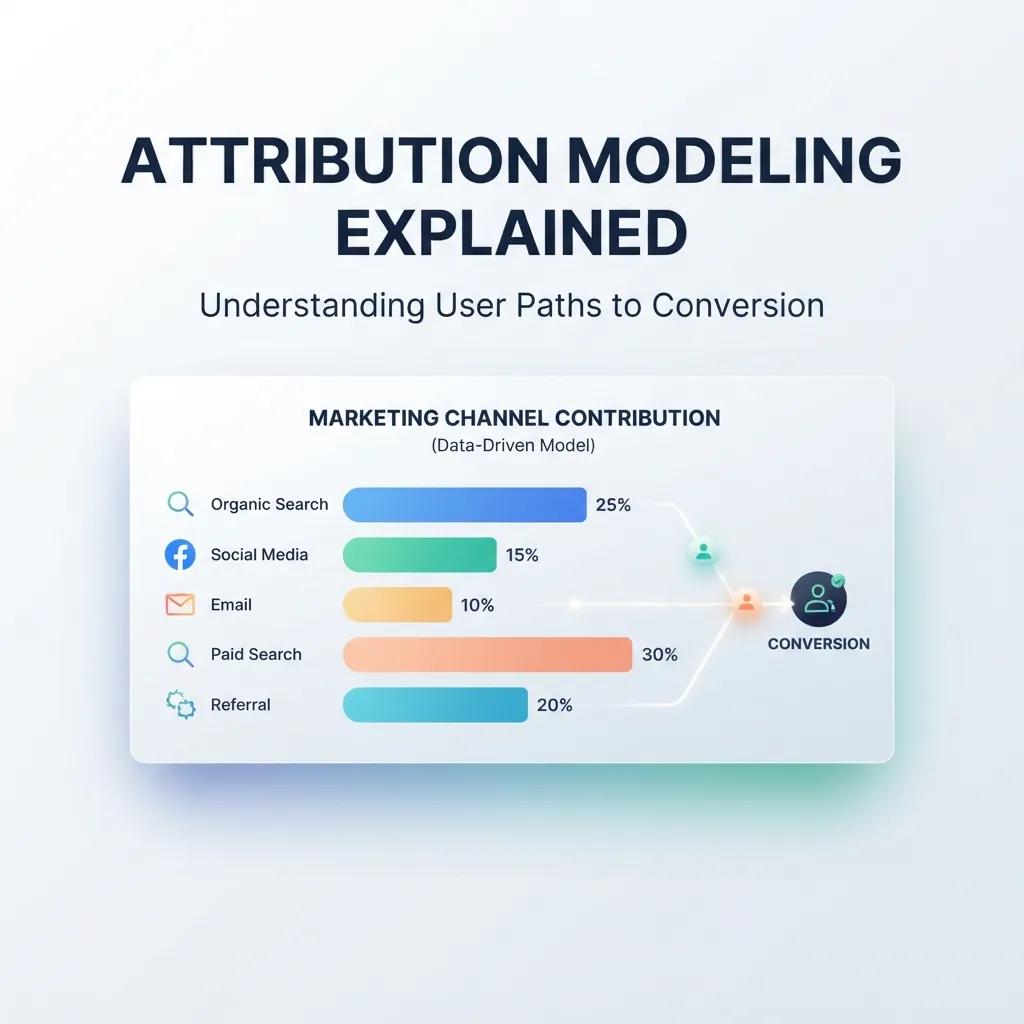
Attribution modeling assigns credit for a conversion across the different touchpoints a customer interacted with before converting, and the model a team chooses can dramatically change how channel performance appears to be working.
Common attribution models include last-click attribution, which credits the final touchpoint before conversion; first-click attribution, which credits the touchpoint that started the journey; linear attribution, which distributes credit evenly across every touchpoint; and various data-driven models, which use statistical methods to weight touchpoints based on their actual observed contribution to conversion.
The choice of model matters enormously for budget decisions. A business relying on last-click attribution alone will tend to overvalue bottom-of-funnel channels like branded search while undervaluing the awareness-stage content and advertising that originally introduced the customer to the brand. Our deep dive on attribution modeling in digital marketing breaks down each model’s strengths and weaknesses and how to choose one that fits a business’s actual customer journey.
Bounce Rate vs Engagement Rate Explained
These two metrics are frequently confused, and the shift in how analytics platforms report them has made the confusion worse in recent years.
Bounce rate, in its classic definition, measures the percentage of sessions where a visitor viewed only a single page and left without triggering any other tracked interaction. A high bounce rate was traditionally treated as a red flag, though this interpretation has always been imperfect — a visitor who reads a single blog post thoroughly and leaves satisfied technically “bounces” despite a genuinely successful visit.
Engagement rate, the metric that has largely replaced bounce rate in newer analytics platforms, measures the percentage of sessions that last a meaningful duration, include multiple page views, or trigger a defined conversion event. This tends to give a more accurate picture of whether a visit was actually valuable, since it accounts for meaningful single-page engagement rather than treating every single-page session as a failure.
Neither metric should be read in isolation — both need context from the specific page’s purpose and the channel driving traffic to it. Our full breakdown of bounce rate vs engagement rate explains how to interpret both metrics correctly across different page types and traffic sources.
What Is Growth Hacking
Growth hacking refers to a marketing approach centered on rapid, low-cost experimentation aimed at finding scalable ways to grow a user base, typically associated with early-stage startups operating with limited budgets and a need for fast, defensible traction.
The core discipline behind growth hacking is a tight feedback loop: forming a hypothesis about what might drive growth, running a small, fast test, measuring the result, and either scaling what works or discarding what doesn’t. This differs from traditional marketing planning, which often involves longer campaign cycles and larger upfront investment before results are known.
Growth hacking isn’t a specific tactic so much as a mindset and process, though certain tactics — viral loops, referral incentives, product-led onboarding hooks — have become closely associated with the discipline because they scale efficiently without proportional spend increases. Our guide on growth hacking covers the experimentation framework in more depth, along with examples of how early-stage companies have applied it successfully.
Marketing Mix Modeling Explained
Marketing mix modeling (MMM) is a statistical approach to measuring how different marketing channels and tactics contribute to overall sales or business outcomes, using historical data rather than individual user-level tracking.
Unlike digital attribution models, which typically rely on tracking individual users across touchpoints, marketing mix modeling analyzes aggregate data — sales figures, media spend by channel, pricing changes, seasonality, and external factors — using regression-based techniques to estimate each channel’s contribution. This makes MMM particularly valuable for measuring the impact of channels that are difficult to track at the individual level, such as television or out-of-home advertising, and it has become increasingly relevant as privacy restrictions limit the accuracy of user-level digital attribution.
MMM works best as a complement to more granular digital attribution rather than a replacement for it — the two approaches answer different questions and are often most useful when triangulated together. Our detailed explainer on marketing mix modeling covers how the methodology works, what data it requires, and when it makes sense for a business to invest in it.
How These Concepts Connect

These eight digital marketing core concepts and metrics don’t exist in isolation — they connect into a coherent picture of how marketing actually functions end to end. Inbound and outbound marketing determine how prospects first encounter a brand. Remarketing recovers interest from those who didn’t convert on the first visit. MQL and SQL definitions govern how that interest gets qualified and handed to sales. LTV:CAC measures whether the entire acquisition engine is economically sound. Attribution modeling and the bounce-versus-engagement distinction determine whether a team can actually trust the data informing those decisions. Growth hacking supplies a fast experimentation process for testing new approaches to any of the above. And marketing mix modeling provides a broader, channel-level check on whether the sum of all these efforts is actually working.
Understanding each concept individually is useful. Understanding how they connect is what turns a marketing team’s reporting from a collection of disconnected numbers into an actual decision-making system.
This is also why the concepts are organized together on a single pillar page rather than scattered across unrelated posts. A reader trying to understand LTV:CAC benefits from also understanding attribution modeling, since a distorted attribution model can quietly feed bad numbers into an otherwise correct LTV:CAC calculation. Someone debating inbound versus outbound budget allocation benefits from understanding growth hacking, since fast experimentation often reveals which channel mix actually performs before a larger campaign commitment is made. Treating these digital marketing core concepts and metrics as a connected system, rather than eight separate definitions to memorize, is ultimately what makes them useful in a real strategy conversation rather than just interview trivia.
Conclusion
Digital marketing core concepts and metrics like these aren’t just vocabulary — they’re the shared language that lets marketing, sales, and finance teams have productive conversations about strategy and budget. A team that clearly understands the difference between inbound and outbound marketing, correctly defines MQL and SQL, tracks LTV:CAC honestly, chooses attribution models deliberately, reads engagement data correctly, experiments through a growth hacking mindset, and occasionally steps back with marketing mix modeling to check the bigger picture is a team equipped to make decisions on evidence rather than assumption. Each linked guide above goes deeper into its specific concept — this pillar page on digital marketing core concepts and metrics exists to show how they all fit together.
Frequently Asked Questions (FAQs)
1. What’s the simplest way to explain inbound vs outbound marketing?
Inbound and outbound marketing are two of the most important Digital Marketing Core Concepts. Outbound marketing pushes a message to a broad audience regardless of interest, while inbound marketing attracts people who are already searching for a solution through content, SEO, and organic channels.
2. Is remarketing the same as retargeting?
Yes, the two terms are generally used interchangeably to describe advertising aimed specifically at people who have already interacted with a brand without completing a desired action. Understanding this distinction is useful when learning Digital Marketing Core Concepts related to paid advertising.
3. What’s the difference between an MQL and an SQL?
An MQL shows enough engagement to suggest interest but hasn’t been vetted for fit, while an SQL has been reviewed and confirmed to have genuine near-term buying intent, usually by a sales development rep. This distinction is another important part of Digital Marketing Core Concepts for aligning marketing and sales teams.
4. What LTV:CAC ratio is considered healthy?
A ratio of 3:1 or higher is a commonly cited benchmark, though the right target varies by industry, margin structure, and how quickly a business needs to recover acquisition costs. LTV:CAC is one of the Digital Marketing Core Concepts that helps businesses evaluate marketing efficiency and customer value.
5. Why does attribution modeling matter so much?
Because the choice of model changes how channel performance appears — last-click models tend to overvalue bottom-funnel channels while undervaluing the awareness-stage efforts that started the customer journey. Attribution is therefore an important part of understanding Digital Marketing Core Concepts and measuring channel performance.
6. Has engagement rate replaced bounce rate in modern analytics?
Largely, yes. Many newer analytics platforms report engagement rate by default, since it accounts for meaningful single-page visits that classic bounce rate would have counted as failures.
7. Is growth hacking only relevant for startups?
It’s most closely associated with early-stage startups, but the underlying discipline — fast, low-cost experimentation with clear measurement — is useful for marketing teams of any size. It can also complement broader Digital Marketing Core Concepts such as testing, analytics, and conversion optimization.
8. What makes marketing mix modeling different from digital attribution?
MMM analyzes aggregate historical data rather than tracking individual users, which makes it well suited to measuring channels that are hard to track at the individual level, like TV advertising. It provides another perspective alongside the Digital Marketing Core Concepts used for digital measurement.
9. Do all businesses need to track every metric in this guide?
Not necessarily at once, but understanding all eight concepts helps a team recognize which metrics matter most for their specific stage and business model. The goal of learning Digital Marketing Core Concepts is to understand which measurements and strategies are relevant to a particular business.
10. How often should MQL and SQL definitions be revisited?
Regularly — ideally whenever a business notices friction between marketing and sales about lead quality, since definitions that worked at one stage of growth often need adjustment as the business scales.
11. Can LTV:CAC be calculated for an early-stage business with limited data?
It can, though early estimates tend to be less reliable since customer lifetime value depends on retention data that a young business may not yet have accumulated in meaningful volume.
12. Where should a marketing team start if these concepts feel overwhelming?
Starting with inbound vs outbound and MQL vs SQL can provide a useful foundation, since these shape day-to-day strategy and cross-team alignment before moving into more analytical areas like attribution and MMM. These fundamentals form a practical starting point for learning Digital Marketing Core Concepts.



Leave a Reply