

SWOT analysis is a strategic planning framework used to evaluate Strengths, Weaknesses, Opportunities, and Threats surrounding a business, project, campaign, or marketing strategy. Strengths and weaknesses are internal factors, while opportunities and threats come from the external environment. In digital marketing, SWOT analysis helps marketers understand their current position, identify competitive advantages, discover growth opportunities, recognize potential risks, and make more informed strategic decisions.
What Is SWOT Analysis?
SWOT analysis is a strategic framework that helps businesses evaluate their current position by examining four key areas: Strengths, Weaknesses, Opportunities, and Threats.
The first two factors—strengths and weaknesses—focus on internal conditions that an organization can generally influence. Opportunities and threats focus on external conditions that may create advantages or challenges.
According to the National Center for Biotechnology Information (NCBI), SWOT analysis is used to assess an organization’s strategic position and compare its capabilities with its competitive environment.
For digital marketers, SWOT analysis provides a simple way to look beyond individual metrics such as clicks, impressions, traffic, or conversions. Instead, it encourages marketers to consider the bigger picture.
For example, a business may have:
- Strong brand recognition as a strength
- Limited content resources as a weakness
- Growing demand in a new market as an opportunity
- Increasing competition as a threat
When these factors are considered together, marketers can make better decisions about where to invest time, money, people, and technology.
What Does SWOT Stand For?

SWOT stands for:
- S — Strengths
- W — Weaknesses
- O — Opportunities
- T — Threats
These four elements are divided into two major categories:
| Internal Factors | External Factors |
|---|---|
| Strengths | Opportunities |
| Weaknesses | Threats |
This distinction is important because internal factors are generally more controllable, while external factors are influenced by the market, competitors, technology, customer behavior, regulations, and other environmental conditions.
Strengths
Strengths are internal capabilities or resources that give a business an advantage.
Examples include:
- Strong brand reputation
- Skilled marketing team
- Loyal customers
- High-quality products
- Strong SEO performance
- Large email subscriber base
- Effective content strategy
- Advanced marketing technology
- Strong social media presence
A strength should be something that genuinely helps the organization compete or achieve its objectives.
Weaknesses
Weaknesses are internal limitations that may prevent a business from reaching its goals.
Examples include:
- Limited marketing budget
- Poor website experience
- Low brand awareness
- Lack of marketing expertise
- Weak content production
- Poor conversion rates
- Limited customer data
- Inconsistent social media activity
- Dependence on one acquisition channel
Identifying weaknesses is not about criticizing a business. It helps marketers understand where improvements are needed.
Opportunities
Opportunities are external circumstances that a business can potentially use to grow or improve its position.
Examples include:
- Emerging customer demand
- New digital platforms
- Growing search interest
- New geographic markets
- Technological developments
- Changes in customer preferences
- New content formats
- Underserved market segments
An opportunity becomes more valuable when a business has the resources and capabilities to take advantage of it.
Threats
Threats are external factors that may negatively affect business performance.
Common examples include:
- New competitors
- Changing algorithms
- Increasing advertising costs
- Economic uncertainty
- Changing consumer behavior
- New regulations
- Negative reviews
- Technology disruption
- Market saturation
Recognizing threats early allows marketers to develop contingency plans rather than reacting after a problem becomes serious.
Why Is SWOT Analysis Important?
SWOT analysis is valuable because it gives businesses a structured way to evaluate their current situation before making strategic decisions.
Instead of relying entirely on assumptions, marketers can organize information into four categories and identify relationships between them.
Strategic planning often involves evaluating internal capabilities alongside external conditions. Research published through the National Library of Medicine describes SWOT analysis as a commonly used component of strategic planning.
1. It Clarifies Business Position
A SWOT analysis can help marketers understand where a business currently stands.
For example, a company may discover that it has excellent products but weak online visibility. That insight can influence future SEO, content, social media, or paid advertising decisions.
2. It Helps Identify Competitive Advantages
A business may have resources or capabilities that competitors cannot easily replicate.
These might include:
- Proprietary data
- Expert knowledge
- Strong customer relationships
- Brand authority
- Unique products
- Specialized content
Identifying these advantages helps marketers build stronger positioning.
3. It Reveals Areas for Improvement
Weaknesses can remain hidden when teams focus only on successful campaigns.
SWOT analysis forces marketers to ask uncomfortable but useful questions:
- Where are we underperforming?
- Which channels are inefficient?
- What resources are missing?
- What are competitors doing better?
- Where are customers experiencing friction?
4. It Helps Discover Growth Opportunities
Digital markets change quickly. New platforms, technologies, search behaviors, and customer expectations can create opportunities.
A structured SWOT analysis can help businesses identify which changes are worth pursuing.
5. It Supports Risk Management
Threats are easier to manage when they are identified early.
For example, if a business depends heavily on paid search traffic, rising advertising costs may represent a significant threat. The company could respond by strengthening organic search, email marketing, social media, referral programs, or other channels.
SWOT Analysis in Digital Marketing
In digital marketing, SWOT analysis can be used to evaluate an entire marketing strategy or a specific channel such as SEO, PPC, social media, email marketing, content marketing, or influencer marketing.
It can also complement a broader digital marketing audit by helping marketers turn observations into strategic insights.
Example of a Digital Marketing SWOT Analysis
Imagine an e-commerce company wants to increase online sales.
Strengths:
- Strong customer reviews
- Recognizable brand
- High-quality product photography
- Existing email list
Weaknesses:
- Low organic traffic
- Slow mobile experience
- Limited video content
- Low repeat-purchase rate
Opportunities:
- Growing demand for the product category
- Increased interest in short-form video
- New content opportunities
- Expansion into new geographic markets
Threats:
- Aggressive competitors
- Rising paid advertising costs
- Changing search algorithms
- Price competition
This analysis provides a starting point for developing a stronger marketing strategy.
How Does SWOT Analysis Help Digital Marketing Strategy?
SWOT analysis becomes especially useful when it is connected to measurable marketing objectives.
For example, if the primary goal is increasing organic traffic, marketers can compare their SEO strengths and weaknesses with external opportunities and threats.
A company might identify:
Strength: Strong topical expertise
Weakness: Few authoritative backlinks
Opportunity: High demand for informational content
Threat: Established competitors dominating search results
The resulting strategy might focus on creating authoritative content, improving internal linking, building relevant backlinks, and targeting underserved search topics.
Marketers can then connect these actions with relevant digital marketing performance metrics and KPIs to measure progress.
What Are the Four Parts of a SWOT Analysis?
Strengths: What Are We Good At?
Ask questions such as:
- What do customers value about our brand?
- What makes our product different?
- Which marketing channels perform well?
- What resources do we have?
- What expertise does our team possess?
- What advantages do we have over competitors?
The answers help identify internal competitive advantages.
Weaknesses: Where Can We Improve?
Consider:
- Which channels perform poorly?
- Where are customers dropping off?
- What resources are missing?
- Do we lack expertise?
- Is our website difficult to use?
- Are our marketing processes inefficient?
Being specific makes weaknesses easier to address.
Opportunities: What Could We Take Advantage Of?
Look for:
- Emerging market trends
- New customer segments
- New technologies
- New content formats
- Search demand
- Competitor gaps
- New platforms
- Partnership opportunities
Opportunities should be evaluated based on potential value and feasibility.
Threats: What Could Hurt Our Performance?
Consider:
- Who are our strongest competitors?
- Are customer preferences changing?
- Are acquisition costs increasing?
- Are regulations changing?
- Are new technologies disrupting the market?
- Are competitors gaining visibility?
Threat analysis helps businesses prepare rather than react.
How to Conduct a SWOT Analysis
A useful SWOT analysis does not require a complicated process. The quality of the result depends largely on the information used and the questions asked.
Step 1: Define the Objective
Start by deciding what you want to analyze.
For example:
- A complete digital marketing strategy
- A new product launch
- An SEO campaign
- A social media strategy
- A website
- A new market
- A specific advertising campaign
A clearly defined objective keeps the analysis focused.
Step 2: Gather Relevant Information
Collect useful information before completing the matrix.
This may include:
- Website analytics
- Search performance
- Conversion data
- Customer feedback
- Competitor research
- Market research
- Social media performance
- Advertising results
- Sales data
You can combine SWOT with competitor analysis in digital marketing to gain a stronger understanding of your competitive position.
Step 3: Identify Strengths
List internal advantages that contribute to your objective.
Avoid vague statements such as “we have good marketing.”
Instead, use measurable or specific observations such as:
- “Organic traffic increased by 35%.”
- “Email generates a high percentage of repeat purchases.”
- “The company has recognized subject-matter experts.”
Step 4: Identify Weaknesses
Identify internal limitations that could prevent success.
Focus on facts rather than personal opinions.
For example:
- Low conversion rate
- Limited content capacity
- High customer acquisition cost
- Poor mobile usability
- Weak brand awareness
Step 5: Identify Opportunities
Study external trends and market conditions.
Ask:
What changes in the market could benefit us?
Look at customer demand, technology, competitors, industry trends, search behavior, and emerging platforms.
Step 6: Identify Threats
Determine which external factors could negatively affect your strategy.
Threats might include new competitors, rising costs, changing regulations, technological disruption, or shifts in consumer preferences.
Step 7: Prioritize the Findings
Do not treat every item as equally important.
Rank each factor based on:
- Potential impact
- Urgency
- Likelihood
- Business relevance
- Ability to respond
This makes the SWOT analysis more actionable.
Step 8: Turn Insights Into Actions
The most important step is converting the findings into decisions.
For example:
Strength + Opportunity: Use strong brand authority to enter a growing market.
Weakness + Opportunity: Improve content production to capture emerging search demand.
Strength + Threat: Use customer loyalty to defend against new competitors.
Weakness + Threat: Reduce dependence on a vulnerable marketing channel.
A SWOT matrix should ultimately support strategic action rather than simply become a document that sits unused.
SWOT Analysis Example for a Digital Marketing Campaign
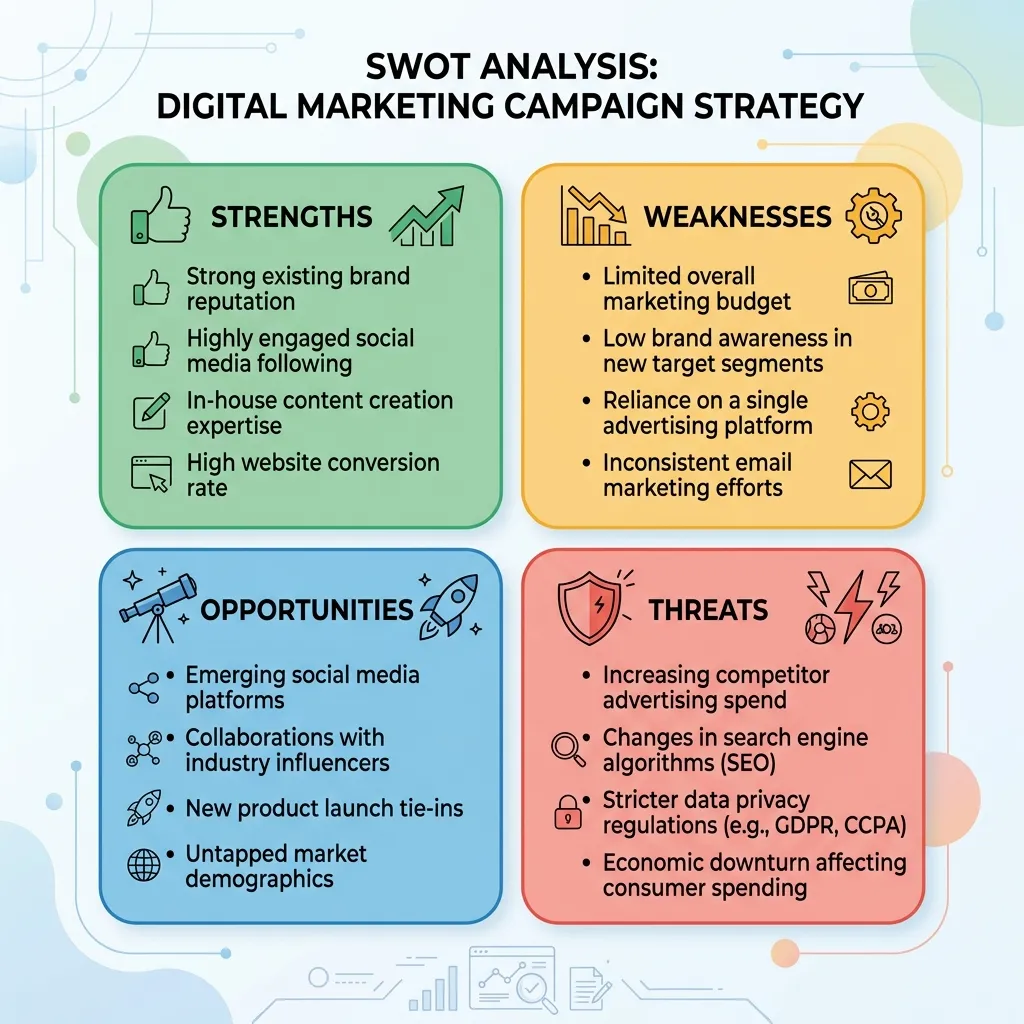
Consider a SaaS company launching a new project-management platform.
| SWOT Area | Example |
|---|---|
| Strengths | Strong product features, experienced team, existing customer base |
| Weaknesses | Low brand awareness, limited marketing budget |
| Opportunities | Growing demand for remote collaboration tools |
| Threats | Established competitors, increasing PPC costs |
The company could use these findings to prioritize content marketing, SEO, customer testimonials, comparison pages, and targeted campaigns rather than depending entirely on expensive paid advertising.
This approach also fits into a broader digital marketing strategy where SWOT findings influence channel selection, content priorities, budget allocation, and performance goals.
What Makes a Good SWOT Analysis?
A high-quality SWOT analysis should be:
Specific
Avoid vague statements. Replace “strong marketing” with a measurable or clearly defined capability.
Evidence-Based
Use analytics, customer feedback, research, and competitive information whenever possible.
Balanced
Do not focus only on positive factors. Weaknesses and threats are equally important.
Relevant
Every item should relate to the objective being analyzed.
Actionable
The final analysis should lead to decisions, priorities, or strategic actions.
Common SWOT Analysis Mistakes
1. Being Too General
Statements such as “good product” or “strong competitors” provide little strategic value.
2. Confusing Internal and External Factors
A lack of SEO expertise is generally an internal weakness, while a competitor’s new SEO strategy is an external threat.
3. Ignoring Evidence
Opinions without supporting information can make the analysis unreliable.
4. Listing Too Many Factors
A long list does not necessarily create a better analysis. Focus on the factors that can materially influence your objective.
5. Treating SWOT as a Final Strategy
SWOT is an analytical framework, not a complete marketing plan. The findings must be translated into priorities and actions.
6. Failing to Update the Analysis
Markets change. Competitors launch new products, algorithms evolve, customer preferences shift, and technologies develop. Therefore, SWOT should be revisited when circumstances change.
What Is the Difference Between SWOT Analysis and Competitor Analysis?
SWOT analysis evaluates internal and external factors affecting an organization, while competitor analysis focuses more specifically on competing businesses and their strategies.
For example:
SWOT analysis:
“What are our strengths, weaknesses, opportunities, and threats?”
Competitor analysis:
“How are our competitors performing, and where can we compete more effectively?”
The two approaches can work together. Competitor research can provide evidence for identifying strengths, weaknesses, opportunities, and threats.
What Is the Difference Between SWOT Analysis and a Digital Marketing Audit?
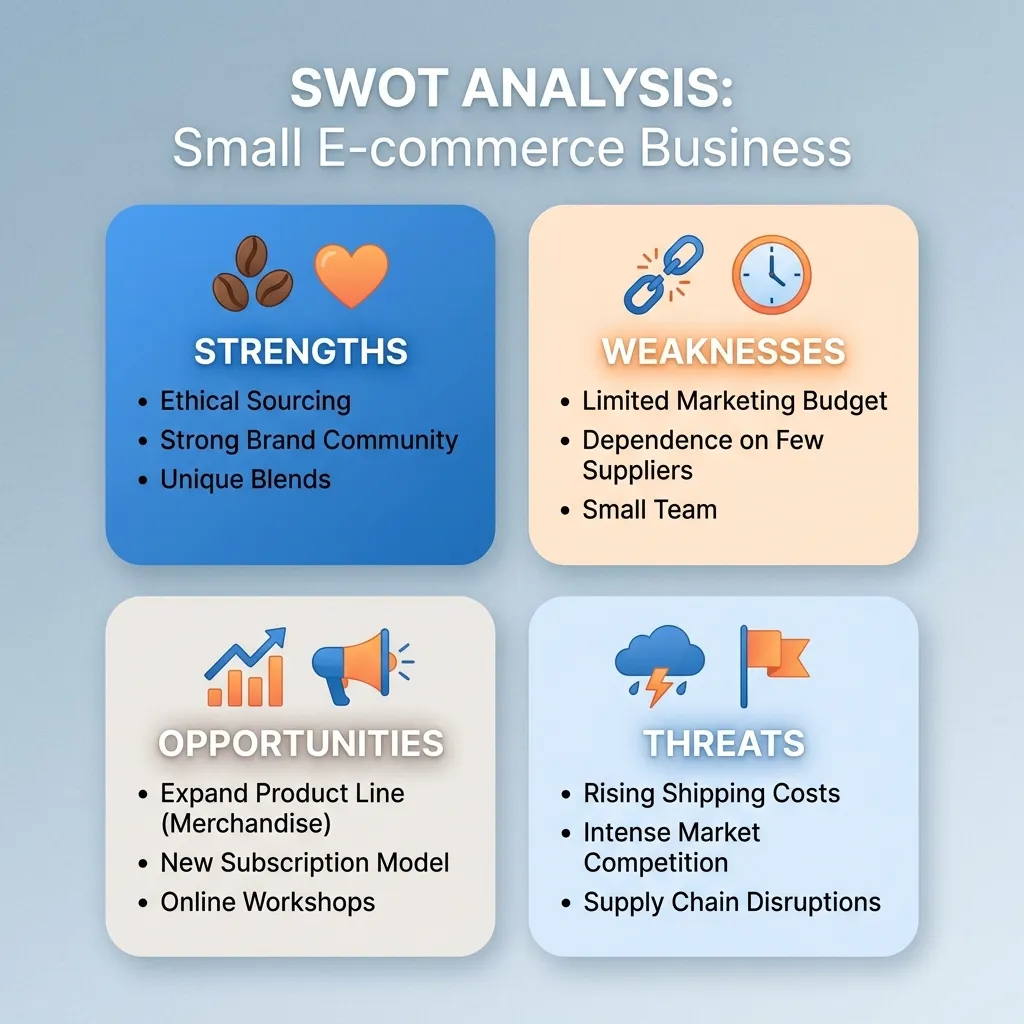
A digital marketing audit typically examines the performance and condition of digital marketing assets, channels, campaigns, and processes.
SWOT analysis takes those findings and places them into a broader strategic framework.
For example, an audit might discover that:
- Organic traffic is declining
- PPC costs are increasing
- Email engagement is strong
A SWOT analysis can then interpret these findings as:
- Weakness: Declining organic visibility
- Threat: Rising paid acquisition costs
- Strength: Strong email engagement
This makes SWOT particularly useful after collecting detailed marketing data.
Advantages of SWOT Analysis
SWOT analysis offers several benefits:
- Simple to understand
- Easy to organize
- Useful for strategic planning
- Applicable to businesses of different sizes
- Helps identify competitive advantages
- Encourages structured thinking
- Highlights risks and opportunities
- Can support marketing decisions
- Helps teams communicate strategic priorities
The NIH’s strategic-planning resources also emphasize structured planning, evidence, collaboration, and stakeholder input when developing strategic priorities.
Limitations of SWOT Analysis
Although SWOT analysis is useful, it has limitations.
A SWOT matrix can oversimplify complex situations. It may also become subjective when teams rely heavily on opinions rather than evidence.
Another limitation is that SWOT represents a particular point in time. Markets can change rapidly, meaning yesterday’s opportunity may become today’s threat.
For this reason, SWOT should be treated as one component of strategic decision-making rather than the only analytical method.
Conclusion
So, what is SWOT analysis? It is a strategic framework that evaluates Strengths, Weaknesses, Opportunities, and Threats to help businesses understand their current position and make more informed decisions.
For digital marketers, SWOT analysis is particularly useful because digital markets are constantly changing. Search algorithms, customer expectations, competitors, advertising costs, technology, and online platforms can all influence marketing performance.
A strong SWOT analysis should therefore go beyond simply filling four boxes. Marketers should use reliable data, identify the most important factors, prioritize findings, and convert those insights into actionable strategies.
When combined with competitor research, marketing audits, performance metrics, and clear objectives, SWOT analysis can become a practical tool for developing a more focused and resilient digital marketing strategy.
Frequently Asked Questions About SWOT Analysis
1. What is SWOT analysis in simple words?
SWOT analysis is a framework for identifying a business’s strengths, weaknesses, opportunities, and threats. It helps organizations understand their current position and make better strategic decisions.
2. What does SWOT stand for?
SWOT stands for Strengths, Weaknesses, Opportunities, and Threats.
3. What are the internal factors in SWOT analysis?
Strengths and weaknesses are considered internal factors because they relate to an organization’s resources, capabilities, processes, and limitations.
4. What are the external factors in SWOT analysis?
Opportunities and threats are external factors because they come from the market, competitors, customers, technology, regulations, economic conditions, and other outside influences.
5. Why is SWOT analysis important in digital marketing?
SWOT analysis helps digital marketers understand their competitive position, identify marketing strengths and weaknesses, discover growth opportunities, and prepare for potential threats.
6. Is SWOT analysis only for businesses?
No. SWOT analysis can be applied to businesses, projects, marketing campaigns, organizations, products, teams, and even individual strategic decisions.
7. How often should a SWOT analysis be conducted?
There is no universal schedule. Businesses should revisit SWOT when major market, competitive, technological, customer, or organizational changes occur. It can also be reviewed periodically as part of strategic planning.
8. What is an example of a strength in digital marketing?
Examples include strong organic search visibility, a loyal email audience, high brand recognition, skilled marketing professionals, or strong customer engagement.
9. What is an example of a weakness in digital marketing?
Examples include low website conversion rates, limited content resources, poor SEO visibility, inadequate analytics, or excessive dependence on one marketing channel.
10. What is an example of a digital marketing opportunity?
An opportunity could be growing search demand, an underserved audience, a new social platform, emerging content formats, or increased demand for a particular product category.
11. What is an example of a digital marketing threat?
Examples include aggressive competitors, increasing advertising costs, algorithm changes, changing customer preferences, new regulations, and technological disruption.
12. Can SWOT analysis improve a digital marketing strategy?
Yes. SWOT analysis can help marketers identify where they have advantages, where improvements are needed, which opportunities deserve attention, and which external risks require preparation.



Leave a Reply