

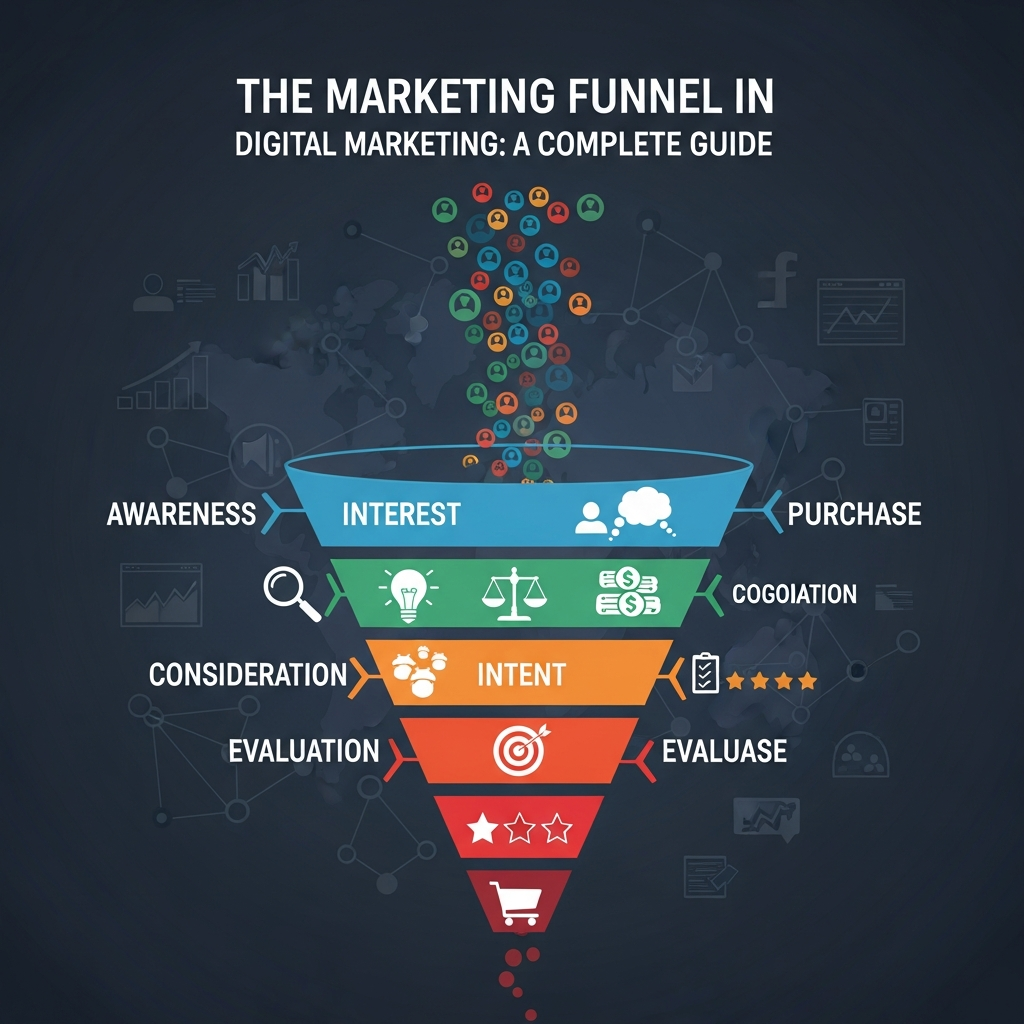
The marketing funnel in digital marketing maps the customer journey from first discovery to loyal advocacy. It consists of five key stages—Awareness, Interest/Consideration, Decision/Conversion, Retention/Loyalty, and Advocacy—each requiring distinct strategies, tools, and metrics to move prospects closer to purchase and long-term brand loyalty.
Most businesses lose customers not because their product is weak, but because their funnel is. A potential buyer discovers your brand, gets distracted, and never returns. A lead downloads your free guide but never hears from you again. A first-time customer makes one purchase, and then disappears. These aren’t random events—they’re symptoms of a poorly structured marketing funnel in digital marketing.
The marketing funnel is one of the most powerful frameworks a business can use to understand and optimize the customer journey. At every stage, there’s an opportunity to guide, persuade, and retain. When executed well, the funnel doesn’t just drive conversions—it builds relationships that compound over time.
This guide breaks down each stage of the marketing funnel in digital marketing, from the first touchpoint to post-purchase advocacy. You’ll learn which activities belong at each stage, which metrics to track, and how to optimize your approach to improve your Ad Conversion Rate and overall digital performance. Whether you’re a Digital Marketing Account Manager refining a client’s strategy or a business owner building your first funnel, this is the blueprint you need.
The digital landscape has made funnels more complex than ever. Consumer Behavior in Digital Marketing shifts constantly—buyers research more, compare more, and expect more personalized experiences. Understanding how to align your funnel with these behaviors isn’t optional. It’s the difference between a campaign that converts and one that burns budget.
What Is the Marketing Funnel in Digital Marketing?
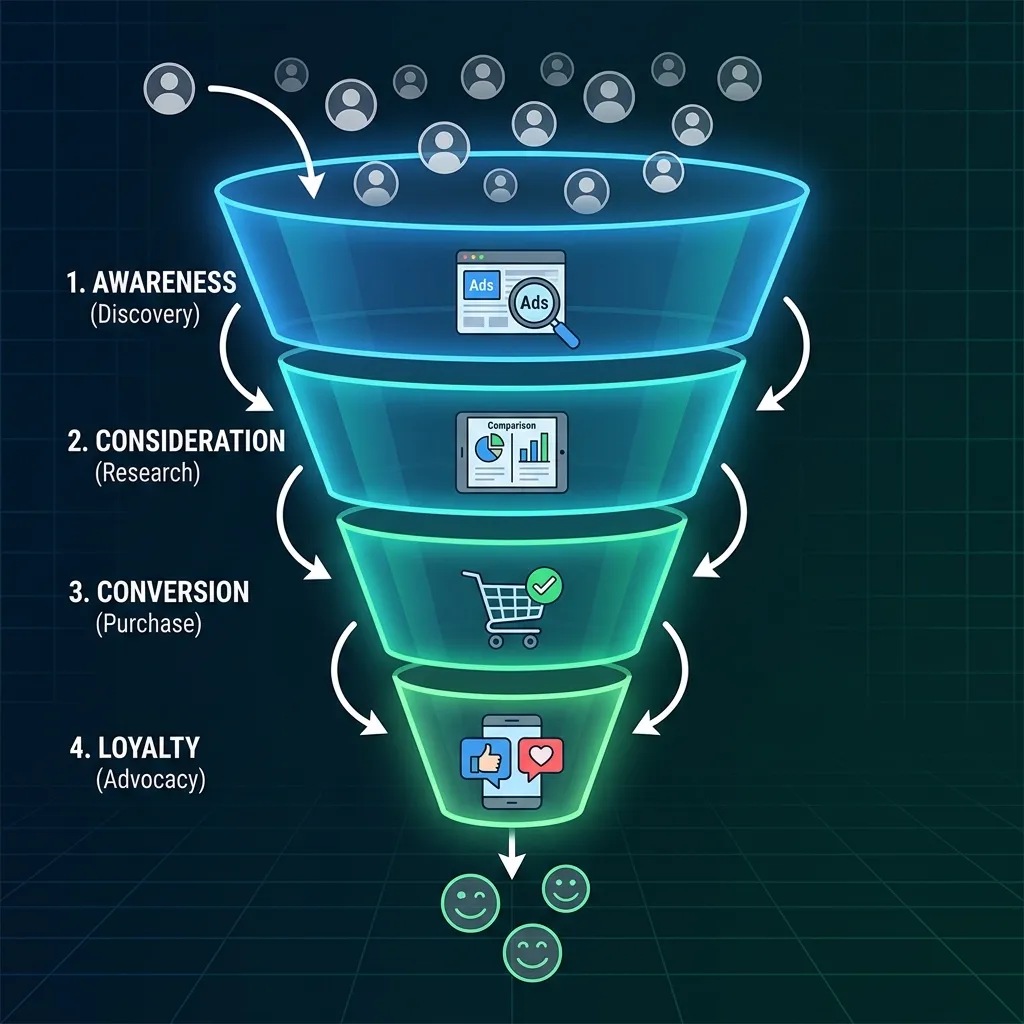
The marketing funnel in digital marketing is a model that represents the stages a prospect goes through before becoming a customer—and ideally, a long-term advocate. The term “funnel” reflects the reality that not every visitor becomes a buyer. Numbers narrow at each stage, which is why understanding where and why people drop off is so critical.
Originally derived from the AIDA model (Awareness, Interest, Desire, Action), the modern digital marketing funnel has expanded to include post-purchase stages like Retention and Advocacy. This evolution reflects a shift in how businesses think about growth—not just acquisition, but lifetime value.
A well-mapped marketing funnel in digital marketing also serves as the foundation for Market Research in Digital Marketing. By analyzing how audiences behave at each stage, marketers can identify demand patterns, content gaps, and conversion barriers.
Why the Marketing Funnel Is Crucial for Digital Marketing Success
Without a funnel, digital marketing efforts become disconnected. You might run paid ads that generate clicks but no leads. You might create content that attracts traffic but fails to convert. The funnel provides structure—it tells you what to do, when, and for whom.
From a strategic standpoint, the marketing funnel in digital marketing:
- Aligns content and campaigns with where a prospect is in their journey
- Improves Ad Conversion Rate by targeting the right message to the right audience at the right stage
- Informs Market Research in Digital Marketing by surfacing behavioral data at each touchpoint
- Guides the Digital Marketing Account Manager in building stage-specific strategies for clients
The Evolution of the Marketing Funnel in the Digital Age
The traditional funnel assumed a linear journey. A consumer sees an ad, visits a store, and buys. Digital changed everything. Today, Consumer Behavior in Digital Marketing is non-linear, multi-channel, and research-heavy. A buyer might discover a brand on Instagram, read a blog post, compare competitors on Google, watch a YouTube review, and finally convert via an email offer—all before making a single purchase.
This means the marketing funnel in digital marketing must account for touchpoint diversity. It must be adaptive, data-driven, and personalized. The funnel isn’t a straight slide anymore—it’s a web of interactions that requires careful orchestration.
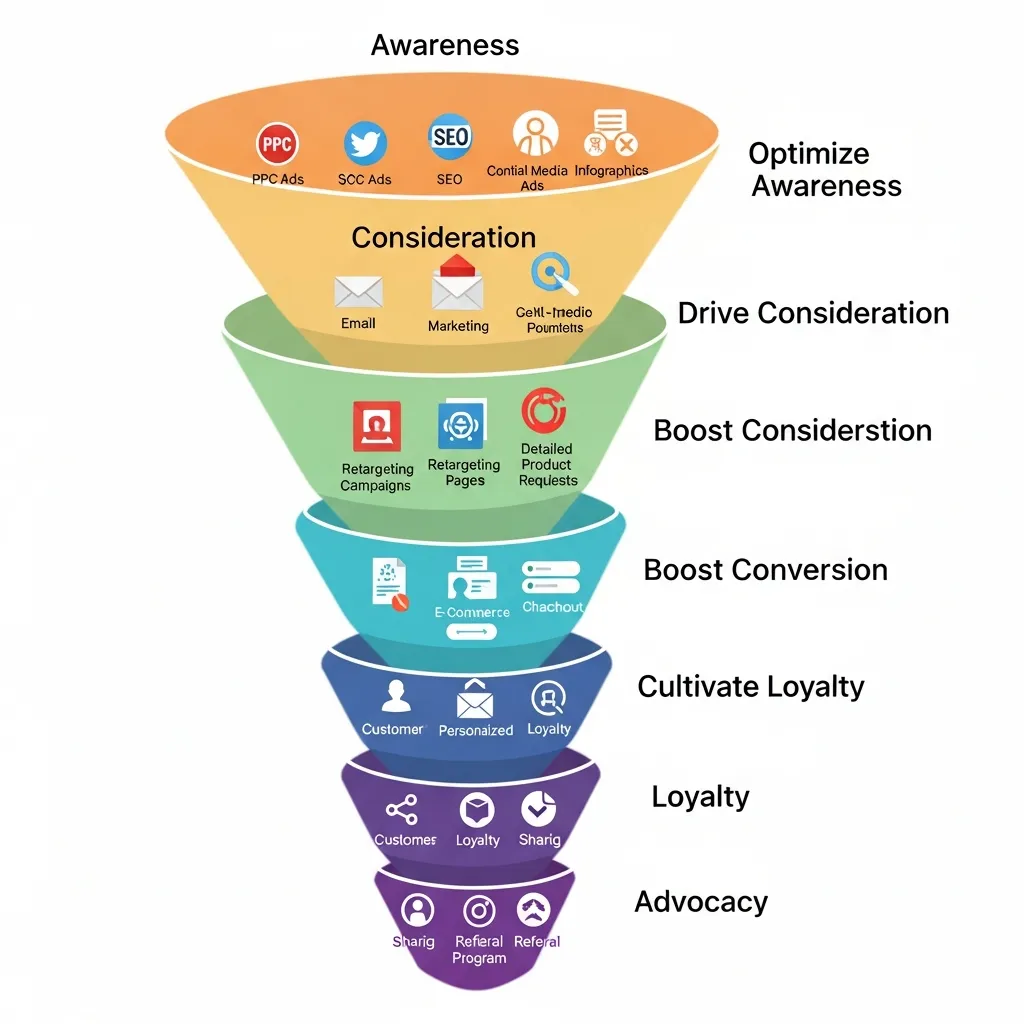
Understanding the Five Stages of the Marketing Funnel in Digital Marketing
Stage 1: Awareness (Top of the Funnel — TOFU)
The awareness stage is where potential customers first encounter your brand. At this point, they may not even know they have a problem your product can solve. The goal here is visibility and reach.
Key activities:
- Content Marketing: Blog posts, videos, infographics, and podcasts that address broad audience pain points
- SEO: Optimizing content for search engines to capture organic traffic from relevant queries
- Social Media: Organic and paid social campaigns to reach new audiences on platforms like Instagram, LinkedIn, and TikTok
- Paid Advertising: Google Ads, display campaigns, and social ads designed for broad reach
Key metrics: Reach, impressions, organic website traffic, social media follower growth
Stage 2: Interest and Consideration (Middle of the Funnel — MOFU)
Once a prospect is aware of your brand, the next challenge is keeping their attention and building trust. The MOFU stage is where Consumer Behavior in Digital Marketing gets nuanced—buyers compare options, research features, and look for social proof.
Key activities:
- Lead Magnets: Free resources (eBooks, checklists, templates) offered in exchange for contact information
- Webinars and Online Events: High-value sessions that demonstrate expertise
- Email Marketing: Automated sequences that nurture leads with personalized, relevant content
- Retargeting Campaigns: Paid ads that re-engage visitors who have already shown interest
Key metrics: Engagement rate, email open and click-through rates, lead generation volume, time on site
Stage 3: Decision and Conversion (Bottom of the Funnel — BOFU)
This is the stage where intent becomes action. A prospect is ready to buy—they just need the right nudge. The marketing funnel in digital marketing depends heavily on conversion optimization at this stage.
Key activities:
- Product Demos and Free Trials: Letting prospects experience the product reduces friction
- Customer Testimonials and Case Studies: Social proof builds confidence
- Special Offers and Limited-Time Deals: Urgency and incentive accelerate decisions
- Streamlined Checkout Processes: Reducing steps and friction in the purchase flow
Key metrics: Conversion rate, Ad Conversion Rate, sales revenue, cost per acquisition (CPA)
Stage 4: Retention and Loyalty
Acquiring a customer costs significantly more than retaining one. According to research by Bain & Company, increasing customer retention rates by just 5% can increase profits by 25–95%. The retention stage of the marketing funnel in digital marketing focuses on turning one-time buyers into repeat customers.
Key activities:
- Post-Purchase Support: Onboarding emails, how-to guides, and proactive customer service
- Loyalty Programs: Points systems, exclusive discounts, and VIP tiers
- Exclusive Content: Members-only resources, early product access, or behind-the-scenes updates
Key metrics: Repeat purchase rate, Customer Lifetime Value (CLV), churn rate, Net Promoter Score (NPS)
Stage 5: Advocacy
Advocates are your most valuable marketing asset. They refer new customers, leave positive reviews, and create user-generated content—all of which fuels the top of the funnel at zero additional cost.
Key activities:
- Referral Programs: Incentivizing existing customers to bring in new ones
- User-Generated Content (UGC): Encouraging customers to share their experiences on social media
- Review Campaigns: Prompting satisfied customers to leave reviews on Google, Trustpilot, or industry platforms
Key metrics: Referral volume, social shares, brand mentions, review rating and count
Strategies for Optimizing Each Stage of the Marketing Funnel in Digital Marketing
How to Build Brand Visibility at the Awareness Stage
Effective SEO is the backbone of TOFU visibility. This means conducting thorough Market Research in Digital Marketing to identify what your audience is searching for, then creating content that directly answers those queries. Target informational keywords with high search volume, optimize title tags and meta descriptions, and build topical authority through content clusters.
Beyond SEO, paid advertising gives you immediate reach. Platforms like Google Ads and Meta Ads allow precise audience targeting based on demographics, interests, and behaviors—critical for managing Ad Conversion Rate from the first click.
How to Nurture Leads Through the Consideration Stage
Personalization is the single biggest lever in the MOFU stage. Email sequences should be segmented based on how a lead entered the funnel. A prospect who downloaded a pricing guide has different needs than one who watched a top-of-funnel explainer video. Behavioral data from your CRM should inform every touchpoint.
Retargeting is equally powerful here. Serving specific ads to users who visited key pages—like pricing or product comparison pages—keeps your brand in consideration without requiring a large budget.
How to Drive Conversions at the Decision Stage
Landing page optimization is non-negotiable. Every element—headline, imagery, copy, CTA—must align with the specific intent of the audience arriving on that page. A/B testing headline variations, CTA placement, and form length consistently improves Ad Conversion Rate over time.
Social proof accelerates decisions. Case studies, video testimonials, and third-party review scores reduce perceived risk and answer the unspoken question every buyer has: “Has this worked for someone like me?”
How to Build Retention and Advocacy Post-Purchase
Exceptional customer service is the foundation of retention. Fast response times, proactive communication, and genuine problem-solving turn satisfied buyers into loyal ones. Layer loyalty programs on top of this foundation to reward repeat behavior.
Community building—whether through a Facebook Group, Slack community, or branded forum—deepens the relationship between brand and customer. Community members stay longer, buy more, and refer more readily.
Measuring Success: Key Metrics Across the Marketing Funnel in Digital Marketing
A Digital Marketing Account Manager lives and dies by data. Each stage of the marketing funnel in digital marketing produces its own signals, and knowing which ones to track—and how to interpret them—is what separates effective strategy from guesswork.
Tracking Website Traffic and User Behavior
Tools like Google Analytics 4 and Microsoft Clarity reveal how users navigate your site, where they drop off, and which pages drive the most engagement. Heatmaps and session recordings offer qualitative depth beyond the numbers.
Analyzing Lead Quality and Quantity
Lead volume matters less than lead quality. A smaller number of highly qualified leads—those who match your Ideal Customer Profile (ICP)—will always outperform a large volume of irrelevant contacts. Scoring leads based on behavior and demographics ensures sales focus on the right opportunities.
Monitoring Ad Conversion Rate
Ad Conversion Rate is one of the most telling metrics in the marketing funnel in digital marketing. It measures the percentage of ad clicks that result in a desired action—whether that’s a form fill, a free trial sign-up, or a purchase. Tracking this metric by campaign, ad set, and audience reveals exactly where paid media is working and where it isn’t.
Assessing Customer Lifetime Value
CLV quantifies the total revenue a business can expect from a single customer over the course of the relationship. A high CLV justifies higher acquisition costs and validates investment in retention programs. Market Research in Digital Marketing helps benchmark CLV against industry standards.
The Role of the Digital Marketing Account Manager
A skilled Digital Marketing Account Manager connects the dots between data points across the full funnel. They identify underperforming stages, reallocate budget toward high-ROI activities, and translate complex analytics into clear strategic recommendations for clients or stakeholders.
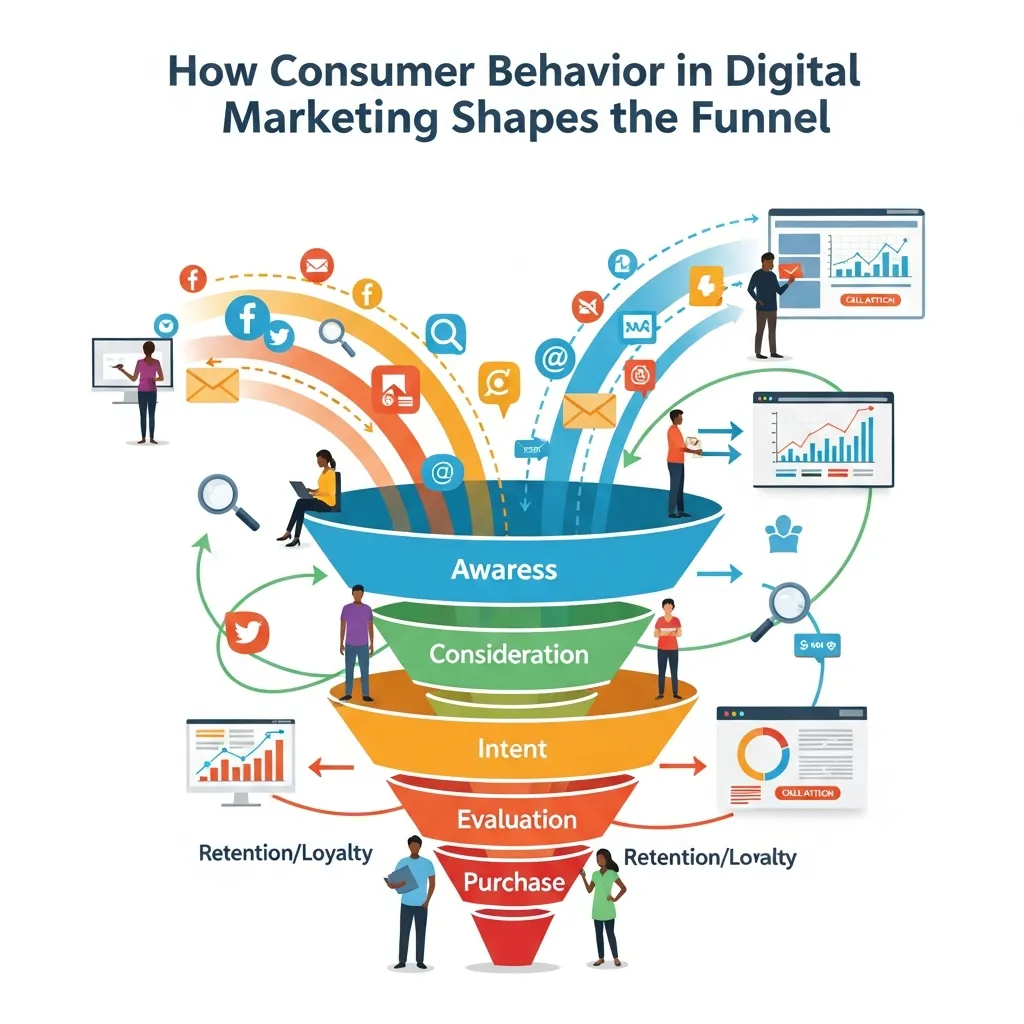
How Consumer Behavior in Digital Marketing Shapes the Funnel
Understanding the Modern Buyer’s Journey
Consumer Behavior in Digital Marketing has shifted dramatically over the past decade. According to Google, the average consumer conducts 12 online searches before engaging with a brand’s website. They expect relevant information at every touchpoint, and they’re willing to abandon brands that don’t deliver.
This means the marketing funnel in digital marketing must be designed around the buyer’s journey, not the brand’s internal process. Mapping content and campaigns to specific buyer questions at each stage—rather than generic messaging—produces meaningfully better results.
The Power of Personalization
Personalization is no longer a differentiator—it’s an expectation. According to McKinsey, 71% of consumers expect companies to deliver personalized interactions, and 76% get frustrated when this doesn’t happen. Dynamic content, behavioral email triggers, and personalized ad creative all contribute to a funnel that feels relevant rather than intrusive.
Market Research in Digital Marketing plays a direct role here. The more granular your understanding of audience segments—their pain points, objections, preferred content formats, and buying triggers—the more precisely you can personalize each stage of the funnel.
Conclusion
The marketing funnel in digital marketing isn’t a static diagram—it’s a living system that requires constant attention, measurement, and refinement. Each stage serves a distinct purpose. Awareness builds reach. Consideration builds trust. Conversion drives revenue. Retention builds loyalty. Advocacy builds compounding growth.
What sets high-performing organizations apart is their ability to treat the funnel as a whole—not a series of isolated campaigns. A Digital Marketing Account Manager who understands how each stage feeds the next can make strategic decisions that improve outcomes across the board, from Ad Conversion Rate to Customer Lifetime Value.
Apply the strategies in this guide stage by stage. Start with the area of your funnel where drop-off is highest—that’s where the biggest opportunity lies. Use Market Research in Digital Marketing to understand your audience deeply, and let Consumer Behavior in Digital Marketing data guide your personalization efforts.
The funnel isn’t just a marketing tool. It’s how businesses grow.
Frequently Asked Questions
What is the marketing funnel in digital marketing?
The marketing funnel in digital marketing is a framework that maps the stages a potential customer moves through—from first becoming aware of a brand to making a purchase and becoming a loyal advocate. Each stage requires different strategies, content types, and metrics.
What are the five stages of the digital marketing funnel?
The five stages are: Awareness (TOFU), Interest/Consideration (MOFU), Decision/Conversion (BOFU), Retention/Loyalty, and Advocacy. Each stage represents a different level of buyer intent and engagement.
How does the marketing funnel improve Ad Conversion Rate?
By targeting the right message to the right audience at the right funnel stage, the marketing funnel in digital marketing ensures paid ads are contextually relevant. BOFU audiences—those closest to purchase—typically convert at higher rates when served direct-response ads, which raises overall Ad Conversion Rate.
What role does a Digital Marketing Account Manager play in the funnel?
A Digital Marketing Account Manager oversees strategy across the full funnel. They analyze performance data at each stage, identify where prospects are dropping off, allocate budget toward high-performing channels, and translate insights into actionable recommendations for clients or internal stakeholders.
How does Consumer Behavior in Digital Marketing affect funnel strategy?
Consumer Behavior in Digital Marketing determines how people discover, evaluate, and purchase products online. Shifts in search behavior, platform usage, and content preferences all impact which tactics work at each funnel stage. Understanding these patterns allows marketers to design more effective, buyer-centric funnels.
What is Market Research in Digital Marketing and why does it matter for the funnel?
Market Research in Digital Marketing involves gathering and analyzing data about target audiences, competitors, and industry trends. It informs every stage of the funnel—from identifying awareness-stage content topics to understanding the objections that prevent conversion at the bottom of the funnel.
Which metrics should I track at each stage of the marketing funnel?
At the awareness stage, track reach, impressions, and organic traffic. In the consideration stage, focus on engagement rate, CTR, and lead volume. At the conversion stage, monitor conversion rate and Ad Conversion Rate. For retention, track repeat purchase rate and CLV. For advocacy, measure referrals, brand mentions, and review scores.
How do I know which funnel stage needs the most attention?
Analyze your funnel data for the largest drop-off point—where prospects leave without moving to the next stage. If traffic is strong but leads are low, MOFU needs work. If leads are strong but sales are weak, the issue is at BOFU. Funnel analytics tools like Google Analytics 4 and HubSpot help pinpoint these gaps.
What is the difference between TOFU, MOFU, and BOFU?
TOFU (Top of Funnel) targets broad audiences who are just becoming aware of a problem or brand. MOFU (Middle of Funnel) focuses on prospects actively researching and comparing options. BOFU (Bottom of Funnel) targets those ready to make a purchase decision. Each layer requires a different tone, content format, and call to action.
How do retention and advocacy fit into the marketing funnel in digital marketing?
Retention and advocacy represent the post-purchase phases of the marketing funnel in digital marketing. Retention focuses on keeping existing customers engaged and encouraging repeat purchases. Advocacy turns satisfied customers into brand ambassadors who generate referrals and user-generated content—fueling the awareness stage at no additional cost.
How does personalization improve funnel performance?
Personalized content, emails, and ads speak directly to the individual’s needs, stage, and behavior. According to McKinsey, 71% of consumers expect personalized interactions from brands. Personalization reduces friction at every funnel stage, improving engagement rates, conversion rates, and customer lifetime value.
How often should I review and update my marketing funnel strategy?
At a minimum, conduct a full funnel audit quarterly. Review stage-specific metrics monthly to catch performance dips early. Major external shifts—new platform algorithm changes, shifts in Consumer Behavior in Digital Marketing, or new competitive entrants—may require more frequent adjustments. A proactive Digital Marketing Account Manager treats funnel optimization as an ongoing discipline, not a one-time project.



Leave a Reply